
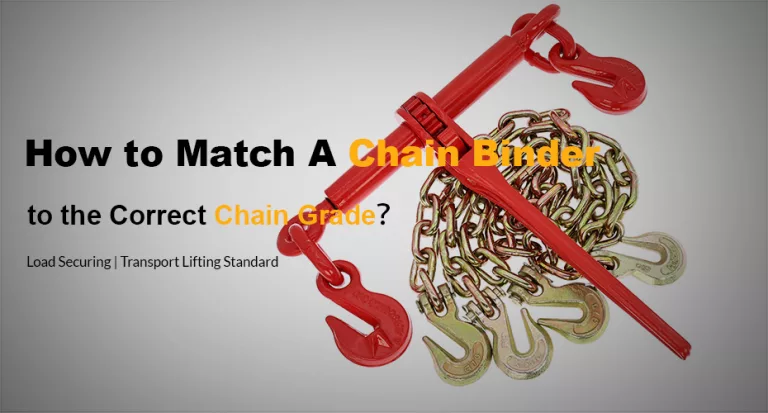
How to Match A Chain Binder to the Correct Chain Grade?
When securing heavy equipment, machinery, building materials, or agricultural supplies for transport, the effectiveness of chain binder depends on the chains used in conjunction with it. Although many operators focus on chain strength, mismatch between chain binder and the transport chains remains one of the most common causes of cargo securing issues.
Whether you’re using a ratchet or lever-type binder, understanding how to match the correct chain grade, size, and working load limit (WLL) is essential for ensuring safety and compliance in transportation operations.
Table of Contents
The Importance of Properly Matching Chains and Binder
The cargo securing system consists of multiple components that work together:
- Transport chain
- Chain binder
- Grab hooks
- Connecting link
- Fixed point
The entire system is designed to ensure cargo remains secure during acceleration, braking, cornering, and road bumps. If any component’s rated capacity is insufficient or if components are incompatible with each other, the performance of the entire securing system will be compromised.
Improper matching of chains and binders may result in:
- Reduced cargo securing capability
- Increased equipment wear and tear
- Cargo shifting during transportation
- Non-compliance with regulations
- Increased safety risks for operators and road users
For industries such as heavy-duty transportation, mining, construction, and agricultural transport, selecting compatible components is not only a good operational practice but also a critical safety requirement.
Understanding the Function of Chain Binders
A chain binder is a device used to tighten transport chains and secure cargo on trailers or transport platforms.
Its main function is to eliminate chain slack and maintain tension throughout the entire conveying process.
The two most common types include:
Ratchet Chain Binder
The ratchet-type fastener uses a threaded locking mechanism, allowing for gradual adjustment of tension.
Its advantages include:
- More precise tension control
- Easier operation
- Lower risk of rebound
- Better suited for long-distance transportation
Lever-type Chain Binder
The lever-type load binder quickly applies chain tension using a rotating handle.
Its advantages include:
- Fast operation
- Simple design
- Lower initial cost
However, many operators prefer using ratchet tightening tools because they perform better in terms of safety and tension control.
Understanding Chain Grades and Their Applications
Not all transport chains have the same manufacturing strength grade.
Grade 43 Chain
Grade 43 chain is commonly used for general purposes. Although it provides sufficient strength for many non-transport tasks, it is rarely found in professional cargo securing systems.
Grade 70 Transport Chain
70-grade chain is the most widely used conveyor chain in North America, Australia, and New Zealand.
Its advantages include:
- High tensile strength
- Excellent durability
- Widely recognized in the industry for cargo securing applications
- Unique golden or yellow chromate surface finish
For flatbed trailers, machinery transport, and heavy equipment hauling, 70-grade chains are always the preferred choice.
Grade 80 Chain
80-grade chains have higher strength and are commonly used in lifting and specialized heavy-duty applications.
Grade 100 Chain
Grade 100 chains have extremely high strength and are typically used in demanding lifting applications where performance requirements are very stringent.
Understanding Working Load Limit (WLL)
It is essential to understand the working load limit (WLL) before selecting a chain binder for the chain.
WLL refers to the maximum load that a component is designed to withstand during normal use.
It differs from breaking strength, which refers to the load at which a component may fail (break).
For example:
* Break strength = ultimate failure point
* Working load limit = safe operating capacity
Professional transport personnel should always base their equipment selection on WLL rather than breaking strength.
WLL is typically stamped or marked on the conveyor chain and tensioner.
Golden Rule: The chain binder specification must match the chain’s load capacity.
The most important rule when selecting a binder is simple:
The chain binder must match the chain size, and its working load limit (WLL) must be equal to or greater than the chain’s WLL.
For example:
| Size | Use with | Working Load Limit (WLL) | Weight (LBS) |
| 1/4-5/16 | 1/4″ (G70) | 2,200 LBS | 3.52 LBS |
| 5/16-3/8 | 5/16″ (G70) – 3/8″ (G70) | 5,400 LBS /6,600 LBS/
7,100 LBS/8,800 LBS |
12.11 LBS |
| 3/8-1/2 | 3/8″ (G70) – 1/2″ (G43) | 9,200 LBS | 14.70 LBS |
| 1/2-5/8 | 1/2″ (G70) – 5/8″ (G43) | 13,000 LBS | 14.55 LBS |
Please strictly follow the manufacturer’s recommendations regarding chain size compatibility.
Can chains and binders of different grades be used together?
This is one of the most frequently asked questions in the transportation industry.
70-grade chain + 70-grade binder
This is the most common and recommended combination for cargo securing.
80-grade chain + 70-grade binder
From a technical standpoint, these components can be connected and used together if their dimensions match. However, the overall system’s load capacity will be limited by the fastener with the lower rated grade (i.e., the Grade 70 fastener).
Grade 100 Chain + Grade 70 binder
This configuration is generally not recommended for professional applications, as high-strength chains cannot fully perform when paired with load binder of a lower rated grade.
Under all circumstances, the load-bearing capacity of the entire system must be evaluated based on the component with the lowest rated class in the system.
Why the component with the lowest rated class determines the system’s load capacity
The strength of a conveyor chain assembly depends on its weakest link.
Please see the following example:
- Working Load Limit (WLL) of 3/8 Grade 70 chain: 6,600 pounds
- Working Load Limit (WLL) of 3/8-5/16load binder: 5,400 pounds
Although the chain itself can safely withstand 6,600 pounds, the entire cargo securing system’s load capacity is limited to 5,400 pounds due to the lower rated capacity of the binder.
The same principle also applies to:
- Grab hooks
- Pear links
- Connecting links
- Anchor points
Each component must meet or exceed the specified working load limit to achieve the intended system load capacity.
Common Mistakes When Matching Chains and Binders
The following common mistakes may reduce security and performance:
1.Using undersized binders
A chain binder with insufficient load capacity will limit the performance of the entire system.
Ignoring WLL Identification
Never judge the compatibility of two components based solely on their appearance.
Mixing components of unknown origin
In professional transportation operations, components without clear identification or traceability should not be used.
2.Using Damaged Equipment
Equipment with deformed hooks, stretched chains, worn threads, or damaged handles should be stopped from use immediately.
Misunderstanding that higher-grade chains can increase system load capacity
Using Grade 80 or Grade 100 chains alone will not automatically increase the overall strength of the system if other components have lower rated grades.
Chain and binder Selection for Australia and New Zealand
In Australia and New Zealand, transport companies are increasingly focusing on cargo restraint compliance and secure cargo securing.
Industries such as the following:
- Heavy-duty transportation
- Mining transportation
- Construction logistics
- Agricultural machinery transportation
Grade 70 transport chains are typically paired with ratchet tensioners rated to match their strength. The transportation industry’s shift toward safer operating practices has also increased market demand for components clearly marked with working load limits (WLL), proof-tested for load capacity, and reliable cargo securing equipment.
Conclusion
Matching the appropriate chain binder to a specific grade of chain is essential for building a safe and efficient cargo securing system.
Its core principle is very clear:
- The binder specification must match the chain size.
- Ensure the working load limit (WLL) of the binder meets or exceeds the chain’s WLL.
- Never mix incompatible grade components without understanding the resulting load capacity limitations.
- Remember: the overall system capacity is determined by the component with the lowest rated load capacity.
For most transportation applications, using Grade 70 transport chains in combination with ratchet or lever-type chain binder that match the rated specifications remains a reliable solution for securely and efficiently securing cargo. By following these guidelines, transportation professionals can enhance safety, ensure compliance, and effectively protect valuable goods throughout the shipping process.