
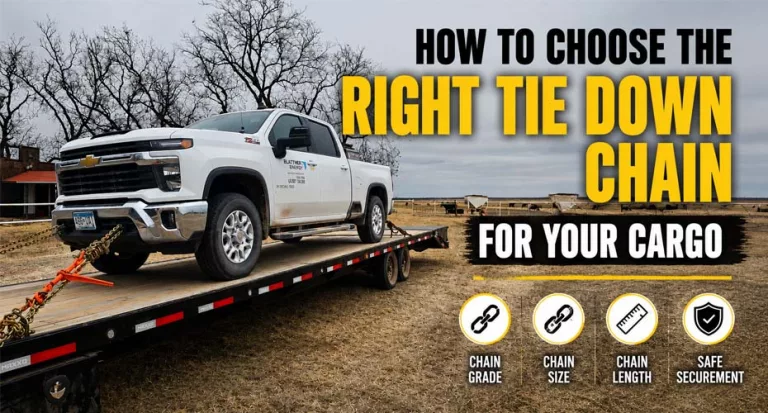
How to Choose Right Tie Down Chain for Your Cargo
Tie-down chains are important tools to ensure cargo securement. Choosing wrong tie down chains Will lead to cargo shifting, equipment damage, and even road traffic accidents.
There’re different grades, sizes, length of tie down chains. Today we will share knowledege about the key factors to consider when selecting binding chains, helping you enhance safety, meet transportation requirements.
Table of Contents
What Is A Tie Down Chain?
Tie down chain is a high-strength transport chain used to secure cargo on trailers, flatbeds, or transport vehicles. Unlike lifting chains, tie down chains are specifically designed for securing cargo during transportation.
They are commonly used in the following industries:
- Vehicle transportation
- Flatbed truck transportation
- Construction equipment transportation
- Agricultural machinery transportation
- Industrial cargo transportation
A standard tie down chain typically includes:
- Transport chain
- U-shaped clevis grab hooks at both ends
- Lever-type or ratchet-type tensioner
- Rated trailer attachment points
All components must work together to form a safe and reliable cargo securing system.
4 Steps To Choose Tie Down Chain
Step 1: Choose the appropriate chain grade
The first step is to select the right chain grade. In North America, Grade 43 chain and Grade 70 chain are used for cargo securing.
- Grade 43 Chain
Grade 43 chain (commonly known as “high test chain”) is made of high-strength carbon steel. It is commonly used for medium-load transportation and securing general cargo.
Typical applications include:
- Multi-purpose trailer
- Agricultural equipment
- Light machinery
- General transportation
Grade 43 chains are economical choose between strength and cost, making them ideal for lighter-duty conveying applications.
2. Grade 70 Chains
Grade 70 chains (also known as “transport chains”) are heat-treated, giving them significantly higher strength than Grade 43 chains. Their yellow galvanized coating also makes them easy to identify during inspection.
Grade 70 chains are widely used in:
- Vehicle transportation
- Commercial freight
- Flatbed trailer cargo securing
- Heavy equipment transport
Due to its higher working load limit (WLL), Grade 70 chains have become the preferred choice for professional transport companies and fleet operators.
| Feature | Grade 43 | Grade 70 |
|---|---|---|
| Material | High-strength carbon steel | Heat-treated alloy steel |
| Strength | Medium | High |
| Typical Finish | White galvanized | Yellow galvanized |
| Common Applications | Utility and light transport | Commercial cargo securement |
If you need to transport heavy duty cargo, Grade 70 chains are usually a wiser investment in the long term.
Step 2: Choose the right chain size
Chain diameter determines working load limit (WLL), so it must be matched by the weight of the cargo.
The most common sizes include: Selecting chain size should be based on the load capacity. Oversize, heavy duty load should equipped with Larger chains to handle.
| Chain Size | Typical Application |
|---|---|
| 5/16″ | Passenger cars, SUVs, light equipment |
| 3/8″ | Pickup trucks, machinery, commercial freight |
| 1/2″ | Heavy construction equipment and industrial cargo |
Step 3: Choose right chain length
Length is another factor that needs to be carefully considered.
Common tie chain lengths include:
| Length | Typical Application |
|---|---|
| 16 ft | Compact vehicles and smaller loads |
| 20 ft | Standard passenger vehicle transport |
| 25 ft | SUVs, pickup trucks, larger equipment |
Among these options, 20-foot chain is the industry standard, as it provides sufficient length to meet the requirements of most vehicle transport scenarios.
If chain is too short may not reach the required attachment point, if too long can result in unnecessary slack and increased wear.
Step 4: Select the matching chain according to the cargo
Different types of cargo require different securing methods.
| Cargo Type | Recommended Chain |
|---|---|
| Passenger Cars | 5/16″ Grade 70 |
| SUVs | 5/16″ or 3/8″ Grade 70 |
| Pickup Trucks | 3/8″ Grade 70 |
| Construction Equipment | 3/8″ or 1/2″ Grade 70 |
| Agricultural Machinery | Grade 43 or Grade 70, depending on weight |
When implementing these recommendations, be sure to verify them based on the actual cargo weight and applicable cargo securing regulations.
Never ignore the Working Load Limit (WLL)
Many buyers focus on chain size or grade but overlook the Working Load Limit (WLL). In fact, WLL is one of the most important specifications when selecting binding chains.
The working load limit refers to the maximum load that a chain assembly is designed to withstand during normal use.
Equally important is that the load capacity of the entire bundling system depends on the component with the lowest rated value, which includes:
- Chain
- Grab hooks
- Load binder
- Trailer tie-down points
Using a high-strength chain with hooks or tensioners rated for lower loads does not increase the system’s overall load capacity.
Common Mistakes When Choosing Tie down Chain
Avoiding common mistakes helps improve safety and reduce costs.
- Incorrect chain grade selection
Using Grade 43 chain for heavy-duty commercial transport may result in insufficient load capacity.
- Choosing a chain based solely on size
A larger diameter does not necessarily mean the chain is suitable; grade and WLL (Working Load Limit) must also be considered.
- Improper chain length selection
A chain that is too long will become loose, while a chain that is too short may not be able to apply proper tension.
- Mixing Different Components
Use compatible hooks, ratchets, and chains with matching rated loads.
- Skip inspection step
Even the strongest chains should be inspected before each shipment for signs of wear, corrosion, bent links, or damaged hooks.
Pre-Departure Checklist
Before transporting any cargo, inspect the entire securing system. Check for the following conditions:
- Bent or stretched link deformation
- Cracks or excessive wear
- Corrosion
- Deformed grab hooks
- Damaged binders
- Missing or illegible identification marks
Replacing parts before they fail is far less costly than dealing with product damage or roadside breakdowns.
Conclusion
Choosing the right tie chain is very important for cargo control. Only by properly matching the chain grade, dimensions, length, and working load limit (WLL)** can you ensure cargo remains secure and safe throughout its journey from departure to destination. If you have any question about tie down chains, please contact Sail Rigging.