


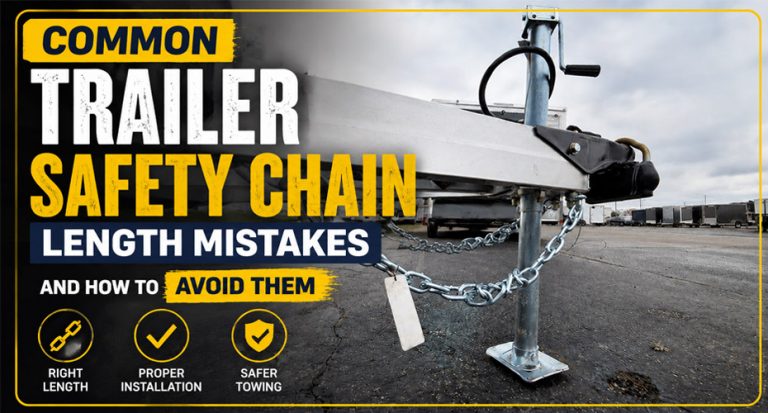
Common Trailer Safety Chain Length Mistakes and How to Avoid Them
Safety chains provide a backup connection between the trailer and the tow vehicle if the coupler or hitch connection fails. Today we are share some information about trailer safety chain length. It is just as important as the chain strength and working load limit.
Many towing problems are caused by simple length mistakes. If too long may drag on the road,if too short can restrict turning and create excessive stress on the connection points.
In this guide, we will explain the common mistakes of trailer safety chain length, why they happen, and how to choose the right setup for safer towing.
Table of Contents
Mistake 1: Trailer Safety Chains Are Too Long
One of the most common mistakes is assuming that longer safety chains provide better protection.
Many trailer owners believe extra length means more flexibility and safety. However, excessive slack can create several problems during towing.
- Chain Dragging on the Road
The most obvious issue with overly long safety chains is road contact.
When chains hang too low, they may hit:
- Pavement
- Driveways
- Speed bumps
- Uneven roads
2. Continuous dragging can cause:
- Worn chain links
- Damaged hooks
- Reduced corrosion protection
- Premature chain replacement
A safety chain should support the trailer in an emergency, not become a part that constantly contacts the road.
3. Reduced Control During a Trailer Separation
If the trailer coupler disconnects, safety chains are designed to temporarily hold the trailer to the tow vehicle.
However, excessive chain length creates too much movement before the chains become fully engaged.
Too much slack may allow:
- The trailer tongue to drop lower
- Increased impact force
- Less control from the driver
The goal is not to make the chains tight, but to maintain controlled slack.
Mistake 2: Trailer Safety Chains Are Too Short
While long chains create problems, chains that are too short can be equally dangerous.
A safety chain should allow normal trailer movement while maintaining a secure connection.
- Limited Turning Ability
During towing, the trailer does not always follow the vehicle in a straight line.
Sharp turns, parking, and backing require the trailer to move at different angles.
If the safety chains are too short:
- They may become tight during turns
- The hooks may experience excessive stress
- The mounting brackets may be overloaded
A properly installed chain should allow the tow vehicle to turn fully without pulling the chain tight.
2. Increased Shock Loading
Road conditions are never perfectly smooth.
When driving over bumps or uneven surfaces, the trailer naturally moves up and down.
A chain with insufficient slack can transfer sudden forces directly to:
- Chain hooks
- Trailer attachment points
- Hitch components
This is known as shock loading, and repeated shock loading can accelerate wear.
Mistake 3: Measuring Only the Chain and Ignoring the Hook Length
Another common mistake is looking only at the chain length.
A trailer safety chain assembly is not made of chain alone. The total usable length depends on:
- Chain length
- Hook type
- Connecting hardware
- Attachment location
For example, two 36-inch safety chain assemblies may have different installed lengths if one uses a large clevis hook and the other uses a compact slip hook.
When selecting a trailer safety chain, always consider the **complete assembly length**, not only the chain itself.
Mistake 4: Measuring Safety Chain Length Without Testing Turning Clearance
A frequent installation mistake is measuring the chain when the trailer and tow vehicle are perfectly straight.
However, real-world towing includes:
- Left turns
- Right turns
- Backing into parking spaces
- Uneven terrain
A chain that looks perfect when parked may become too tight during a sharp turn.
A simple installation check:
1. Connect the trailer to the tow vehicle.
2. Turn the vehicle fully left.
3. Turn the vehicle fully right.
4. Check chain movement and clearance.
The chains should:
✔ Remain securely connected
✔ Allow full turning movement
✔ Stay away from the ground
Mistake 5: Installing Safety Chains Incorrectly Without Crossing Them
Many trailer owners focus on chain length but overlook installation method.
In many towing setups, safety chains are crossed underneath the trailer tongue.
The typical installation method is:
- Left trailer chain connects to the right hitch point
- Right trailer chain connects to the left hitch point
Why cross the chains?
Because crossed chains create a support cradle.
If the coupler disconnects, the crossed chains can help support the trailer tongue and reduce the chance of the tongue contacting the road.
However, crossing chains does not mean they should be extremely tight.
The chains still need enough slack for normal turning.
Mistake 6: Choosing the Same Chain Length for Every Trailer
Not every trailer requires the same safety chain length.
The correct length depends on several factors:
- Trailer design
- Hitch height
- Chain mounting location
- Tow vehicle setup
- Trailer application
For example:
1.Small Utility Trailer
Often uses shorter safety chains because of compact dimensions.
2.Boat Trailer
May require moderate chain length due to different coupler and frame designs.
3.Car Hauler or Equipment Trailer
Usually requires heavier chain assemblies and may need longer lengths due to larger trailer structures.
A universal “one-size-fits-all” approach does not work for trailer safety chains.
Mistake 7: Focusing on Chain Length but Ignoring Chain Strength
Chain length and chain strength are two different factors.
A correctly sized chain must match both:
- Physical length requirements
- Load requirements
Chain strength depends on:
- Chain diameter
- Chain grade
- Working Load Limit (WLL)
Common trailer safety chain grades include:
1.Grade 43 Chain
Often used for:
- Utility trailers
- Cargo trailers
- Light-duty towing applications
2.Grade 70 Chain
Commonly selected for:
- Car haulers
- Equipment trailers
- Heavy-duty towing
A longer chain is not automatically safer. The chain must have the correct strength rating for the trailer weight.
How to Fix Trailer Safety Chain Length Problems
If your trailer safety chains are too long:
Consider:
- Replacing them with the correct length
- Adjusting the attachment method if allowed
- Selecting a different chain assembly
Avoid:
- Tying knots in the chain
- Twisting chains excessively
- Allowing chains to drag
If your safety chains are too short:
Consider:
- Choosing a longer chain assembly
- Changing hook combinations
- Selecting a chain length designed for your trailer setup
Never force a chain connection that does not provide enough movement.
Trailer Safety Chain Length Checklist Before Every Trip
Before towing, inspect your safety chains and confirm:
✅ Chains are securely attached
✅ Hooks are fully connected
✅ Chains have enough slack for turning
✅ Chains do not touch the road
✅ Chains are not twisted
✅ Links and hooks show no damage
✅ Chain grade and WLL match trailer requirements
A few seconds of inspection can prevent serious towing problems.
Conclusion
Choosing the correct trailer safety chain length will provide reliable backup protection when towing. If you have any question about trailer safety chain, please feel free to contact Sail Rigging.