
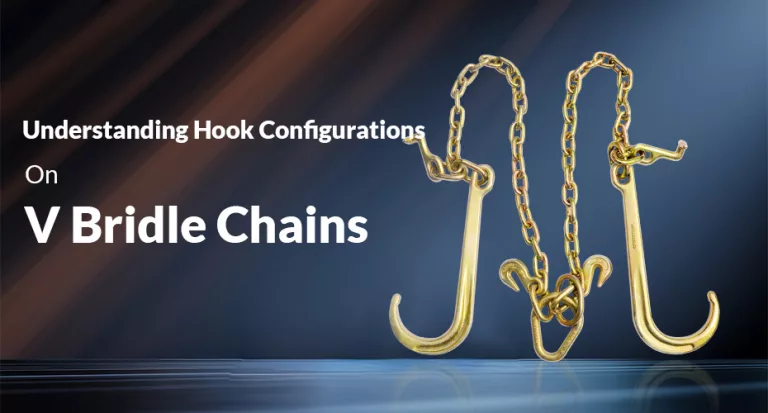
Understanding Hook Configurations on V Bridle Chains
The hook configuration attached to the chain plays an equally important role in ensuring a secure connection, efficient operation, and damage-free recovery.
Many tow operators only pay attention to chain size and Working Load Limit (WLL) but ignore the correct hook combination. If using the wrong hook, it is difficult to connect to factory recovery points, increase setup time, or even damage suspension components and vehicle frames.
This guide explains the common hook configurations used on V bridle chains, their applications, and how to choose the right tow hook for different recovery jobs.
Table of Contents
What Is A Hook Configuration On A V Bridle Chain?
A V bridle chain consists of two chain legs connected to a master link or pear link, with recovery hooks attached to each end. The combination is called hook configuration.
V bridle chains are different from standard towing chain. They are designed to fit a wide range of vehicles with different hook attachment points. The right hook configuration allows the chain to connect securely without placing unnecessary stress on the vehicle.
Common configurations include:
- 15-inch/8 inch J Hook + RTJ Hook
- Mini J Hook + RTJ Hook
- Dual 15-inch/ 8inch J Hooks
- Dual RTJ Hooks
- R Hook + T Hook
Each combination is designed to meet specific recovery needs and vehicle designs.
Why Hook Configuration Matters?
Not all vehicles have the same recovery hook configuration. Modern passenger cars, SUVs, pickup trucks, and commercial vehicles all use different frame openings, suspension components, or factory tie-down locations.
The Advantages Of Choosing The Correct Hook Configuration:
- Faster and easier vehicle hookup
- Better load distribution during recovery
- Reduced risk of hook slippage
- Improved towing stability
- Less chance of damaging factory recovery points
- Greater compatibility with different vehicle models
A properly matched hook configuration also helps operators work more efficiently, especially when handling multiple vehicle types throughout the day.
Understanding the Most Common Hook Types
15-Inch J Hook or 8 inch J Hook
The 15-inch J Hook is one of the most widely used recovery hooks in the towing industry.
Large J Hook makes it ideal for accessing deeper frame openings and larger attachment points.
Typical applications include:
- Pickup trucks
- SUVs
- Light-duty commercial vehicles
Advantages include:
- Long reach
- Strong engagement
- Excellent versatility
- Suitable for heavier recovery work
Mini J Hook
A Mini J Hook performs the same basic function as a standard J Hook but features a shorter, more compact design.
Application
- Passenger cars
- Sedans
- Compact SUVs
- Smaller crossover vehicles
Mini J Hook can reach confined attachment points while reducing the chance of contacting body panels or suspension components.
RTJ Hook
The RTJ Hook is one of the most popular recovery hooks used on modern V bridle chains.
The name comes from its multi-purpose design, combining the functions of an R Hook, T Hook, and Mini J Hook into one versatile component.
Function
- Fits multiple OEM recovery slots
- Reduces the number of hooks operators need to carry
- Speeds up vehicle hookup
- Compatible with many domestic and imported vehicles
For towing companies handling a wide variety of vehicles, RTJ hooks offer excellent flexibility.
R Hook
The R Hook is designed to fit specific frame slots commonly found on many domestic vehicles.
It is frequently used on:
- GM trucks
- Chevrolet pickups
- GMC SUVs
- Some Ford models
When matched with the correct attachment point, an R Hook provides a secure and stable connection during recovery.
T Hook
A T Hook fits T-shaped factory tie-down openings found on certain vehicle frames.
Common applications include:
- Ford vehicles
- Chrysler models
- Some imported vehicles
Its unique shape allows the hook to lock securely into designated recovery slots without slipping under load.
Grab Hook
Although not typically attached directly to a vehicle, the **Grab Hook** is an essential component of many V bridle chain assemblies.
Its primary functions include:
- Shortening chain length
- Adjusting chain position
- Removing slack
- Securing the chain during transport
Because it grips an individual chain link, a Grab Hook allows operators to make quick adjustments without additional hardware.
Popular Hook Configurations and Their Applications
Different recovery situations require different hook combinations.
| Hook Configuration | Best Application | Typical Vehicles |
|---|---|---|
| Mini J + RTJ | General vehicle recovery | Sedans, compact SUVs |
| 15″ J + RTJ | Heavy-duty recovery | Pickups, SUVs |
| Dual RTJ | Mixed vehicle fleets | Passenger cars and light trucks |
| Dual 15″ J | Large recovery points | Commercial vehicles |
| R Hook + T Hook | OEM frame connections | Domestic vehicles |
Selecting the correct configuration improves both safety and recovery efficiency.
How to Choose the Right Hook Configuration
Before purchasing a V bridle chain, consider the following factors.
- Vehicle Type
Passenger cars often require smaller hooks, while trucks and SUVs benefit from longer J Hooks.
- Recovery Points
Always identify the manufacturer’s recommended attachment points before selecting hooks.
- Chain Size
Hook size should match the chain size, whether using **5/16-inch** or **3/8-inch** transport chain.
- Working Load Limit
Each component ( the chain, hooks, connecting links, and master link) —should have a Working Load Limit suitable for the intended recovery load. The overall capacity of the assembly is determined by its lowest-rated component.
- Fleet Requirements
If your business services a wide range of vehicles, choosing a versatile configuration such as 15-inch J Hook + RTJ Hook can reduce equipment changes and improve productivity.
Common Mistakes When Choosing Recovery Hooks
Even experienced operators occasionally make mistakes when selecting hook configurations.
Avoid these common issues:
- Choosing hooks based only on appearance
- Using oversized hooks on compact vehicles
- Ignoring factory recovery points
- Mixing incompatible hook types
- Using bent or worn hooks
- Exceeding the Working Load Limit
- Failing to inspect hooks before each recovery
Routine inspection and proper hook selection help prevent unnecessary equipment failures.
Inspect Your Hook Assembly Regularly
Recovery equipment is subjected to heavy loads and harsh environments. Before each job, inspect the entire V bridle chain assembly.
Look for:
- Cracks or fractures
- Bent hooks
- Excessive wear
- Corrosion
- Elongated chain links
- Damaged connecting links
- Missing or unreadable WLL markings
If any component shows signs of damage, replace it immediately. Never continue using a compromised recovery assembly.
Conclusion
Understanding hook application and selecting the proper hook configuration is important for towing and road recovery. If you have any doubt about v bridle chain hook configurations,please feel free to contact us.