
How To Choose The Right V-Bridle Chain for Your Wrecker?
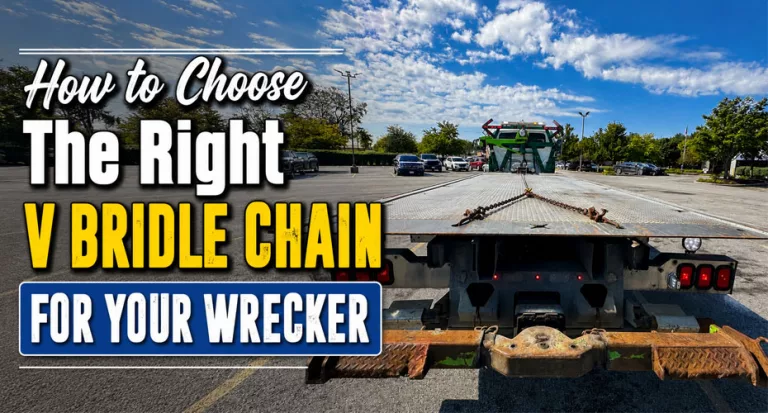
V bridle chains are one of the most commonly used recovery tools on flatbed trailers or tow trucks. They connect disabled vehicles to winch cables, allowing for more even distribution of pulling force and reducing stress on individual connection points during loading.
However, not all V-type chains are suitable for various rescue operations. Chain size, hook configuration, working load limit, and quality all affect the component’s performance in real-world applications. Choosing an wrong configuration may slow down rescue efforts, damage vehicle components, or create unnecessary safety risks.
This guide will help you choose the right V bridle chain for your wrecker, enabling you to select equipment that meets your daily rescue needs.
Table of Contents
What Is The Purpose Of V Bridle Chains?
A V bridle chain is a towing attachment designed to connect the winch cable to two secure points on the vehicle. Instead of using a single-point pull, this chain forms a balanced “V” shape, thereby distributing the load more evenly.
Common application scenarios include:
- Load disabled vehicles onto flatbed trailers
- Tow vehicles from roadside accident scenes
- Assist in light and medium-duty towing operations
- Secure vehicles during winch recovery
- Reduce stress on suspension systems or frame attachment points
The V bridle chain helps improve stability and controllability during vehicle loading by sharing the traction force between two chain branches.
How To Choose Right V Bridle Chain?
Step 1: Select the appropriate chain size based on the tow truck
Selecting the correct chain diameter is 1st factor.
Grade 70 5/16inch and Grade 70 3/8 inch transport chain are two common used size in the North American trailer industry.
| Chain Size | Typical WLL | Recommended Applications |
|---|---|---|
| 5/16″ Grade 70 | 4,700 lbs | Passenger cars, SUVs, light-duty wreckers |
| 3/8″ Grade 70 | 6,600 lbs | Pickup trucks, vans, medium-duty recovery |
For most everyday towing operations, the 5/16 inch bridle chain is the preferred choice, as it offers an excellent balance between strength, weight, and ease of use.
For heavier vehicles or more demanding rescue operations, 3/8-inch v bridle chain offers greater load capacity and durability.
Choosing a chain that is too large may increase weight without improving efficiency, while a chain that is too small may fail to meet the required working load limit (WLL) for the job.
Step 2: Choose the right hook configuration
Hook configuration is just as important as the chain itself.
Modern V-type chain rigging is designed to fit various vehicle connection points, so selecting the right combination enhances both safety and operational efficiency.
Common types of hooks include:
| Hook Type | Typical Application |
|---|---|
| 15″ J Hook | Axles and suspension components |
| Mini J Hook | Smaller attachment points on compact vehicles |
| R Hook | Ford frame slots |
| T Hook | GM frame slots |
Many towing companies use a combination device that integrates 15-inch J-hooks, R-hooks, T-hooks, and mini J-hooks, allowing a single V-bridle chain to handle various passenger cars and light trucks.
Before purchasing, consider the vehicle brands and models your towing service most frequently handles.
Step 3: Verify the Working Load Limit (WLL)
Working Load Limit (WLL) is one of the most important specification parameters when selecting v bridle chains.
Please note that the WLL value applies to the **entire assembly**, not just the chain itself.
The ultimate load capacity depends on each load-bearing component, including:
- Chain
- Master Link
- Pear Link
- J-hook
- R-hook
- T-hook
- Mini J-hook
Even with high-quality chains, the overall load capacity cannot be improved if other components have lower rated load capacities.
Please be sure to compare the specifications of the complete assembly, rather than focusing solely on the chain itself.
Step 4: Consider the type of vehicle you are rescuing
Each tow company has different rescue needs.
If your work primarily involves passenger cars and crossover SUVs, a **5/16-inch Grade 70 V-belt chain** is usually sufficient for everyday operational needs.
For companies that frequently require rescue of the following vehicles:
- Pickup truck
- Commercial van
- Large SUV
- Light commercial vehicle
Using a 3/8-inch Grade 70 fitting may provide higher reliability and broader applicability.
Many experienced operators equip their trailers with multiple V bridle chains to quickly select the most suitable device for different rescue situations.
Step 5: Select High-Quality Forged Components
Not all V-bridle chains are manufactured to the same standards.
When comparing products, be sure to pay attention to the quality of each component.
Please note the following characteristics:
- Forged alloy hook
- Heat-treated Grade 70 transport chain
- Precision-machined connecting links
- Clearly marked working load limit (WLL)
- Durable protective coating
- Consistent and reliable welding and forging quality
High-quality components not only enhance durability but also reduce wear during frequent rescue operations.
Step 6: Inspect Manufacturing Quality and Testing Results
A reliable V bridle chain should maintain consistent quality control throughout the entire production process.
Professional manufacturers typically conduct the following tests:
- Material verification
- Dimensional inspection
- Tensile strength testing
- Proof load testing
- Hardness testing
- Pre-shipment visual inspection
Routine testing helps ensure that each component meets the expected performance requirements and maintains consistency in product quality across batches.
When possible, suppliers should be selected who can provide test records, product traceability information, and technical documentation.
Step 7: Consider Corrosion Resistance
Towing operations take place in diverse environments, including rain and snow, muddy roads, and surfaces treated with de-icing salt.
The surface protective coating helps reduce corrosion and extends the chain’s service life.
Common surface treatment processes are zinc plated.
Although surface treatment does not increase the rated working load, it helps maintain appearance and reduces future maintenance requirements.
Common Mistakes When Choosing V Bridle Chains
Understanding some common misconceptions can help avoid many procurement issues.
Avoid:
- Choosing chains based solely on price
- Ignoring compatibility between hooks and different vehicle manufacturer models
- Selecting the wrong chain diameter
- Confusing working load limit with minimum breaking strength
- Assuming all 5/16-inch V-type trailer chains are of equal quality
- Making purchases without consulting technical specifications or test data
Spending time on a more complete chain component usually results in better long-term value.
Conclusion
Choosing the right V-type tow chain for your recovery vehicle depends on ensuring the equipment matches the vehicles you typically rescue. Chain size, hook configuration, rated working load, manufacturing quality, and corrosion resistance collectively determine the component’s overall performance. If you have any doubt about V bridle chain, don’t hesitate to contact Sail Rigging.