


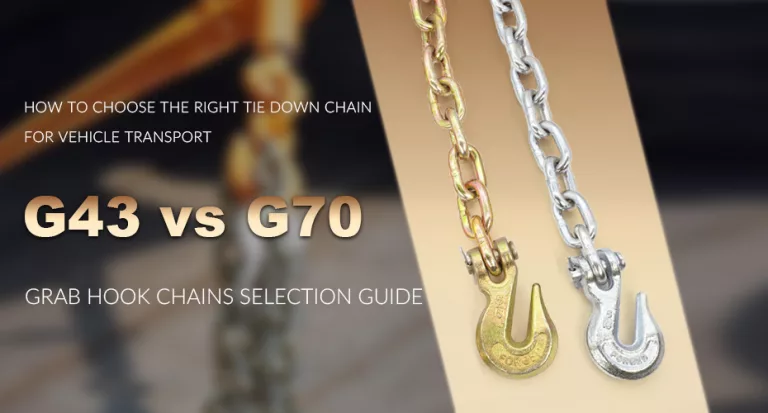
How to Choose the Right tie Chain for Vehicle Transport: Guide to G43 and G70 Hook Chains
Choosing right tie down chains is crucial in flatbed truck transportation. Tie down chains are key component connecting the vehicle to the trailer and ensuring safety. If not correct, it will cause cargo shifting, equipment damage, or even serious road accidents.
Understanding how to select the correct binder chain grade, size, and length is essential for safely and efficiently transporting vehicles.
Table of Contents
What Is Tie Down Chain?
Tie chains are used to secure cargos or loads to flatbed trailers during transportation. It will help to prevent the vehicle from shifting forward, backward, or sideways while the trailer is in motion.
In practical applications, tie down chains are commonly used for:
- Passenger vehicle transport (sedan carriers)
- Pickup and SUV transport
- Commercial fleet relocation
- Light and heavy equipment transportation
A complete fixed system typically includes:
- Transport chain (G43 or G70 grade)
- Hook (fork-type hook for length adjustment)
- Chain tensioner (lever-type or ratchet-type)
- Vehicle anchor point (connection point on chassis or axle)
Among these components, the grade of the chain plays a crucial role in determining the overall strength of the system.
Why Is The Clevis Grab Hook Popular In Cargo Control?
In vehicle transport applications, grab hooks are the most widely used. Unlike general-purpose hooks, grab hooks are specifically designed to shorten chain length and adjust tension, making them an ideal choice for cargo securing systems.
The hook allows the operator to:
- Quickly adjust chain length
- Securely lock onto specific links
- Maintain consistent tension during transport
This design fits perfectly with G43 and G70 chains, offering particular advantages in flatbed truck applications where quick loading and unloading of cargo is required. Thanks to its reliability and ease of use, the grab hook system has become the standard configuration for vehicle securing chain assemblies across most of North America.
Selection of Vehicle Securing Chain Length
Chain length is another important consideration in vehicle transportation. The most commonly used lengths in the industry include:
- 16 feet – Suitable for compact cars and short-wheelbase vehicles
- 20 feet – The most common standard length for passenger car transport
- 25 feet – Ideal for SUVs, pickup trucks, and long-wheelbase vehicles
A 20-foot chain is widely regarded as the industry standard, as it provides sufficient flexibility for most vehicle models without causing excessive slack.
Choosing the appropriate length will affect:
- Efficiency of the tension angle
- Flexibility of the hook position
- Safety during emergency braking or turning
A chain that is too short cannot properly secure the vehicle, while a chain that is too long may drag on the ground and accelerate wear.
Comparison of Grade 43 and Grade 70 Fixed Chains
Selecting the appropriate chain grade is the most important decision when building a fixed system.
Grade 43 (High Strength Chain / High Test Chain)
Grade 43 is a carbon steel chain commonly used for light to medium-duty applications. It offers a good balance between cost and strength, making it widely used in general-purpose and agricultural transport applications.
Main Features:
- Moderate strength
- Cost-effective option
- Suitable for light towing operations
Typical Applications:
- Small vehicle transport
- Multi-purpose trailer
- Non-commercial transportation
However, due to its working load limit (WLL) being lower than Grade 70, Grade 43 is not the preferred choice for professional vehicle transport operations.
Grade 70 (Transport Chain)
Grade 70 is a heat-treated steel chain specifically designed for cargo securing and transportation.
Main Features:
- Higher tensile strength
- Superior strength-to-weight ratio
- Yellow chromate coating for identification
- Approved by the Department of Transportation (DOT) for transportation applications
Typical Applications:
- Car carrier (car transport vehicle)
- Commercial flatbed truck transportation
- Heavy-duty vehicle transportation
Grade 70 is the most widely used chain in professional transport operations, as it provides a higher safety margin and superior durability under dynamic conditions.
Why Chain Grade Matters More Than Chain Length?
Many users focus only on chain length (such as 16 feet, 20 feet, or 25 feet). However, in professional cargo securing operations, chain grade and working load limit (WLL) are more important.
Even if the chain length is appropriate, it remains unsafe if any of the following conditions occur:
- Chain grade is too low for the vehicle weight
- WLL (Working Load Limit) does not meet the requirements of transport conditions
- The system includes weak components (such as undersized hooks)
In a complete fixed system, the overall strength depends on the weakest component among the chain, hook, and tensioner assembly.
The Role of the Grab Hook in the System
Hooks play a crucial role in adjusting and securing the binding chains. They are directly attached to fixed points on the vehicle, allowing operators to select different links to achieve proper tension.
Its main functions include:
- Quickly adjust chain length during installation
- Securely lock chain links
- Compatible with tensioners (load binders)
This makes them an essential component in professional vehicle transport systems.
Common Mistakes When Choosing Lashing Chains
The following common mistakes may reduce security and efficiency:
- Using Grade 43 chains in heavy-duty transport
- Ignoring the Working Load Limit (WLL) ratings
- Selecting incorrect chain lengths for the vehicle type
- Using non-hook-type attachments
- Mixing incompatible chain grades and components
Avoiding these errors helps improve safety and extend the equipment’s service life.
Recommended Standard Configuration for Vehicle Transport
Typical professional configurations include:
- 5/16 inch or 3/8 inch Grade 70 chain
- Hook ends on both sides
- Available in 16-foot, 20-foot, and 25-foot lengths
- Lever-type or ratchet-type chain tensioner system
This configuration is widely used in the U.S. flatbed trucking industry and meets most cargo securing requirements.
Conclusion
Selecting the appropriate vehicle transport fixed chain requires consideration of chain grade, specifications, length, and system compatibility. Grade 70 chains, known for their high strength and compliance with regulatory requirements, are the most widely used standard in professional transportation; whereas Grade 43 chains are suitable for light-duty transport needs.
In most practical transportation operations, the safest and most reliable practice is to select a Grade 70 chain system equipped with a grab hook, based on vehicle weight, and to choose an appropriate length (such as 16 feet, 20 feet, or 25 feet).
Selecting an appropriate securing chain system not only ensures safer transportation and better cargo stability, but also fully meets the requirements of modern cargo securing standards.