
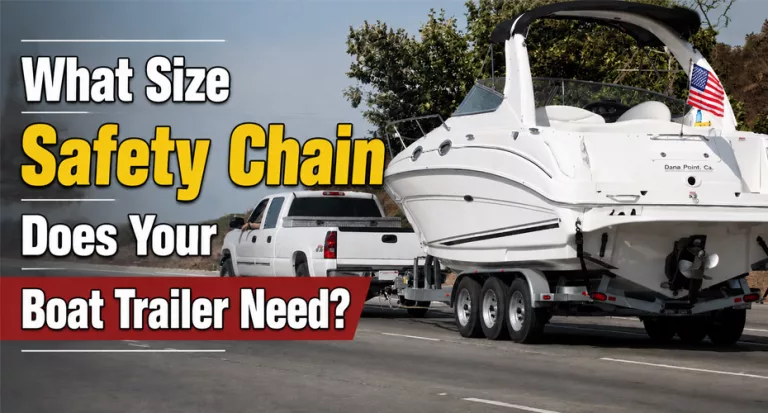
What Size Safety Chain Does Trailer Boat Need?
Trailer safety chain is one crucial safety component for towing boat trailer. It is a backup coupling device between trailer and towing vehicle. When the primary connection fails, safety chain ensures that the trailer does not detach from the towing vehicle and remains under control, thereby reducing the risk of serious accidents. Today This blog will show you how to choose the right size safety chain for your boat trailer.
Table of Contents
Why Is Choosing The Right Size Safety Chain Crucial?
The marine trailer safety chain was originally designed as a supplementary connection system. During normal towing, the pulling load is carried by the primary coupling device; the safety chain only comes into play when the trailer becomes detached from the towing vehicle.
A properly configured safety chain helps:
- Prevents trailer separation
- Maintains trailer connection in emergencies
- Provides additional control force when the primary coupling fails suddenly
- Enhances overall towing safety
- Complies with traffic safety regulations
However, it can only function properly when the safety chain’s load capacity matches the trailer’s weight.
If chain is too small may lack sufficient strength, if too large adds unnecessary weight and cost without improving actual safety.
How To Choose Right Trailer Boat Safety Chain?
Step 1: the actual weight of the marine trailer
Before selecting the chain size, you need to know the Gross Trailer Weight (GTW). The weight should include all items loaded onto the trailer.The total weight includes:
* Hull weight
* Trailer frame weight
* Engine or outboard motor
* Fuel tank and fuel
* Battery
* Fishing gear
* Safety equipment
* Personal belongings
The correct calculation formula is:
Total trailer weight = hull + trailer + all loaded equipment
For example, a boat with a nominal weight of 3,000 pounds may actually weigh over 3,500 pounds when loaded with fuel, batteries, and accessories.
Always select the safety chain based on the total weight of the trailer when fully loaded, not the empty weight.
Step 2: Choose the right chain size
Common chain diameters used for marine trailer safety chains include:
- 1/4 inch
- 5/16 inch
- 3/8 inch
The chain size depends on the trailer weight and the required Working Load Limit.
General Reference Guide:
| Loaded Trailer Weight | Common Chain Size | Typical Application |
|---|---|---|
| Up to 3,500 lbs | 1/4″ Chain | Small boats, personal watercraft trailers |
| 3,500–7,000 lbs | 5/16″ Chain | Most recreational boats |
| 7,000+ lbs | 3/8″ Chain | Larger boats and heavy-duty trailers |
This table is for reference only. Please confirm the required load capacity according to local regulations and manufacturer specifications.
For many recreational boat trailers, the **5/16-inch safety chain** is one of the most commonly used specifications, as it provides a good balance between strength, weight, and ease of operation.
Step 3: Understanding Chain Grade Selection
The performance of trailer safety chain depends not only on its diameter, but also significantly on its grade.
Common grades of trailer safety chains include:
Grade 30 Chain
30-grade chains are typically used for light-duty operations.
Common uses:
- Compact multi-purpose trailer
- Lightweight boat trailer
- General-purpose utility
Grade 43 Chain
43-grade chains are widely used in the trailer industry because their strength exceeds that of standard 30-grade chains.
Advantages:
- Higher working load limit (WLL)
- Excellent balance of strength and weight
- Suitable for various recreational boat trailers
Grade 70 Chain
The strength of G70 chain is higher than G43 chain.
Common applications:
- Heavy-duty trailer
- Cargo securing
- High-load capacity towing operations
When selecting a chain grade, always check the rated load capacity of the entire assembly, including hooks and connectors.
Step 4: Check the Working Load Limit (WLL)
Working load limit is one of the most important specifications when selecting trailer safety chains.
WLL refers to the maximum load that a chain assembly can withstand under normal operating conditions.
Many buyers often focus only on the chain diameter, but ignore the actual load capacity depends on the entire system:
- Chain
- Hook
- Connector
- Connection point
- Assembly design
For example, connecting a high-strength chain to a hook with a lower rated load does not create a safer system. The maximum safe load capacity of the entire system depends on the component with the lowest rated load.
Always select a safety chain with a total working load limit (WLL) equal to or greater than the trailer’s requirements.
Step 5: Choose the Right Hooks and Connectors
The chain itself is only part of the safety system.
Common trailer safety chain hardware accessories include:
- S Hooks
- Clevis Slip hooks (with safety latches)
- Quick links
- Connecting links
The hook should meet the following requirements:
- Matches chain dimensions
- Matches rated load capacity
- Can securely lock onto the towing vehicle’s attachment point
- Corrosion-resistant in marine environments
For marine trailers, galvanized hooks and fittings are typically preferred due to their superior corrosion resistance.
Step 6: Consider using galvanized safety chains in marine environments
The operating environment of marine trailers makes corrosion a major issue.
Exposure to saltwater accelerates rusting and shortens the service life of unprotected steel components.
Common surface treatment methods include:
Zinc-Plated Chain
Advantages:
- Affordable pricing
- Suitable for freshwater environments
- Provides basic corrosion protection
Hot-Dip Galvanized Chain
Advantages:
- Thicker zinc coating
- Better resistance to saltwater
- Longer service life in marine environments
For boats frequently used in coastal areas or saltwater environments, galvanized safety chains are typically the preferred choice.
Step 7: Properly Install the Safety Chain
Selecting the right chain size is only part of ensuring safety; proper installation is equally crucial.
Recommended installation procedure:
- Cross-Safety Chain
Cross the chain beneath the trailer’s tongue to form a support bracket; this bracket helps hold up the trailer if the towing connection fails.
- Avoid excessive laxity
The chain length should be sufficient to accommodate turns, but should not drag on the ground.
- Regularly inspect the hook
The inspection includes:
- Is the hook bent?
- Are there any cracks?
- Is it severely rusted?
- Is the chain deformed?
- Are the connecting hardware components damaged?
If the safety chain is found to be damaged, it should be replaced immediately.
Common Mistakes When Choosing a Boat Trailer Safety Chain
Many trailer problems are caused by improper chain selection. Common mistakes include:
- Selecting chains based solely on diameter
- Ignoring working load limit (WLL)
- Using chains below the specified grade
- Choosing chains that are too short
- Using corroded chains
- Forgetting to inspect hooks and connectors
- Replacing only a damaged component with an incompatible substitute
The complete safety chain component should always be regarded as an integrated system.
Conclusion
Make sure your boat trailer’s safety chain system as the rated load capacity is very important factor in towing your boat. If you have any doubt in boat trailer safety chain, don’t hesitate to contact Sail Rigging.