


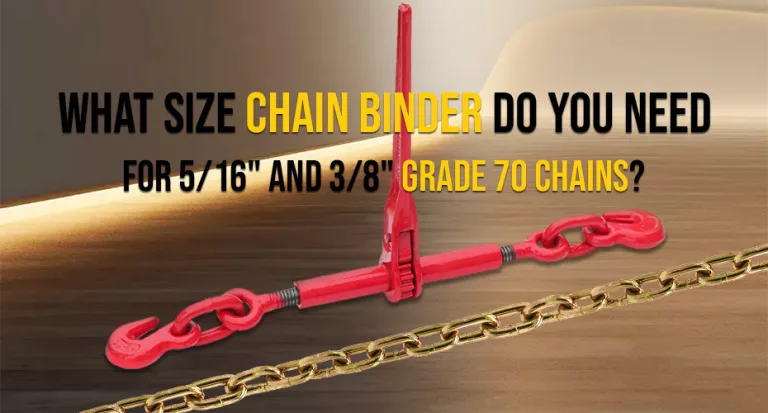
What Size Chain Binder Do You Need For 5/16 Inch And 3/8 Inch Grade 70 Chains?
Selecting the appropriate chain binder is same important as choosing the right transport chain. In the cargo securing industry, many operators often focus on the size and strength of the chains but ignor whether the binders are properly matched. If chain binder is too small, it will reduce the overall load capacity of the securing system. If one is too large, it may fail to provide adequate fit or tension range.
Today i will share why choose right load binder size, the size of load binder, which size chain binder for 5/16 chain and 3/8 chain.
Table of Contents
Why Choosing the Right load binder Size Is Crucial?
The transport chain and the chain binder together form a complete cargo securing system. The chain provides the necessary strength to secure the cargo, while load binder is responsible for applying and maintaining tension during transportation.
When the chain binder size does not match the chain:
- Proper binder may be difficult to achieve.
- The system’s rated working load (WLL) may be reduced.
- Hooks and links may experience excessive wear.
- The risk of cargo shifting during transport may increase.
For professional transport personnel, equipment transportation companies, and trailer operators, selecting the appropriate load binder size is a fundamental yet critical step in ensuring safe transportation.
Understanding Grade 70 Transport Chains
Grade 70 chain (commonly known as transport chain ) is the most widely used chain for cargo securing in North America, Australia, and New Zealand.
Its main features include:
- Made of high-strength carbon steel
- Designed specifically for cargo securing applications
- Features a distinctive gold or yellow chromate coating
- Excellent strength-to-weight ratio
Grade 70 chains’s application:
- Flatbed trailer transportation
- Heavy equipment transportation
- Agricultural machinery transportation
- Vehicle transportation
- Construction equipment securing
With its outstanding performance, Grade 70 chain remains the preferred choice for most conveying applications.
What do the dimensions of a chain binder represent?
A common misconception is that the size of a chain binder refers only to the dimensions of the binder itself. In fact, the size designation indicates the chain specification to which the binder is suitable.
For example:
5/16-inch to 3/8-inch Chain binder
This chain binder is suitable for:
- 5/16-inch chain
- 3/8-inch chain
3/8-inch to 1/2-inch Chain binder
This chain binder is suitable for:
- 3/8-inch chain
- 1/2-inch chain
Its size range takes into account the following factors:
- Hook opening size
- Take-up length
- Thread travel
- Tension capacity
Selecting the appropriate size ensures proper engagement with the chain and allows the tensioner to generate sufficient tension.
5/16-inch Grade 70 Chain Recommended Tensioner
5/16-inch Grade 70 is one of the most common conveyor chain specifications.
Typical pecifications are as follows:
| Chain Size | Grade | Working Load Limit |
| 5/16inch | G70 | 4700lbs |
For this chain specification, the recommended tensioner is typically:
5/16-inch to 3/8-inch Ratchet chain binder
or 5/16-inch to 3/8-inch Lever-Type Chain binder
These chain binders are specifically designed for 5/16-inch conveyor chains, providing an appropriate adjustment range and working load capacity.
Common application scenarios include:
- Multi-purpose trailer
- Pickup truck transport
- Small construction equipment
- Vehicle transportation
This combination offers a good balance between strength and ease of use for operators frequently handling light to medium loads.
Recommended Chain Tensioner for 3/8-inch Grade 70 Chain
When securing heavier equipment, many transportation professionals choose 3/8-inch Grade 70 chain.
Typical specifications are as follows:
| Chain Size | Grade | Working Load Limit |
| 3/8 inch | G70 | 6600lbs |
For this chain specification, the most common recommended configuration is:
3/8-inch to 1/2-inch Ratchet Chain binders
or
3/8-inch to 1/2-inch Lever-Type Chain Binder
These larger-sized chain binder are specifically designed for heavy-duty transportation operations.
- Excavators
- Skid Steer Loaders
- Tractors
- Construction Machinery
- Heavy-duty Trailers
Since large equipment generates greater forces during transportation, selecting a properly sized chain binder is particularly important.
Comparison of Ratchet and Lever Type Binder for Grade 70 Chains
After selecting the appropriate specification, the operator must choose ratchet type binder or lever type binder.
Ratchet-type chain binder
Why Are Ratchet-type chain binders becoming increasingly popular?
- Tensioning process is easier to control
- Adjustment is simpler
- Lower risk of rebound
- Enhanced operator safety
These advantages make it the preferred choice for long-distance and frequent transportation operations.
Lever-type chain binder
Why are Lever-type chain binders still widely used?
- Faster tensioning speed
- Simple operation
- Lower procurement cost
Many experienced operators still use lever binders, especially in applications where quick and convenient operation is desired.
Common Mistakes When Choosing a Chain Binder
The following types of errors may lead to performance degradation and compromise safety.
- Select based solely on chain diameter
Selecting based solely on chain size is insufficient. Always verify the rated working load (WLL) of both the chain and the tensioner.
- Ignoring the Working Load Limit (WLL)
The rated working load of the chain tensioner shall be equal to or greater than the rated working load of the chain.
- Mixing components of unknown origin
Mixing components from different sources without verifying their rated parameters may result in system vulnerabilities.
- Using an oversized chain binder
An oversized chain binder may not provide adequate tension travel for a thinner chain.
- Using an undersized chain binder
This is one of the most serious errors, as it will limit the load-bearing capacity of the entire cargo securing system.
Quick Reference Guide
For most transportation applications, the following combination is recommended:
| Chain Size | Grade | Working Load Limit | Recommended Chain Binder |
| 5/16 inch | Grade 70 | 4700lbs | 5/16-3/8 load binder |
| 3/8 inch | Grade 70 | 6600lbs | 3/8-1/2 load binder |
Please confirm the specifications with the manufacturer and ensure that all components in the cargo securing system have the appropriate rated parameters.
Conclusion
Choosing the right tensioner for Grade 70 transport chains is not just about convenience—it directly affects the safety and effectiveness of the entire cargo securing system.
For most application scenarios:
5/16-inch Grade 70 chain is best paired with a 5/16″-3/8″ load binder.
3/8-inch Grade 70 chain is typically used with a 3/8″-1/2″ load binder.
No matter ratchet-type chain binder or lever-type chain binder you choose, chain size, chain binder size, and working load limit (WLL) are properly matched. A correctly sized system helps maintain cargo stability, ensures compliance with transportation regulations, and gives you greater confidence in every transport operation. If you have any question, don’t hesitate to contact Sail Rigging.