
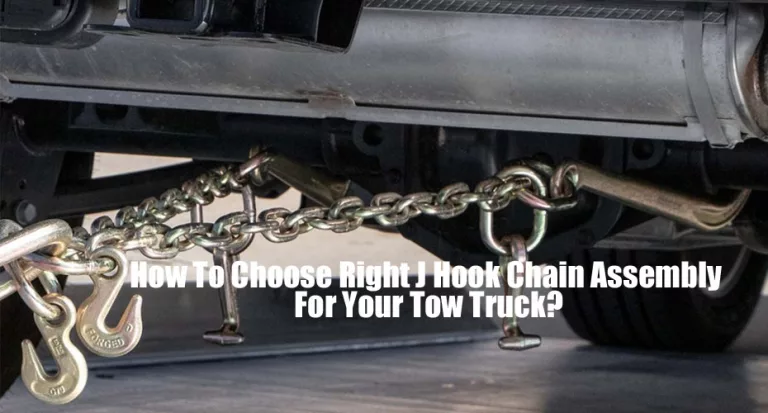
How to Choose the Right J Hook Chain Assembly for Your Tow Truck
Choosing the right J-hook chain assembly is more important than many tow operators realize. Wrong hook assembly will slow down recovery operations, cause safety hazards during transport.
Today, i will share how to select the right J hook chain assembly, the advantage of J hook chain assemblies, hope it will help you improve efficiency, reduce downtime, and protect your equipment and the vehicles.
Table of Contents
What is a J-hook chain assembly?
The J-hook chain assembly is a towing and recovery chain system used to secure vehicles during transportation or rescue operations.
Typical components may include:
- 70-level transport chain
- Forged J-hook
- Grab hook
- Pear-shaped link
- Main chain link
The J-hook is designed to connect to the vehicle’s securing points, frame openings, or designated trailer locations. The chain transfers the load to the trailer, while other components help maintain proper alignment and tension.Due to its versatility, the J-hook chain assembly is widely used in the North American trailer and roadside assistance industry.
How To Choose Right J Chain Hook Assemblies
understand your application
Before selecting a chain component, consider the type of vehicle you most frequently tow.
Light Trailer
5/16 inch Grade 70 chain is sufficient for passenger cars, compact SUVs, and small crossovers.
Where To Use
- Roadside Assistance
- Vehicle transportation
- Flatbed trailer loading
- Medium Rescue
Pickups, trucks, and large SUVs require more robust components to handle heavier loads.
Operators typically choose heavier chain configurations to enhance durability and safety.
Heavy Rescue
Commercial trucks, construction equipment, and large-scale rescue operations require chain components with higher load capacity limits and more robust hook structures.
Selecting right chain hook assemblies based on actual application is the first step of safe towing.
Choosing the Right Chain Grade
Not all cable carriers are manufactured to the same standards.
- Grade 43 (G43)Chain
G43 chains are typically used for general purposes but are rarely employed in professional towing operations.
2. Grade 70 (G70) Chain
G70 chains remain the industry standard for trailer applications.
Its advantages include:
- High tensile strength
- Excellent wear resistance
- Complies with U.S. Department of Transportation (DOT) recognized transportation application standards
- Higher strength-to-weight ratio
Yellow Galvanizing also enables operators to quickly identify G70 on-site.
3. Grade 80 (G80) chain
Grade 80(G80) chains are typically used for special lifting or heavy-duty operations requiring higher strength.
For most towing operations, G70 chains offer the best balance between performance, durability, and cost.
Choosing the Right Chain Size
Chain size directly affects the working load limit (WLL) of the component.
The two most commonly used sizes are: 5/16-inch chain and 3/8 inch chain.
5/16 inch chain’s applicable:
- Passenger vehicles
- Light towing
- General transportation operations
3/8-inch chain is commonly used for:
- Large truck
- Rescue operations
- Heavy-duty operations
Although larger chains can provide higher load capacity, they also increase weight. Choosing the appropriate size helps balance safety and usability.
Choosing the Right Hook Configuration
Hook configuration is just as important as the chain itself.
Standard J-Type Hook Assembly
The standard J-hook remains one of the most widely used tow hooks. Its advantages include:
- Quick Installation
- Wide range of compatible vehicle models
- Easy to operate
Mini J-hook Assembly
Mini J-hooks are commonly used in situations with limited space or when operating small vehicles.
Cluster Hook Assembly
Many professional tow operators prefer to use a combination unit that includes the following hook:
- J-hook
- T-hook
- R-hook
This cluster allows a single chain assembly to fit more vehicle brands, reducing the need to carry multiple different chain setups.
The Importance of the Pear Link
The pear-shaped connecting ring is a component often overlooked.
Unlike traditional round connecting rings, pear-shaped connecting rings provide a dedicated load-bearing point that helps maintain proper alignment between the hook and the chain.
Its main advantages include:
- Improved load distribution
- Reduced lateral forces
- Optimized hook positioning
- Minimized chain twisting
- Enhanced trailer safety
The circular connecting ring allows the hook to rotate freely 360 degrees, which may result in unpredictable stress conditions.
The pear-shaped design helps control the direction of force and reduces the risk of the hook slipping into an unfavorable position during rescue operations.
For many professional towing operators, this compact component significantly enhances safety and equipment performance.
Consider Corrosion Resistance
Trailer equipment is constantly exposed to rain, road de-icing salt, mud, and harsh weather conditions.
Common surface treatment processes include:
- Galvanizing
- Yellow chromate passivation
- Powder coating
- Hot-dip galvanizing
For operators working in coastal areas or regions where road de-icing is frequently performed during winter, corrosion resistance significantly affects the equipment’s service life.
Proper surface protection helps reduce maintenance costs and extends service life.
Check Quality Before Purchase
Not all chain components are of the same quality.
Before purchasing, please verify the following:
- Working Load Limit (WLL) marking
- Material specification
- Hook forging process
- Proof load test records
- Welding quality
- Traceability documentation
Professional towing operations should always use components manufactured by suppliers with well-established quality control processes.
Testing and certification are often just as important as the hardware itself.
Conclusion
Understanding the advantage of J Chain hooks assemblies and where to use will help us to improve safety and efficiency. If you have any question about J Chain Hook Assemblies, Please feel free to contact Sail Rigging.