


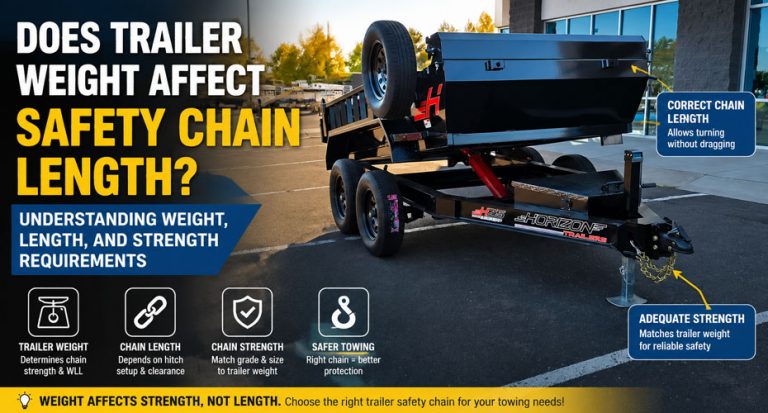
Does Trailer Weight Affect Safety Chain Length? Understanding Weight, Length, and Strength Requirements
Trailer owners want to know if trailer weight affect safety chain length when choosing a trailer safety chain.
Actually trailer weight does not directly determine safety chain length, but it has a major impact on chain strength, chain grade, diameter, and Working Load Limit (WLL).
Choosing the correct trailer safety chain requires understanding chain length & strength requirements. Right safety chain must provide enough flexibility for towing and enough capacity to support the trailer in an emergency.
Table of Contents
Trailer Weight and Safety Chain Length: What Is the Difference?
One common mistakes when selecting trailer safety chains is mistake chain length with chain strength.
Chain length and chain strength are diffent.
- Chain Length Determines:
- How much movement the trailer has during towing
- Whether the vehicle can make normal turns
- Whether the chain has enough clearance from the ground
- Whether the chain can properly support the trailer tongue if the coupler fails
2. Chain Strength Determines:
- How much load the chain can safely handle
- Whether the chain matches the trailer weight
- Whether the chain can withstand emergency forces
For example, two trailers may use a similar safety chain length because their hitch designs are similar. The heavier trailer is, the stronger chain will be(wll).
A longer chain is not automatically safer, and a thicker chain is not always the correct solution.
Does a Heavier Trailer Need Longer Safety Chains?
No, a heavier trailer doesn’t automatically need longer safety chain.
The chain length mainly depends on:
- Trailer design
- Hitch location
- Distance between attachment points
- Tow vehicle setup
- Turning clearance requirements
For example:
A 5,000 lb utility trailer and a 10,000 lb equipment trailer may require a similar chain length if both have the same hitch configuration.
However, the heavier equipment trailer will likely need:
- Larger chain diameter
- Higher chain grade
- Higher Working Load Limit
- Stronger hooks and attachment points
The weight of the trailer affects the capacity of the chain, not length of the chain.
How Trailer Weight Affects Safety Chain Selection
Trailer weight is one of the most important factors when choosing the correct safety chain.
Before selecting a chain, trailer owners should know their:
- Empty trailer weight
- Maximum cargo weight
- Gross Trailer Weight (GTW)
The basic calculation is:
Trailer Weight + Maximum Cargo Weight = Gross Trailer Weight
For example:
A empty car hauler weighs 3,000 lbs and carries a 5,000 lb vehicle.
Total trailer weight:
3,000 lbs + 5,000 lbs = 8,000 lbs
This means the safety chain system must be suitable for an 8,000 lb towing application.
Understanding Working Load Limit (WLL) for Trailer Safety Chains
When choosing a trailer safety chain, we should pay more attention on working load limit.
WLL refers to the maximum load a chain assembly is designed to safely handle during normal use.
It is different from breaking strength.
- Breaking Strength
The force required to cause chain failure during testing.
2. Working Load Limit
The maximum recommended working load for safe operation.
Trailer safety chains should be selected according to working load limit, not breaking strength.
A properly rated chain provides a safety margin for unexpected towing conditions, such as sudden braking or trailer separation.
What Size Safety Chain Do You Need for Your Trailer Weight?
The correct chain size depends on the trailer application and load capacity.
A general guide:
| Trailer Weight | Common Chain Size | Common Grade |
|---|---|---|
| Under 3,500 lbs | 1/4″ chain | Grade 43 |
| 3,500–7,500 lbs | 5/16″ chain | Grade 43 / Grade 70 |
| 7,500–10,000 lbs | 3/8″ chain | Grade 70 |
| 10,000+ lbs | 3/8″ or larger | Grade 70 |
These are general guidelines. Actual requirements may vary depending on:
- Trailer manufacturer recommendations
- Local regulations
- Hitch design
- Safety chain assembly rating
Does a Heavier Trailer Need a Stronger Safety Chain?
Yes.While a heavier trailer does not necessarily need a longer chain, it usually requires a stronger chain.
A heavier trailer creates greater forces during:
- Emergency braking
- Sudden acceleration
- Trailer separation
- Uneven road conditions
For this reason, heavy-duty trailers often use higher-strength chains.
- Grade 43 Trailer Safety Chain
Grade 43 chain is commonly used for:
- Utility trailers
- Boat trailers
- Cargo trailers
- Light-duty towing
Advantages:
- Cost-effective
- Reliable performance
- Commonly available in galvanized finishes
2. Grade 70 Trailer Safety Chain
Grade 70 chain is commonly selected for:
- Car haulers
- Equipment trailers
- Heavy-duty towing
Advantages:
- Higher strength-to-weight ratio
- Designed for demanding transport applications
- Popular in professional towing markets
Choosing between Grade 43 and Grade 70 depends on trailer weight, application, and required WLL.
Common Mistakes When Matching Trailer Weight and Safety Chains
Mistake 1: Choosing Chain Size Only by Diameter
Many users assume:
“A larger chain must always be better.”
However, chain performance depends on:
- Chain grade
- Material
- Heat treatment
- Manufacturing quality
- WLL rating
A smaller Grade 70 chain may have higher strength than a larger lower-grade chain.
Mistake 2: Using the Wrong Type of Chain
Not every chain is designed for trailer safety applications.
For example, lifting chain, transport chain, and general-purpose chain may have different requirements.
Always select a chain specifically suitable for trailer safety applications.
Mistake 3: Ignoring Hook Strength
The hook is just as important as the chain.
A strong chain with a weak hook creates a potential failure point.
The hook capacity should match or exceed the chain rating.
Common trailer safety chain hook options include:
- Slip hooks
- Grab hooks
- Clevis hooks
How to Choose the Correct Safety Chain Length After Selecting Strength
The correct selection process should follow this order:
Step 1: Determine trailer weight requirements
Step 2: Choose the correct chain grade and WLL
Step 3: Measure the required chain length
Step 4: Select the proper hook style
When measuring safety chain length:
- Connect the trailer to the tow vehicle
- Check left and right turning clearance
- Make sure the chain does not drag
- Ensure there is enough slack for normal movement
The goal is to achieve a balance:
Enough slack for safe turning, but not excessive slack that creates hazards.
Trailer Safety Chain Installation Tips
Even the correct chain can become unsafe if installed incorrectly.
- Cross the Safety Chains Properly
Many towing setups use crossed safety chains.
The crossed design creates a support cradle under the trailer tongue if the coupler disconnects.
2. Avoid Excessive Slack
Chains that are too loose may:
- Drag on the road
- Wear faster
- Reduce emergency support
3. Avoid Chains That Are Too Tight
Chains without enough slack may:
- Limit turning
- Increase stress on hooks
- Damage mounting points
Conclusion
Trailer weight doesn’t affect safety chain length direclty.Trailer weight mainly affects chain strength, grade, diameter, and Working Load Limit. Safety chain length is determined by trailer design, hitch setup, and required movement clearance.
When choosing trailer safety chains, always consider the complete system:
- Trailer weight
- Chain grade
- Chain diameter
- WLL rating
- Hook capacity
- Proper chain length
A correctly selected safety chain provides reliable backup protection and helps ensure safer towing on the road.
The best trailer safety chain is not simply the biggest or longest option — it is the one that is properly matched to your trailer and towing requirements. If you have any question, please feel free to contact Sail Rigging.