


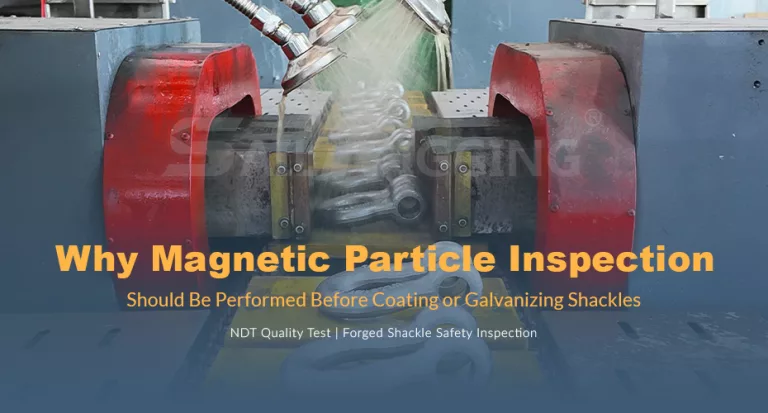
Why Magnetic Particle Inspection Should Be Performed Before Surface Treatment
Shackles are important components used in construction, marine, mining, and transport. Even a small crack can lead to serious failure under load. As a result, magnetic Particle Inspection (MPI) is widely used as a key non-destructive testing (NDT) method in shackle production. MPI must be performed before any surface treatment.
This article explains why magnetic particle inspection is essential for shackle and why performance before treatment.
Table of Contents
Why MPI Is Critical Inspection for Shackle
Shackles are load-bearing components and often operate under dynamic and unpredictable working conditions. They must withstand the influence of various stresses and environmental factors such as tensile, impact loads, vibration and corrosion. Simple visual inspection can only detect obvious surface defects, while magnetic particle testing (MPI) technology is specifically designed to reveal internal cracks and near-surface discontinuities that are imperceptible to the naked eye.
The working principle of magnetic particle testing lies in:
first, the steel component is magnetized, and then ferromagnetic particles are applied to its surface. If there are cracks inside the component, it will cause magnetic flux leakage. At this point, ferromagnetic particles will accumulate at the defect site, thus making the originally hidden defect visible. Due to its extremely high sensitivity, magnetic particle testing has become a mandatory standard inspection item for forged lifting slings in many international markets, including Australia, New Zealand, Europe and North America.
Why No Surface Treatment Is the Best Condition for MPI
Performing MPI on a bare metal (raw steel) surface provides the highest inspection accuracy.
Before coating or galvanizing, the shackle surface is clean, conductive, and free from any barrier layers. This condition offers several advantages:
- Magnetic particles can move freely across the surface without obstruction. This allows even very fine cracks to produce clear indications.
- There is no interference from paint, oil, or zinc layers. Any coating applied before inspection can reduce sensitivity and distort magnetic field distribution.
- Bare steel provides better contrast between the magnetic particles and the surface, making defect indications easier for inspectors to evaluate.
For forged shackle inspection, this is the most reliable condition to ensure that no structural defects are missed.
Why Coating or Galvanizing Can Mask Critical Defects
Once a shackle is painted or galvanized, the surface condition will be different.
Surface treatment can fill small surface discontinuities, making fine cracks invisible. Similarly, galvanizing creates a zinc layer that can cover or partially seal surface defects.
In some cases, zinc may even flow into small cracks during the galvanizing process, creating a “false surface” that hides the original defect.
If MPI is performed after coating, the inspection reliability decreases significantly. The magnetic field response becomes less clear, and defect signals may be weakened or completely masked.
This is why performing MPI after surface treatment introduces a serious risk: critical cracks may go undetected .
Optimal Inspection Stage in Forged Shackle Production
In a proper manufacturing process, MPI should be performed at a specific stage to achieve maximum effectiveness.
The ideal inspection point is:
- After forging
- After heat treatment
- After machining
- Before any surface coating or galvanizing
This stage is often referred to as the “golden inspection window.”
At this point, the material has already completed all high-stress manufacturing processes. Heat treatment is particularly important because internal stresses from quenching can sometimes generate micro-cracks.
By performing MPI at this stage, manufacturers can detect defects before any additional value is added to the product through surface finishing. This prevents unnecessary cost loss and ensures defective parts are removed early.
Advantage Of Magnetic particle inspection
If a defect is discovered after galvanizing or painting, the part is usually scrapped. In many cases, the cost loss is not only the raw material but also includes:
- Forging and machining cost
- Heat treatment cost
- Surface treatment cost
- Labor and inspection cost
This means a single rejected part becomes a full-process loss.
By identifying defects early through MPI, manufacturers can:
- Reduce rework rates
- Improve production yield
- Avoid full batch rejection
- Prevent customer complaints
- Increase overall manufacturing efficiency
For forged shackle suppliers, this directly improves both profitability and quality reputation.
Typical Crack Locations Detected by MPI in Shackles
Magnetic particle inspection is especially effective in identifying cracks in high-stress regions of shackles.
Common defect-prone areas include:
- The crown (bow section), where bending stress is highest
- Lug or ear transition zones with sharp geometry changes
- Pin hole edges where stress concentration occurs
- Threaded regions and root transitions
- Forging parting lines where material flow may be uneven
These areas are critical because they are directly exposed to working loads during lifting or towing operations.
Even a small crack in these locations can grow under repeated stress cycles, leading to failure.
Industry Requirements and Export Market Expectations
MPI before coating is often a strict requirement In Australia and New Zealand.
Many customers request:
- MPI reports before galvanizing
- Third-party Inspection Report (SGS, BV, etc.)
- Heat treatment records
- Traceability documents linked to batch numbers
These requirements are part of a broader quality assurance system designed to ensure that lifting hardware meets the safety standards required by demanding industries such as mining, maritime operations, and construction.
Without proper MPI documentation, forged shackles may fail customer audits or be rejected during import inspections.
Conclusion
Magnetic particle inspection is one of the most important quality control links in the manufacturing process of forged shackles. However, its effectiveness largely depends on the timing of implementation. Magnetic particle inspection carried out before coating treatment or hot-dip galvanizing can ensure the highest detection sensitivity, prevent defects from being masked, and reduce costly rework.
In addition, this move also meets the requirements of international quality standards and can enhance the reliability of the product under actual working conditions. For forging shackle manufacturers and suppliers, the correct inspection sequence is by no means merely a technical detail – it is the key to ensuring the safety of lifting operations, the consistency of product quality, and winning the long-term trust of customers. If you have any question about shackle, don’t hesitate to contact Sail Rigging.