
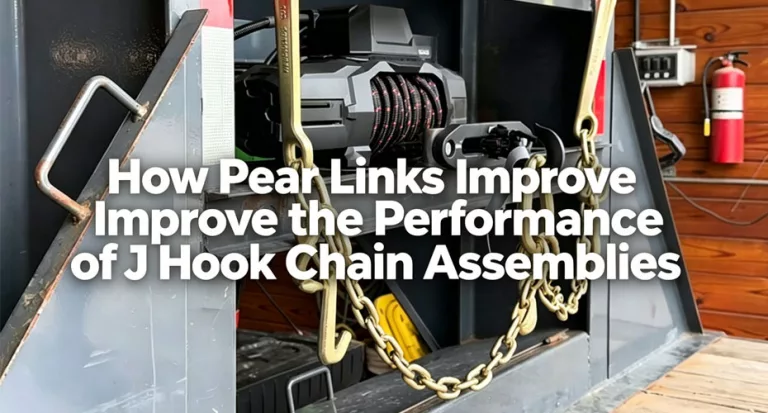
How Pear Links Improve the Performance of J Hook Chain Assemblies
In towing and vehicle recovery, Grade 70 chain, J hook, R hook, T hooks play an unexpectedly crucial role in the overall performance and safety of tow chain assemblies. Today i will share some important information about pear link.
Although it is simple in appearance, the forged pear-shaped connecting link improves load alignment, reduces wear, enhances safety, and helps trailer equipment operate more reliably under demanding conditions. For many professional trailer operators, it has become a standard feature in modern J-hook chain assemblies.
Table of Contents
What Is A Pear Link?
The pear link (also known as a pear-shaped link) is a forged steel connector characterized by its wider lower section and narrower upper section. Unlike traditional round links, this pear-shaped design creates a controlled load path between the chain and the attached hook.
Pear links are commonly found in the following components:
- J-hook chain assembly
- Mini J-hook assembly
- Cluster hook assembly
- V-shaped sling chain assembly
- Vehicle recovery chain
Most heavy-duty pear-shaped connecting links are made of forged carbon steel or alloy steel, designed to meet the strength requirements of Grade 70 conveyor chain systems.
Applications of Pear Links
In a typical J-hook chain assembly, pear links serve as the connection point between the hook and the chain.
Common configurations include:
- J-hook + pear-shaped connecting link + chain
- Mini J-hook + pear-shaped connecting link + chain
- Combination hook assembly + pear-shaped connecting link
- V bridle chain+ pear-shaped connecting link
The pear-shaped link does not directly connect the hook to the chain, but instead provides additional freedom of movement, allowing the hook to align more naturally during trailer operations.
This seemingly minor improvement can significantly affect the force distribution within the trailer system.
How Pear links Improve Load Alignment
One of the greatest advantages of the pear-shaped connecting ring is its ability to improve load alignment.
During towing and recovery operations, the direction of pull often changes as vehicles move, turn, or are loaded onto flatbed trailers. If the connection point cannot accommodate these movements, lateral forces (side loading) may occur. Side loading subjects the hook to forces in unintended directions, thereby increasing the stress load on the hook and chain assembly.
The pear link allows controlled movement between components, helping the hook align more effectively with the actual pulling direction. This not only reduces unnecessary stress but also contributes to a more even load distribution.
This flexibility significantly enhances equipment performance for rescuers dealing with damaged vehicles or complex recovery angles.
Pear link and round link: Why the difference matters
Many people believe that pear link and round link serve the same purpose. Although both are used as connectors, their performance characteristics differ significantly.
The traditional round link has a symmetrical shape, allowing the attached hook and chain to move freely around its entire circumference. This means the hook can rotate 360 degrees and may come to rest in positions that do not provide the optimal load path.
Resulting in:
- The hook may slide on the connecting ring
- Load direction becomes difficult to predict
- Lateral loading is more likely to occur
- Equipment stability may be reduced
In contrast, pear link provides a dedicated load-bearing point, typically located within an effective working area of approximately 60 degrees.
This design helps:
- Maintain proper hook alignment
- Improve load transfer efficiency
- Reduce unnecessary hook movement
- Lower the risk of connection instability
For trailer professionals, this creates a safer working environment for operators and equipment.
Reduce wear and extend service life
Wear and tear is one of the most common reasons why trailer equipment needs to be replaced.
When the hook is frequently repositioned or subjected to uneven loads, the wear rate at critical contact points increases.
By maintaining component alignment during operation, the pear-shaped connecting ring helps reduce:
- Hook wear
- Link wear
- Friction between components
- Stress concentration at connection points
In the long run, this helps extend the service life of the entire trailer assembly.
For fleets operating multiple trailers, even a slight increase in equipment lifespan can significantly reduce maintenance costs.
Why Pear link Enhance Trailer Safety
Safety has always been the primary reason many trailer equipment manufacturers specify pear links in their components. The controlled geometry of pear-shaped links helps reduce a variety of common risks:
- Hook misalignment
- Chain twisting
- Uneven load distribution
- Unexpected component displacement
- Increased lateral load
Stability is crucial in vehicle recovery operations. A connection system that maintains proper alignment helps operators achieve better control and reduces the risk of equipment failure—especially when towing disabled vehicles along roadsides, at accident scenes, or over rough terrain.
Comparison of Forged pear links and Welded pear links
Not all pear-shaped rings have the same performance.
For heavy-duty trailer applications, forged pear links are generally superior to welded products.
Forged pear links offer the following advantages:
- Higher strength
- Improved fatigue resistance
- Enhanced impact resistance
- Greater dimensional consistency
Since towing and rescue operations often involve impact loads and dynamic forces, forged components are typically a safer and more durable choice.
Professional tow equipment manufacturers typically use die-forged pear-shaped rings to ensure compatibility with Grade 70 chain systems and the demands of high-strength rescue operations.
How to Choose the Right Pear Links
When selecting pear links for J-hook chain assemblies, the following factors should be considered:
- Chain specification
- Rated working load (WLL)
- Hook configuration
- Material grade
- Surface treatment
The strength grade of the pear link must match the rated strength of the entire chain assembly. Using undersized connectors will reduce the system’s overall load capacity and create unnecessary safety hazards.
For outdoor trailer environments, corrosion-resistant surface treatments also help enhance the product’s long-term durability.
Conclusion
Although it may appear to be just a simple connector, the pear-shaped ring plays a crucial role in the performance of modern J-hook chain assemblies.
Compared to traditional round rings, forged pear links offer a dedicated load-bearing point that optimizes load alignment, reduces lateral forces, enhances safety, and extends equipment service life. These advantages make pear links perfect choice for professional towing, vehicle recovery, and transport chain applications.
For trailer operators and equipment buyers seeking to enhance reliability and safety, choosing high-quality forged pear links are a small investment that delivers significant long-term benefits.