
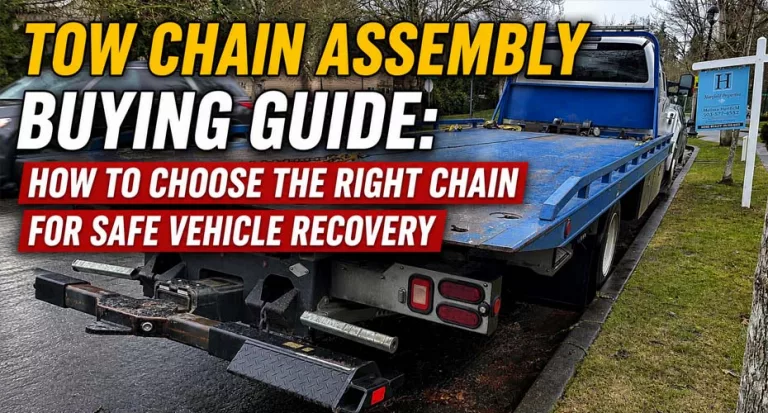
Tow Chain Assembly Buying Guide: How to Choose the Right Chain for Safe Vehicle Recovery
For towing companies, rescue personnel, and vehicle transport professionals, selecting the right tow chain assembly is crucial. Right chain assembly not only enhances safety and reduces equipment wear but also helps ensure compliance with transportation regulations.If wrong selection can lead to equipment failure, vehicle damage, and costly downtime.
This guide will provide a detailed overview of key factors to consider when selecting trailer chain components, including chain grade, hook type, working load limit, and common pitfalls to avoid.
Table of Contents
What is a tow chain?
The tow chain assembly is a complete towing system consisting of chains, hooks, connecting rings, and coupling accessories, specifically designed for securely securing or rescuing vehicles.
Depending on the specific application scenario, a trailer chain assembly may include the following components:
- Grade 70 transport chains
- J-hooks
- RTJ hooks
- Grab hooks
- Pear links
- Connecting links
These components are widely used in:
- Tow truck operators
- Vehicle recovery companies
- Auto transport businesses
- Equipment transportation contractors
Different trailer scenarios require different chain configurations, so it’s essential to understand the various component types before purchasing.
Common Types of Trailer Chain Components
V-Bridle Chain Assembly
The V bridle type chain consists of two chain branches connected to a central main link. This design helps evenly distribute the load during towing and recovery operations.
V bridle type chain assemblies are commonly used for:
- Wheel-lift towing
- Vehicle recovery
- Light towing operations
Many operators prefer V bridle type chain assemblies because they offer excellent stability and a variety of connection options
J-Hook Chain Assembly
The J-hook assembly is one of the most commonly used trailer chains in North America.
Its advantages include:
- Fast vehicle connection
- Easy to operate
- Strong compatibility with vehicle mounting points
They are commonly used in flatbed trailers and vehicle transport trailers.
Axle Chain Assembly
The axle chain is specifically designed to wrap around vehicle axles or suspension components, suitable for situations where direct attachment to the frame is not possible.
They are commonly used for:
- Damaged vehicles
- Vehicle recovery operations
- Special towing scenarios
When used properly, axle chains can ensure a secure connection while minimizing the risk of vehicle damage.
RTJ Combined Hook Assembly
The RTJ combination hook assembly integrates multiple types of hooks into a versatile trailer solution.
Typical assembly components usually include:
- RTJ hook
- Grab hook
- Mini J hook
- Large J hook
This flexibility enables operators to handle various types of vehicles using just a single set of components.
Understanding Chain Grades
One of the most important considerations when making a purchase is the chain grade.
Chain grade reflects material strength and applicable scenarios.
Grade 43 Chain
43-grade chains are commonly used for general-purpose applications.
Its advantages include:
- Lower cost
- High versatility
However, for applications involving vehicle restraint equipment that must comply with DOT (U.S. Department of Transportation) standards, Grade 43 chains are typically not the preferred choice.
Grade 70 Chain
The 70-grade transport chain is the standard configuration in the vehicle transportation and trailer industry.
Key advantages include:
- High strength-to-weight ratio
- Complies with DOT cargo securing standards
- Exceptional durability
Grade 70 chains are typically yellow galvanized, which helps distinguish them from chains of other grades.
For most towing companies, 70-grade chains remain the most practical and widely accepted choice.
Grade 80 Chain
80-grade chains are made of alloy steel and have higher strength than 70-grade chains.
It is commonly used for:
- Heavy rescue operations
- Rigging operations
- Harsh working conditions
Although stronger, it is not always necessary for regular vehicle towing operations.
Choosing the Right Chain Size
Choosing the right chain size is just as important as selecting the correct grade.
A chain that is too small may not provide sufficient load capacity, while a chain that is too large will add unnecessary weight and reduce efficiency.
Typical recommendations are as follows:
| Vehicle Type | Recommended Chain |
| Passenger Cars | 5/16″ Grade 70 |
| SUVs | 5/16″ Grade 70 |
| Pickup Trucks | 3/8″ Grade 70 |
| Medium-Duty Trucks | 1/2″ Grade 70 |
Before selecting a chain size, be sure to verify the vehicle weight and towing requirements.
Why WLL is Crucial ?
Working Load Limit (WLL) refers to the maximum load that a chain assembly can safely withstand during normal operation.
This is one of the most important specifications to consider when selecting a trailer chain assembly.
Many buyers often focus only on the chain size, but in reality, every component within the assembly affects the overall load capacity.
For example:
| Component | WLL |
| Chain | 4,700 lbs |
| J Hook | 5,400 lbs |
| Pear Link | 11,300 lbs |
Although some components have higher rated load capacities, the overall rated load capacity of the assembly is only 4,700 pounds due to the chain’s lowest load capacity.
This principle is known as the Lowest Rated Component Rule and is widely recognized in the trailer and rigging industry.
Choosing the Right Type of Hook
The choice of hook directly affects safety, convenience, and compatibility.
J Hooks
J-hooks are ideal for various vehicle transport applications due to their quick installation and ease of use.
Mini J Hooks
The mini J-hook is suitable for tight spaces and vehicles with limited connection points.
RTJ Hooks
RTJ hooks offer greater versatility and are commonly used in vehicle rescue operations.
Grab Hooks
The hook allows the operator to shorten the chain length and make quick adjustments during the fixing process.
Choosing the right type of hook can improve efficiency and reduce risks caused by improper connections.
Surface Treatment Options
Trailer chain assemblies are often exposed to rain, road de-icing salt, mud, and harsh weather conditions.
Surface treatment plays a crucial role in determining service life.
Common surface treatment methods include:
- Zinc Plated
Provides basic corrosion resistance and is cost-effective for general applications.
- Hot-Dip Galvanized
Provides excellent corrosion protection in coastal and high-humidity environments.
- Powder Coated
Enhances appearance and provides additional wear resistance.
Common Purchasing Misconceptions
Many first-time buyers make some avoidable mistakes.
The most common misconceptions include:
- Choose solely based on price
Low-cost products may use substandard materials or components that do not meet industry standards.
- Ignoring Working Load Limit (WLL)
Always verify the rated load of the entire assembly, rather than relying solely on the load capacity of individual components.
- Choosing the wrong hook configuration
The chain assembly will only function effectively when it is compatible with the vehicle and towing method.
- Neglecting corrosion protection
Chains used outdoors should have an appropriate protective surface treatment.
- Purchasing from unverified suppliers
Reputable manufacturers should provide test reports, material certifications, and product traceability information.
Conclusion
A towing chain is more than just a simple combination of chains and hooks. It is a critical safety component that directly affects trailer performance, operator safety, and vehicle protection.
When evaluating trailer chain components, the following five key factors should be given close attention:
- Chain grade
- Chain size
- Working load limit (WLL)
- Hook configuration
- Product quality and certification
Taking the time to select the right components not only improves efficiency and reduces liability risks, but also ensures long-term safety in vehicle rescue operations.
Before placing an order, be sure to obtain detailed specifications and confirm that the component meets your trailer operation requirements. A well-designed trailer chain assembly is a significant investment in safety, reliability, and long-term performance. If you have any question about tow chains, please feel free to contact Sail Rigging.