


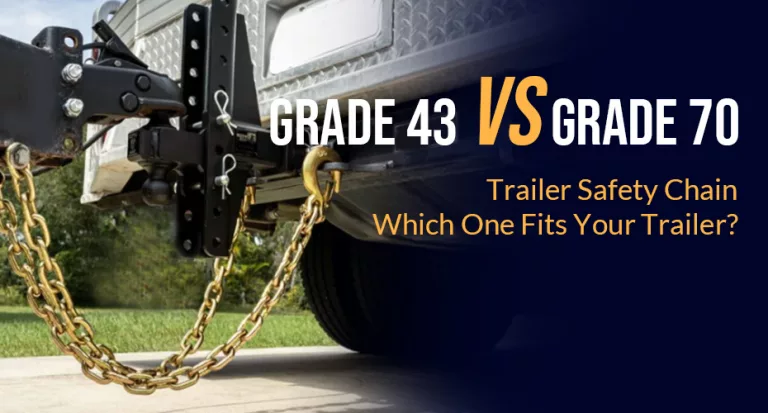
Grade 43 vs Grade 70 Trailer Safety Chain: Which One Should You Choose?
Trailer safety chains are important safety components on any trailer. It is simple but crucial.if the trailer becomes detached from the towing device (hitch), the safety chain ensures that the trailer remains connected to the tow vehicle, reducing the risk of the trailer becoming uncontrolled and sliding away.
G43 and G70 chain trailer safety chains are typically recommended. Although both are widely used in the trailer industry, they differ in strength, application scenarios, and performance. Understanding these differences helps you choose right suitable chain for your trailers.
Table of Contents
What Is A Trailer Safety Chain?
The trailer safety chain serves as a backup connection between the trailer and the towing vehicle.It will provide additional security if failed hitch, damaged connector, or accidental disengagement.
Safety chains are commonly found on the following types of trailers:
- Utility trailers
- Equipment transport trailers
- Car transport trailers
- Boat trailers
- Landscape and gardening trailers
Most regulations regarding trailers require that safety chains must be properly sized and securely connected. Selecting the correct grade of chain is a crucial part of meeting these regulatory requirements.
What Is Grade 43 Chain?
G43 chains are commonly known as “high test chains,” made of carbon steel and stronger than standard ordinary chains (proof coil chains).
Due to its balance of strength and economy, G43 chains are commonly used in:
- Multi-purpose trailer
- Agricultural equipment
- General towing operations
- Light cargo securing
One of the main advantages of G43 chain is its lower cost. It is an economical and practical choice for tow truck operators who occasionally tow light loads.
However, G43 chains are not specifically designed for vehicle transport applications. As trailer weights increase, many users prefer to choose higher-strength alternatives.
What Is A G70 Chain?
G70 chains are commonly known as “transport chains.” Made from heat-treated steel, they offer significantly higher strength compared to Grade 43 chains of the same size. Grade 70 chains are widely recognized for their golden or yellow chromate coating and are commonly used in:
- Vehicle transportation
- Automotive transport trailers
- Equipment trailers
- Commercial trailer services
- Rescue operations
Due to its higher working load limit, Grade 70 chains have become the preferred choice for many professional trailer manufacturers and transportation companies.
Main Difference Grade 43 vs. Grade 70 Trailer Safety Chain
Although G43 chains and G70 chains look similar, there are significant differences between them.
| Feature | Grade 43 | Grade 70 |
|---|---|---|
| Material | Carbon Steel | Heat-Treated Steel |
| Strength | Moderate | Higher |
| Typical Finish | Self Color or Zinc | Gold Chromate |
| Common Applications | Utility Trailers | Vehicle Transport |
| Weight Efficiency | Lower | Higher |
| Cost | Lower | Higher |
| Professional Use | Limited | Widely Used |
The most noticeable difference lies in strength. Grade 70 chains offer higher load capacity without increasing the chain diameter.
- Common Trailer Safety Chain Sizes
Chain size plays a crucial role in determining the chain’s working load limit.
Common Grade 43 Sizes
| Chain Size | Typical Application |
|---|---|
| 1/4″ | Small Utility Trailer |
| 5/16″ | Boat Trailer |
| 3/8″ | Medium-Duty Trailer |
| 1/2″ | Heavy Utility Trailer |
Common Grade 70 Sizes
| Chain Size | Typical Application |
|---|---|
| 5/16″ | Car Hauler Trailer |
| 3/8″ | Equipment Trailer |
| 1/2″ | Heavy Equipment Trailer |
| 5/8″ | Commercial Trailer |
When selecting chain size, always consider the trailer’s gross vehicle weight rating (GVWR), rather than simply matching the original equipment configuration.
- Trailer Weight and Recommended Chain Size
The table below provides a general reference guide for selecting trailer safety chains.
| Trailer GVWR | Recommended Chain |
|---|---|
| Up to 3,500 lbs | 1/4″ Grade 43 |
| 3,500–7,000 lbs | 5/16″ Grade 43 or Grade 70 |
| 7,000–14,000 lbs | 3/8″ Grade 70 |
| 14,000–20,000 lbs | 1/2″ Grade 70 |
| Over 20,000 lbs | 5/8″ Grade 70 |
Please verify local regulations and manufacturer recommendations before making a final decision.
- Working Load Limit (WLL) Comparison
One of the simplest ways to compare chain grades is to check their working load limit (WLL).
| Chain Size | Grade 43 WLL | Grade 70 WLL |
|---|---|---|
| 1/4″ | 2,600 lbs | — |
| 5/16″ | 3,900 lbs | 4,700 lbs |
| 3/8″ | 5,400 lbs | 6,600 lbs |
| 1/2″ | 9,200 lbs | 11,300 lbs |
As shown in the table above, for chains of the same diameter, Grade 70 chains consistently provide higher load capacity than Grade 43 chains.
This means that trailer owners can achieve higher strength without increasing the chain size or weight.
Is a Grade 70 chain more expensive?
For many trailer owners, the final choice depends on budget and specific needs.
For light trailers and occasional towing needs, Grade 43 chains are a reliable choice. If sizes are properly and maintained well, their performance is excellent.
However, Grade 70 chains offer the following advantages:
- Higher working load limit
- Superior strength-to-weight ratio
- Broader applicability
- Wider acceptance in the transportation industry
- Longer service life under harsh conditions
For commercial operators, equipment transporters, and vehicle shipping companies, the additional investment in Grade 70 chains is often justified by their superior performance and increased safety margins.
How to Choose the Right Trailer Safety Chain
When selecting a trailer safety chain, consider the following questions:
- What is the GVWR (Gross Vehicle Weight Rating) of the trailer?
The chain must be able to withstand the trailer’s maximum rated weight.
- How is the drag frequency?
Commercial users typically benefit from the durability and high load capacity of Grade 70 chains.
- What type of trailer is being used?
A small, multi-purpose trailer may only require Grade 43 chains, while car transport or equipment transport trailers might be better suited to Grade 70 chains.
- Is an additional safety margin required?
Many operators choose Grade 70 chains because they offer higher strength without significantly increasing the chain size.
Common Mistakes in Product Selection
When selecting a trailer safety chain, avoid the following common mistakes:
- Choosing chains based solely on price
- Ignoring working load limits
- Using chains that do not match the trailer weight (undersized)
- Mixing chains of different grades
- Failing to regularly inspect chains for wear and corrosion
Regular inspections help identify issues promptly before chain link stretching, excessive wear, corrosion, or hook damage develop into safety hazards.
Conclusion
Grade 43 and Grade 70 trailer safety chains each have their place in the towing industry. For lighter trailers and general-purpose applications, Grade 43 remains a cost-effective choice; whereas Grade 70 offers higher strength, greater working load limits, and superior performance, meeting the demands of high-intensity towing operations.
For most equipment trailers, vehicle transport trailers, and commercial towing applications, Grade 70 chains are typically the preferred choice due to their superior safety and reliability. Selecting the appropriate grade and specification of chain for your trailer not only enhances towing safety and reduces risks but also ensures consistent and dependable performance in every transport operation. If you have any question about trailer safety chains, don’t hesitate to contact Sail Rigging.