


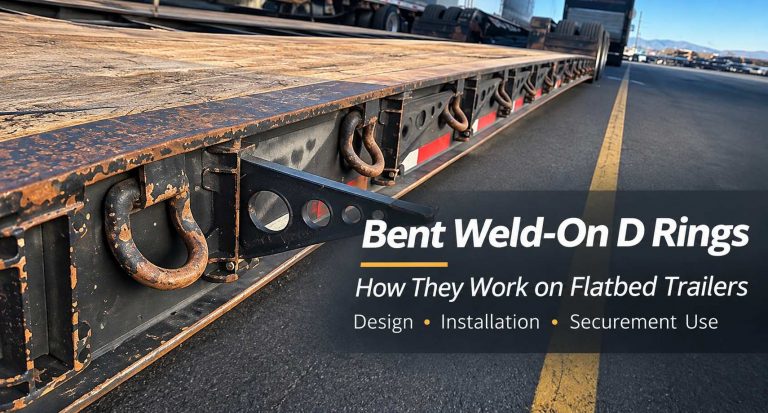
What Is A Bent Weld-On D Ring and How Does It Work?
A bent weld-on D ring is a permanent cargo tie-down anchor with an angled ring and a weldable mounting clip. The bend can change how a hook or strap approaches the trailer surface, but the real suitability of an anchor depends on its dimensions, rated capacity and installation.
1. What Is a Bent Weld-On D Ring?
On a flatbed or equipment trailer, an anchor point needs to be positioned where a chain hook or strap fitting can engage correctly. A bent weld-on D ring is one option for this job. It has a D-shaped steel ring with a bent or angled portion, held by a mounting clip designed to be welded to a suitable steel structure.
Unlike a bolt-on anchor, the clip becomes a permanent part of the structure once installed. The ring remains the attachment point for a compatible tie-down connection. The product should not be treated as a complete securement system: the trailer structure, weld, ring, hook, chain or strap and loading direction all matter.
Understanding the parts
- D-shaped ring: the steel attachment point for compatible tie-down hardware.
- Bent section: the angled portion that changes the ring’s position relative to the mounting surface.
- Weld-on clip: the mounting component designed to be welded in accordance with the manufacturer’s instructions.
- Weld and supporting steel: the installed load path into the trailer or frame, which must be assessed separately from the ring rating.
2. How Does the Bent Design Work?
The angle of the ring can affect access and clearance. For example, an anchor installed close to a steel frame member may be easier to reach when its ring sits at a more useful angle. Depending on the specific geometry, the bend can also help keep a connection fitting away from a nearby surface.
That benefit should be checked against the actual hook opening, available space and anticipated direction of pull. A bent ring is not automatically safer, stronger or suitable for side loading. Always follow the ratings and loading restrictions of the particular model.
During use, the connection forces pass from the hook or strap fitting into the D ring, through its clip and welded connection, and finally into the trailer structure. The assembled installation is only as suitable as the components and supporting structure used together.
3. Where Are Bent Weld-On D Rings Used?
Flatbed trailers
Flatbeds carrying steel sections, construction materials or machinery may need permanent anchor points around the deck or frame. A bent ring may help with connection access at locations where a conventional ring is awkward to reach.
Equipment trailers
Trailers used for compact excavators, tractors and other equipment need anchors placed to suit the machinery’s designated tie-down points. The position, number and rating of the anchors must be considered as part of the full cargo securement arrangement.
Truck bodies and transport structures
Where the supporting steel and installation are suitable, weld-on D rings can also provide attachment points on cargo bodies and other transport structures. The presence of a steel surface alone does not establish that it is a suitable welding location.
4. Bent D Ring vs. Standard Weld-On D Ring
Both types can serve as permanent steel tie-down anchors. The meaningful difference is their geometry and how that geometry fits the mounting location—not an assumption that one must carry a greater load.
| Feature | Bent Weld-On D Ring | Standard Weld-On D Ring |
|---|---|---|
| Ring profile | Angled or bent | Conventional profile |
| Connection clearance | Depends on bend and mounting position | Depends on ring and mounting position |
| Mounting | Weld-on clip | Weld-on clip / approved bracket |
| Load capacity | Model-specific rating | Model-specific rating |
| Best selection basis | Access, clearance, rating and fit | Geometry, rating and installation fit |
If the conventional model leaves enough room for the connection hardware, it may be entirely suitable. Choose a bent design when its measured geometry offers a genuine installation advantage.
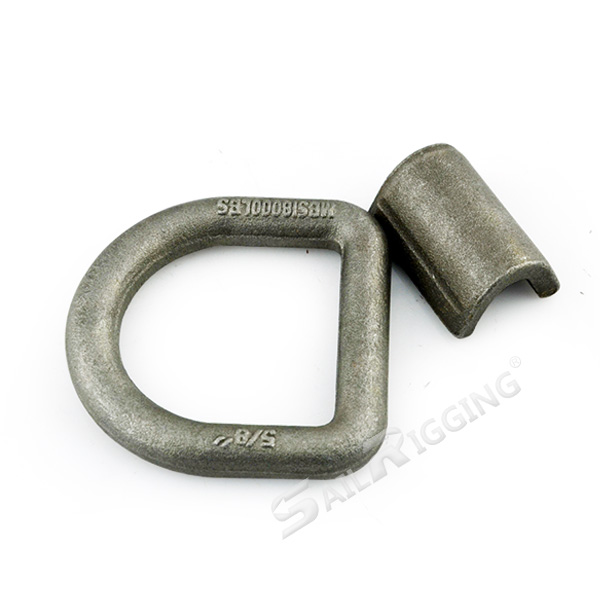
Standard Weld-On D Ring
Sail Rigging’s standard model features a drop-forged carbon steel D ring and a weld-on mounting clip, supplied with a self-color, oiled finish. Compare its geometry and published product specifications with the installation needs of your trailer.
5. What Should You Check Before Ordering?
For trailer manufacturers and distributors, a drawing and a clear specification are more useful than choosing by appearance alone.
- Dimensions: check ring diameter, internal opening, overall height, bend profile and clip dimensions against the available installation space.
- Working Load Limit: confirm the manufacturer’s WLL for the exact model and permitted load direction. Do not substitute Minimum Breaking Strength (MBS/MBL) for WLL.
- Connection fit: confirm the hook or strap fitting engages correctly without interference, edge loading or forced positioning.
- Material and production: request the ring and clip material specifications, manufacturing process and inspection information rather than assuming every model uses the same material.
- Surface finish: consider the operating environment, corrosion exposure and whether the finish is appropriate for the required welding procedure.
- Mounting structure: verify that the trailer steel and approved installation method can carry the intended loading.
For a comparison with other D ring mounting types, see How to Choose the Right D Ring for Your Trailer.
6. Installation and Inspection: What Matters?
Welding is a structural installation task. The anchor’s published rating does not automatically establish the capacity of a weld or trailer frame. Installation should be performed by a qualified professional following the anchor manufacturer’s approved procedure and applicable trailer requirements.
01 · Verify the location
Check the supporting steel, clearances, attachment geometry and intended loading direction before installation.
02 · Use an approved welding procedure
Prepare and install the mounting clip as specified for the product and trailer structure. Do not invent weld sizes or procedures.
03 · Inspect before use
Check weld condition, cracks, distortion, severe corrosion, ring movement and the surrounding steel structure.
Do not use an installation with visible cracks, significant deformation or other damage until it has been evaluated and corrected as required. The capacity of the ring itself must not be presented as the verified capacity of the completed installation.
7. Frequently Asked Questions
What is a bent weld-on D ring used for?
It provides a permanent tie-down point for compatible chains, hooks or straps on a suitable steel trailer or transport structure. The installed anchor must be rated for the intended securement arrangement.
Is a bent weld-on D ring stronger than a standard weld-on D ring?
Not necessarily. The bend changes the ring geometry, not automatically its rated strength. Compare the exact model’s WLL, dimensions and permitted loading directions.
Can a bent D ring be welded to any trailer?
No. The anchor and supporting structure must be suitable for welding and capable of carrying the applied loads. Use the manufacturer’s installation requirements and a qualified welding professional.
Can I attach ratchet straps or transport chains to a bent D ring?
Yes, when the ring opening, connection hardware, loading direction and rated capacity are compatible. Check the complete assembly rather than the D ring alone.
Is the ring’s breaking strength the same as its WLL?
No. Minimum breaking strength (MBS/MBL) describes a strength-test limit, while WLL is the specified working capacity. Neither number should be assumed to represent the installed trailer anchor’s capacity without checking the complete installation.
Looking for Weld-On D Rings for Your Trailer Product Line?
Sail Rigging supplies weld-on D rings and related cargo securement hardware. Share your drawings, target application, ring dimensions and required load ratings so our team can discuss suitable product options and technical documentation.
Related D Ring Articles
Explore more Sail Rigging guides on choosing, installing and evaluating cargo tie-down anchors.