


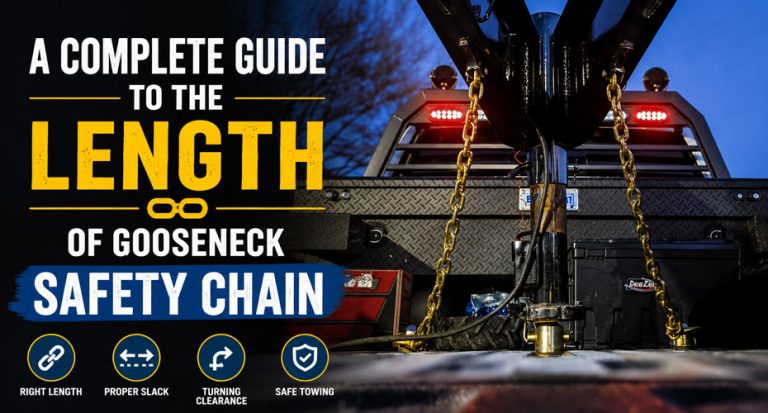
A Complete Guide To The Length Of Gooseneck Safety Chain
When choosing gooseneck safety chain, buyers often focus on chain diameter and grade. But chain length you should deserve more attention.
If too short, it may make connection difficult or restrict normal trailer movement. If too long, it will create excessive slack, drag on the road, or interfere with other components.
There is no single length that fits all gooseneck trailer. The correct length depends on the distance between the trailer’s attachment points, truck’s safety-chain anchors, movement and clearance required during towing. Common commercial product configurations include lengths such as 42, 44, 60, and 84 inches, but these should be treated as available product configurations—not universal requirements.
For U.S. applications, applicable regulations and the trailer manufacturer’s instructions should always be checked. For example, 49 CFR §393.70 requires that safety devices covered by that section have no more slack than necessary to permit proper turning, and that the safety device and its attachment means have sufficient ultimate strength for the towed vehicle weight.
Table of Contents
What Determines Gooseneck Safety Chain Length?
Right chain length is mainly determined by the physical geometry of the towing system, rather than the trailer’s weight alone.
Several factors should be considered.
Distance Between Attachment Points
First, measure the distance between trailer-side safety-chain attachment point and truck-bed anchor point.
The distance can vary depending on:
- Gooseneck coupler design
- Pin box configuration
- Truck bed hitch design
- Safety chain anchor location
- Trailer frame construction
This is why a chain that fits one gooseneck trailer may not be the right length for another.
1. Trailer Movement
A gooseneck trailer does not remain perfectly aligned with the tow vehicle while driving.
The trailer and truck articulate relative to each other when turning, so gooseneck trailer chain need enough usable length to accommodate normal movement without becoming excessively tight.
2.Ground Clearance
The chain should also remain clear of the road surface during normal towing.
A chain that is significantly longer than necessary can form a low-hanging loop. That increases the possibility of dragging, contacting obstacles, or experiencing unnecessary wear.
What Are Common Gooseneck Safety Chain Lengths?
There is no universal length for each gooseneck trailer, but have common commercial configurations.
For example, an 84inch chain may be appropriate for a particular gooseneck setup with attachment points that require additional reach. It could be unnecessarily long for another trailer with anchor points positioned much closer together.
Correct length comes from the trailer and hitch configuration, not simply from the chain size.
How to Measure the Correct Gooseneck Safety Chain Length
Before ordering a replacement chain, measuring the actual towing setup is usually more useful than guessing based on another trailer.
Step 1: Connect the Trailer Normally
Position the gooseneck trailer and tow vehicle as they would be during normal towing.
The truck and trailer should be on relatively level ground for the initial measurement.
Step 2: Locate Both Attachment Points
Identify:
- Trailer-side safety-chain attachment point
- Truck-bed safety-chain anchor point
Measure along the approximate path the chain will follow rather than measuring an unrelated straight-line distance.
Step 3: Consider Turning
The straight position is only one operating condition.
Think about what happens when the truck turns. The distance and angle between the connection points change as the trailer articulates.
The chain must have enough freedom to accommodate this movement.
Step 4: Check Ground Clearance
After estimating the required length, consider how much the chain will hang below the trailer and hitch.
A chain should not normally be allowed to drag on the road.
Step 5: Select the Appropriate Available Length
Select the nearest suitable standard length that provides the required movement without creating excessive slack.If you need customized chain assemblies, pls clarify chain length, chain diameter, grade, hook type, and finish.
How Much Slack Should a Gooseneck Safety Chain Have?
This is one of the most misunderstood aspects of safety-chain installation.
A safety chain should generally **not be pulled completely tight**.
At the same time, it should not hang excessively low.
The objective is:
1. Enough slack for normal turning and articulation, but no more slack than necessary.
This principle is also reflected in U.S. federal requirements applicable to certain towing configurations.
49 CFR §393.70 specifies that the safety device should have no more slack than necessary to permit the vehicles to turn properly.
2.Too Little Slack
A chain that is too short may:
- Become tight during a turn
- Restrict normal trailer movement
- Place additional loading on hooks and attachment points
- Make connection difficult
3.Too Much Slack
An excessively long chain may:
- Hang close to the road
- Drag during towing
- Experience accelerated wear
- Contact other trailer components
- Create unnecessary movement
Therefore, the goal isn’t to eliminate slack completely. It is to control the amount of slack.
Is a Longer Gooseneck Safety Chain Better?
No.
This is one of the most common misconceptions when selecting a replacement chain.
A longer chain provides more reach, but additional length does not automatically provide additional safety.
Consider these three situations:
- Too Short:
Connection may be difficult and normal turning may be restricted.
- Correct Length
The chain connects securely while allowing necessary movement.
- Too Long:
Excessive slack may cause the chain to hang or drag.
The best chain is therefore not the longest chain available. It is the chain that provides the required connection distance with appropriate movement and ground clearance.
Does Trailer Weight Affect Safety Chain Length?
This question often causes confusion because trailer weight and chain length are related to different aspects of chain selection.
Trailer Weight Mainly Affects Strength
Trailer weight should be considered when determining the required:
- Chain grade
- Chain diameter
- Working Load Limit
- Ultimate breaking strength
- Hook capacity
- Attachment strength
Trailer Geometry Mainly Affects Length
Chain length depends more directly on:
- Distance between attachment points
- Hitch configuration
- Truck-bed anchor position
- Turning angle
- Required slack
- Ground clearance
A useful way to remember this is:
Weight determines how strong the safety chain needs to be; trailer geometry determines how long it needs to be.
However, these specifications should not be considered independently. The final safety-chain assembly must be appropriate for the complete towing system.
FMCSA guidance for certain full-trailer applications states that the safety device and its attachment means must have an ultimate strength of at least the gross weight of the vehicle or vehicles being towed. FMCSA also notes that state requirements can be more stringent.
Does Chain Length Affect Chain Strength?
Chain length and chain strength are different specifications.
For example, changing a chain from 44 inches to 84 inches does not automatically change the chain’s grade or nominal diameter.
Strength is primarily associated with factors such as:
- Material
- Chain diameter
- Chain grade
- Manufacturing process
- Heat treatment
- Hook design
- Connection components
However, the complete assembly still needs to be considered.
A high-strength chain connected to an unsuitable hook or weak attachment point does not automatically create a high-strength safety-chain system.
For this reason, buyers should evaluate:
Chain + Hook + Attachment Point + Installation
rather than looking at chain length or diameter alone.
How to Install a Gooseneck Safety Chain Correctly
Once the correct chain has been selected, installation should be checked carefully.
Step 1: Inspect the Chain
Look for:
- Cracked links
- Excessive wear
- Severe corrosion
- Bent components
- Damaged hooks
Do not install a chain that is already compromised.
Step 2: Connect the Trailer Side
Attach the chain to the designated trailer attachment point according to the trailer manufacturer’s instructions.
Step 3: Connect the Truck Side
Attach the hook to the appropriate safety-chain anchor in the truck bed.
Make sure the hook is fully engaged.
Step 4: Check the Chain Position
Look for:
- Adequate slack
- Sufficient ground clearance
- No contact with moving parts
- No unnecessary twisting
Step 5: Check Turning Clearance
Before towing, consider the full range of normal turning movement.
The chain should not become excessively tight during normal articulation.
For regulated applications, the installation should also comply with the applicable federal, state, and local requirements. FMCSA identifies 49 CFR §§393.70 and 393.71 among the regulations governing certain coupling and towing operations.
How to Choose the Right Gooseneck Safety Chain
For trailer manufacturers, fleet operators, distributors, and replacement-parts buyers, the selection process can be simplified into seven questions:
1. What length do I actually need?
Measure the connection distance and account for movement.
2. What chain diameter is required?
Select the diameter based on the required capacity rather than appearance.
3. What chain grade should be used?
Grade 43 and Grade 70 are common transport-chain grades, but the appropriate grade depends on the application.
4. What is the required capacity?
Check WLL and, where applicable, ultimate breaking strength.
5. What hook is required?
Make sure the hook is compatible with the truck-bed anchor.
6. What attachment points are being used?
The trailer-side and vehicle-side attachment points are part of the complete safety system.
7. What regulations apply?
Requirements can vary according to the trailer, vehicle, operation, and jurisdiction. Do not assume that one federal provision applies to every gooseneck trailer.
FAQ
1. How long should a gooseneck safety chain be?
The correct length is determined by the distance between the trailer and truck attachment points, while allowing sufficient slack for normal turning and maintaining appropriate ground clearance.
2. Is 42 inches long enough for a gooseneck safety chain?
It may be suitable for some configurations, but not all. Measure the actual connection distance before selecting a 42-inch chain.
3.Is 44-inch gooseneck safety chain a standard length?
44 inches is a commonly available product configuration, but it should not be treated as a universal requirement for every gooseneck trailer.
4.Can I use an 84inch safety chain on a gooseneck trailer?
Yes, an 84-inch configuration can be suitable where the trailer design requires additional reach. However, if the chain is unnecessarily long, excessive slack may result.
5.Should a gooseneck safety chain be tight?
No.It needs enough slack to accommodate normal turning and articulation. At the same time, excessive slack should be avoided.
6.Does trailer weight determine safety-chain length?
Not directly. Trailer weight primarily affects the required strength and capacity, while the physical configuration of the trailer and hitch primarily determines length.
Final Checklist for Choosing Gooseneck Safety Chain Length
Before ordering or installing a gooseneck safety chain, check:
✓ Trailer GVWR
✓ Chain grade
✓ Chain diameter
✓ WLL and/or required breaking strength
✓ Trailer attachment-point location
✓ Truck-bed anchor location
✓ Required chain length
✓ Hook compatibility
✓ Turning clearance
✓ Ground clearance
✓ Appropriate slack
✓ Trailer manufacturer’s requirements
✓ Applicable federal and state regulations
Conclusion
The length of gooseneck safety chain is not universal, which depends on coupler, hitch, safety chain anchor, trailer frame construction etc. If you have any question about gooseneck safety chain, please feel free to contact Sail Rigging.