
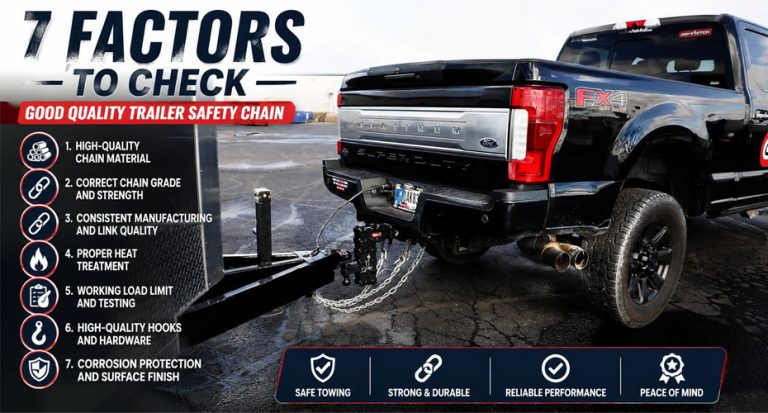
7 Factors to Check Good Quality Trailer Safety Chain
A reliable trailer safety chain needs the right material, grade, manufacturing process, load rating, hooks, and corrosion protection.
This matters because a safety chain is designed as a backup connection if the primary trailer coupling fails. For U.S. commercial applications, FMCSA requirements address the use and strength of safety devices intended to prevent a trailer from breaking loose.
So,what makes a good trailer safety chain?
Here are 7 factors buyers should check before purchasing.
Table of Contents
High-Quality Chain Material
The material is the foundation of chain performance.
A quality trailer safety chain should be manufactured from steel with consistent mechanical properties and controlled chemistry. Good raw material helps the chain achieve the required combination of strength, toughness, and durability.
For wholesale buyers, it is worth asking the supplier:
- What steel material is used?
- Is the material traceable?
- Is a material certificate available?
- Are mechanical properties verified?
Material consistency becomes especially important when chains are produced in large quantities. A professional manufacturer should be able to maintain consistent quality from batch to batch.
Correct Chain Grade and Strength
Chain grade is another major factor.
ASTM A413/A413M covers carbon steel chain and identifies Grade 30, Grade 43, and Grade 70 as different chain classes, with dimensional and mechanical testing requirements.
In general:
| Chain Grade | Common Description | Typical Application |
|---|---|---|
| G30 | Proof Coil | Light-duty applications |
| G43 | High Test | Trailer and general towing |
| G70 | Transport Chain | Higher-strength transport applications |
A higher grade isn’t automatically the right choice for every trailer. The chain should be selected according to the trailer’s weight, applicable requirements, and intended use.
Most importantly, do not judge chain quality simply by diameter. Two chains with similar dimensions can have different grades, mechanical properties, and load ratings.
Consistent Manufacturing and Link Quality
Look closely at the chain links.
A quality trailer safety chain should have consistent:
- Link diameter
- Inside length
- Inside width
- Link shape
- Weld or forming quality
Poorly formed links can create inconsistent loading and may indicate inadequate manufacturing control.
ASTM A413/A413M includes dimensional requirements as well as mechanical testing for applicable carbon steel chain grades.
For manufacturers, dimensional inspection is therefore not simply a cosmetic check. It is part of maintaining consistent product performance.
A good chain should also have smooth, properly formed links without obvious cracks, severe surface defects, or abnormal deformation.
Proper Heat Treatment
Heat treatment is one of the less visible but more important factors in chain quality.
Depending on the chain design and manufacturing process, heat treatment may involve processes such as normalizing, quenching, or tempering.
The objective is to achieve an appropriate balance between strength and toughness.
A chain that is too soft may not achieve the required strength. On the other hand, excessive hardness without adequate toughness can increase brittleness.
For this reason, professional manufacturers should control heat-treatment parameters and verify the resulting mechanical properties.
When evaluating a supplier, ask whether the factory has:
- Controlled heat-treatment equipment
- Hardness testing
- Process records
- Batch traceability
These details can tell you much more about chain quality than appearance alone.
Working Load Limit and Testing
Working Load Limit (WLL) is one of the most important specifications when purchasing a trailer safety chain.
WLL should not be confused with breaking strength.
Breaking strength represents the load at which a test specimen ultimately fails, while WLL is the rated maximum working load under specified conditions.
A quality chain should have a clearly defined rating supported by appropriate testing.
Typical quality-control procedures can include:
- Proof load testing
- Breaking-force testing
- Elongation testing
- Dimensional inspection
- Hardness testing
- Visual inspection
ASTM A413/A413M includes proof testing, breaking-force testing, and elongation testing for the covered carbon-steel chain grades. ([ASTM International][2])
For a complete safety-chain assembly, don’t look at the chain alone. The **hook, connecting link, attachment point, and other load-bearing components** also need to be appropriate for the intended application.
High-Quality Hooks and Connecting Hardware
A strong chain cannot compensate for a weak hook.
Trailer safety chains commonly use hardware such as:
- Clevis grab hooks
- Trailer S-hooks
- Connecting links
The hook needs to match the chain size and intended load.
It should also engage securely with the trailer and tow-vehicle attachment points.
When inspecting a hook, look for:
- Cracks
- Excessive wear
- Permanent deformation
- Bent throat
- Damaged latch
- Severe corrosion
The complete assembly should be treated as a system. A lower-rated component can limit the performance of the entire safety-chain assembly.
Some trailer safety-chain manufacturers also offer different grades and hook configurations, including G30, G43, and G70 chains with clevis slip hooks or trailer S-hooks.
Corrosion Protection and Surface Finish
Trailer safety chains spend much of their life outdoors.
Rain, humidity, road salt, mud, and chemicals can gradually attack the steel surface. Over time, severe corrosion can reduce the effective cross-section of a chain link and compromise its condition.
Common finishes include:
Zinc Plated
Zinc plating provides basic corrosion protection and is suitable for many general-purpose applications.
Hot-Dip Galvanized
Hot-dip galvanizing provides a thicker zinc coating and is often preferred where greater outdoor corrosion resistance is required.
The right finish depends on the operating environment. A trailer used regularly in wet or coastal conditions may require more corrosion protection than one used occasionally in a dry environment.
Trailer Safety Chain Quality Checklist
Before buying a trailer safety chain, use this simple checklist:
| Quality Factor | What to Check |
|---|---|
| Material | Steel specification and traceability |
| Chain Grade | G30, G43, G70, etc. |
| Manufacturing | Consistent link dimensions |
| Heat Treatment | Controlled process and hardness |
| WLL | Clearly defined load rating |
| Testing | Proof, breaking-force and dimensional testing |
| Hooks | Correct size, strength and condition |
| Surface Finish | Suitable corrosion protection |
This approach is more reliable than choosing a chain based only on price.
Signs of a Low-Quality Trailer Safety Chain
Some warning signs are easy to spot.
Be cautious if you find:
- Unknown chain grade
- Missing load markings
- Inconsistent link dimensions
- Poorly formed hooks
- Excessive surface defects
- Heavy rust on a new product
- No testing information
- No material documentation
- No product traceability
For commercial buyers, the absence of technical documentation can be just as concerning as a visible manufacturing defect.
How to Choose a Reliable Trailer Safety Chain Manufacturer
If you’re buying trailer safety chains in bulk, the supplier is just as important as the product specification.
Before placing an order, consider asking:
1. What material do you use?
2. Which chain grades can you manufacture?
3. What heat-treatment process do you use?
4. What testing equipment is available?
5. Can you provide inspection reports?
6. Is batch traceability available?
7. What hook configurations can you supply?
8. Can you customize chain length and assembly?
A manufacturer with controlled forging or forming, heat treatment, testing, inspection, and traceability capabilities can provide much more consistent quality than a supplier that simply purchases finished chain and resells it.
Conclusion
A quality trailer safety chain is ultimately part of a complete towing safety system. Selecting the right product and inspecting it regularly helps ensure that the chain is ready to perform when the primary coupling system does not. If you have any question about trailer safety chain, you could contact us directly.