



How Long Should Boat Trailer Safety Chains Be?
Boat trailer safety chains should be short enough to stay clear of the road, but long enough to allow the tow vehicle and trailer to turn without pulling the chains tight. There is no universal chain length that fits every boat trailer.
Quick answer: How much slack is enough?
Use only the slack necessary for normal turning and articulation, without dragging or contacting the ground. Connect the chains to approved attachment points and follow your trailer and tow-vehicle manufacturer’s instructions.
Why Boat Trailer Safety Chain Length Matters
Safety chains are a secondary connection between the trailer and the tow vehicle. If the primary coupling disconnects, properly installed chains are intended to help keep the trailer connected long enough for the driver to bring the combination under control. They do not replace a properly secured coupler or other required towing equipment.
Too short: restricted turning
If the chains become taut during a turn, they can place unwanted loads on their attachment points or interfere with the trailer’s movement. An arrangement that seems fine while parked straight may not work during a tight maneuver.
Too long: dragging and excessive movement
Chains that hang near the pavement can scrape the road, wearing chain links or damaging hooks. Excess slack can also allow more trailer movement following a coupling failure.
The goal is not to maximize slack. It is to find the shortest practical arrangement that still permits the required turning and articulation.
How to Check the Correct Safety Chain Length
A product listing may offer a chain length of 24–40 inches, but that range is not a universal installation recommendation. The correct finished assembly length depends on the trailer tongue, hitch geometry, connection points, and vehicle combination.
Do not estimate the correct length from the distance between the hitch ball and coupler alone. What matters is the actual path between the attachment points and the movement needed for turning.
If your existing chains are unsuitable, use a correctly rated replacement assembly or a manufacturer-approved adjustment method. Do not weld, cut, or otherwise modify rated chain components without authorization.
Should Boat Trailer Safety Chains Cross Under the Tongue?
For many conventional bumper-pull boat trailers, the recommended arrangement is to cross two safety chains beneath the coupler in an X pattern. This can help form a cradle beneath the tongue if the primary coupling separates.
However, a crossed arrangement still needs adequate turning clearance, secure attachment points, and proper ground clearance. Follow the trailer manufacturer’s instructions and applicable local requirements. An X pattern by itself does not guarantee a safe installation.
For general trailering guidance, the BoatUS Foundation recommends crisscrossed safety chains with enough slack for turning but not enough to drag.
Does Trailer Weight Determine Chain Length or Chain Strength?
Trailer weight is mainly a capacity-selection issue, not a direct formula for chain length. For a boat trailer, confirm the trailer’s loaded weight or applicable GVWR, the required safety-chain assembly rating, and the relevant state or other towing rules.
Chain diameter alone does not tell you the strength of an assembly. Chain grade, hooks, attachment hardware, and the way the assembly is rated all matter. A higher minimum breaking force is not the same as a higher published Working Load Limit (WLL), and neither number should be treated as the trailer’s allowable towing weight without checking the complete system.
For commercial motor vehicles, additional federal rules may apply depending on the towing configuration. For recreational boat trailers, check the state laws and manufacturer instructions that apply to your setup.
Sail Rigging Trailer Safety Chain Options: G30, G43 and G70
Sail Rigging offers trailer safety chain assemblies with S hooks or clevis slip hooks with latches. Available chain sizes, hook configurations, and lengths vary by product. Compare the three options below, then check the linked product pages or contact us for detailed specifications and the rated capacity of the finished assembly.
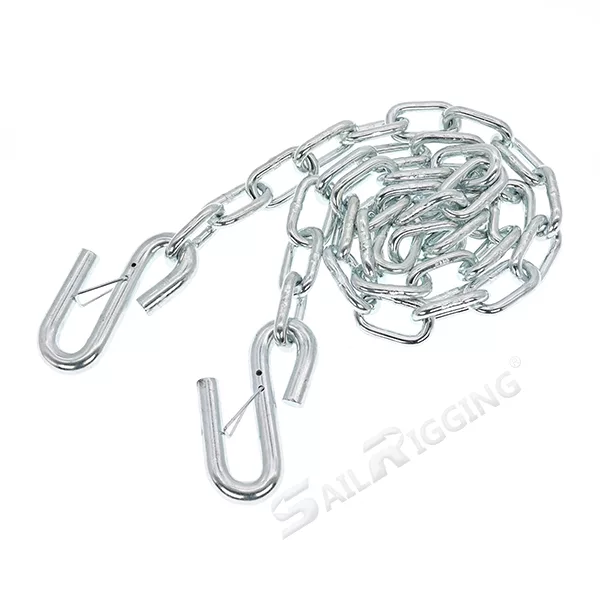
GRADE 30
G30 Safety Chain with S Hooks
Available with 3/16″–5/16″ G30 chain and S hooks in single- or double-hook configurations. Min. Breaking Force: 2,000–7,600 lbs (8.9–33.8 kN). Confirm the rated capacity of the finished assembly.
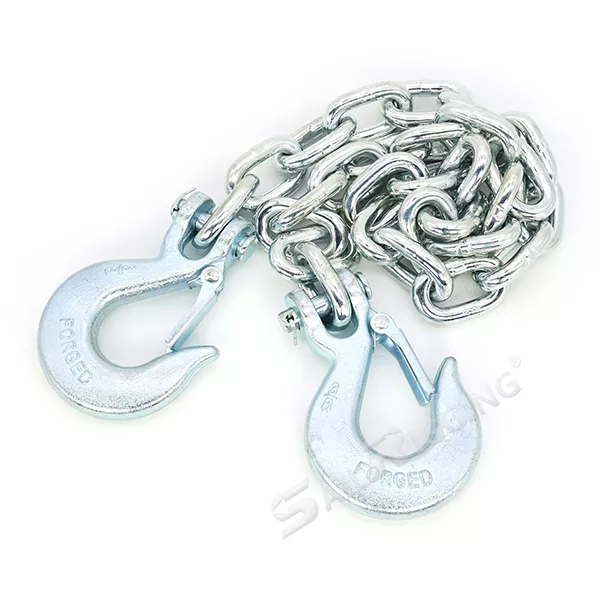
GRADE 43
G43 Chain with Clevis Slip Hook
Available in 5/16″ and 3/8″ G43 chain with a clevis slip hook and latch. Min. Breaking Force: 11,700–16,200 lbs (52–72 kN). Confirm the rated capacity of the finished assembly.
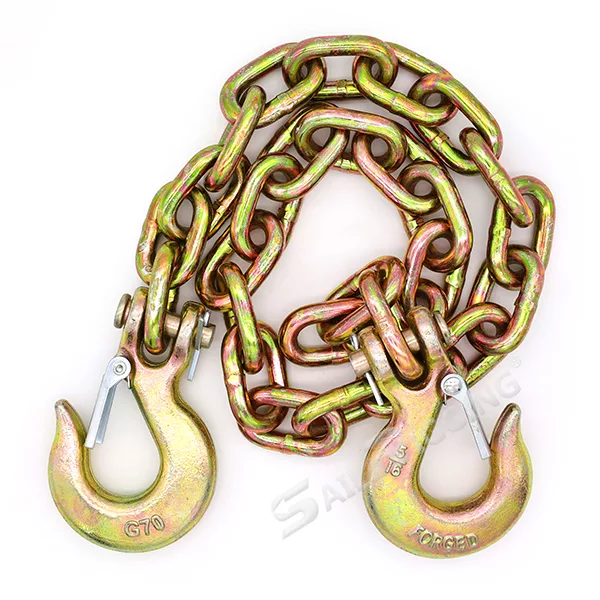
GRADE 70
G70 Trailer Safety Chain
Available in 1/4″–1/2″ G70 chain with a clevis slip hook and latch. Min. Breaking Force: 12,600–45,200 lbs (56–200.8 kN). Confirm the rated capacity and required length.
What about galvanized finishes and custom lengths?
Boat trailers encounter water, humidity, and road contaminants, so corrosion protection matters. A galvanized finish can help resist corrosion, but it does not eliminate the need for inspection—especially after saltwater exposure.
Where standard assemblies do not fit the intended vehicle and trailer connection points, ask Sail Rigging about available configurations and custom length options. Any custom assembly must have its components, attachment method, and capacity verified for the intended application.
Frequently Asked Questions
1. Is there a standard safety-chain length for every boat trailer?
No. The appropriate length depends on the tow vehicle, trailer tongue, attachment points and turning requirements. A catalog length range is not a substitute for checking the installed assembly.
2. Should the safety chains touch the ground?
No. They need sufficient slack to turn without binding, while remaining clear of the pavement during towing and normal articulation.
3. Do boat trailer safety chains need to be crossed?
Two chains are commonly crossed under the tongue on conventional bumper-pull trailers to provide a cradle in the event of disconnection. Follow the specific trailer instructions and applicable requirements.
4. Can I shorten an existing safety chain?
Do not cut, weld or alter a rated assembly unless its manufacturer provides an approved procedure. Choose a correctly rated replacement configuration instead.
5. Is minimum breaking force the same as WLL?
No. Minimum breaking force is a strength-test specification; WLL is a rated working capacity. For trailer safety chains, request the finished assembly’s applicable rating and verify it against the trailer requirements.
Need a Trailer Safety Chain for Your Product Line?
Sail Rigging supplies G30, G43 and G70 chain assemblies for trailer and cargo-control applications. Share your chain grade, size, required assembly length, hook configuration and rating requirements so our team can review the suitable options.