


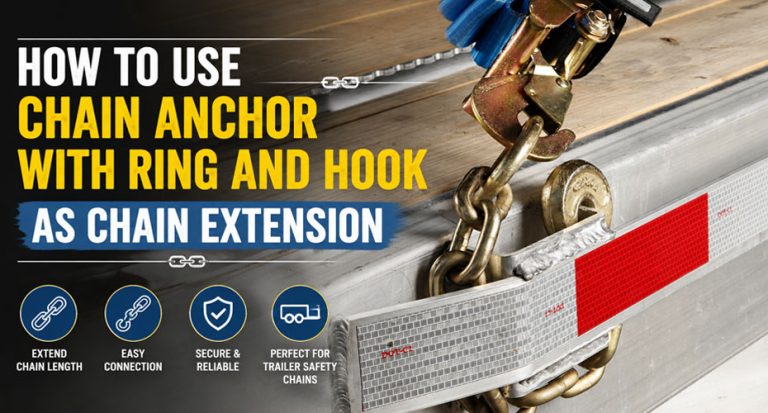
How To Use Chain Anchor With Ring and Hook As Chain Extension
When a trailer safety chain is in good condition but does not provide enough reach for a particular towing setup, replacing the entire chain may not always be the most practical solution. A properly designed Chain Anchor With Ring and Hook can serve as a chain extension, providing additional reach between an existing chain and a rated attachment point.
But adding length is only part of the job. The extension must also be compatible with the existing chain, hook, attachment point, and required load capacity.
So, how do you use a Chain Anchor With Ring and Hook as a chain extension?
The basic process is to connect the extension to the existing chain using the appropriate hook or connection point, attach the ring to the designated rated connection point, and then verify that the complete assembly has sufficient strength, proper clearance, and appropriate slack for the application.
What Is a Chain Anchor With Ring and Hook?
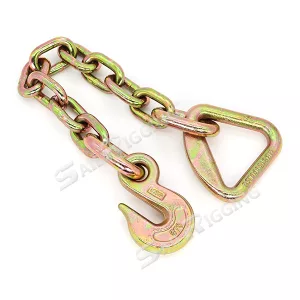
A Chain Anchor With Ring and Hook is a chain assembly or connection configuration that combines a chain, a ring, and a hook to create an additional connection point.
The three components have different functions.
The Chain
The chain provides the additional reach required for the application. Its diameter and grade affect the strength of the assembly.
The Hook
The hook provides a quick connection to a compatible chain or attachment point. The hook must be correctly sized and rated for the application.
The Ring
The ring provides a connection point at the opposite end of the assembly. Depending on the product design, it can connect to a rated trailer attachment point or another compatible component.
When used as an extension, the complete assembly effectively adds usable length to an existing chain system.
However, it should not be assumed that every ring-and-hook chain assembly is suitable for trailer safety-chain use. **The product must be specifically designed, rated, and installed for the intended application.*
For regulated commercial towing, safety-chain requirements can apply to the complete towing system. For example, FMCSA regulations address safety chains or cables for full trailers, and improper safety-chain attachment is specifically identified as a violation.
When Do You Need a Chain Extension?
The most common reason for using a chain extension is simple: the existing chain does not provide enough reach.
This can happen when:
- The tow vehicle has different connection points
- A trailer is used with different hitch configurations
- The original chain was selected too short
- The trailer design requires additional connection distance
- A replacement chain is inconvenient or unnecessary
For example, imagine an existing trailer safety chain that is in good condition. The chain has the appropriate strength, but its connection point is several inches short of the intended attachment point.
Replacing the complete chain is one option.
A properly rated chain extension may provide another.
The important distinction is that an extension should solve a length problem, not compensate for an incorrectly rated or damaged chain.
How Does a Chain Anchor With Ring and Hook Work as a Chain Extension?
The concept is straightforward.
A typical configuration can be understood as:
Existing Chain → Hook → Extension Chain → Ring → Rated Attachment Point
The extension provides additional physical reach while maintaining a mechanical connection between the two sides.
The objective is not simply to make the chain as long as possible. The extension should provide enough additional length to allow the intended connection without creating excessive slack.
This is especially important on trailers because the safety-chain arrangement needs to accommodate normal movement while avoiding unnecessary dragging or interference.
For U.S. commercial applications, federal rules and guidance address safety-chain strength and attachment. FMCSA guidance, for example, states that when two safety chains are used in the situation covered by §393.70(d), their combined ultimate breaking strength can meet the federal requirement when it equals the gross weight of the vehicle being towed; individual state requirements may be more stringent.
How to Install a Chain Anchor With Ring and Hook as a Chain Extension
Step 1: Inspect the Existing Chain
Before adding an extension, inspect the original chain.
Look for:
- Cracked or deformed links
- Excessive wear
- Severe corrosion
- Bent hooks
- Damaged attachment points
An extension should not be used to “repair” a chain that is already unsafe.
Step 2: Check Chain Compatibility
Next, compare the existing chain with the extension.
Check:
- Chain diameter
- Chain grade
- Working Load Limit
- Hook size
- Ring size
- Application requirements
The fact that two components physically connect does not automatically mean they are suitable as a complete assembly.
Step 3: Connect the Hook
Connect the extension hook to the appropriate existing chain or rated connection point.
Make sure the hook is fully engaged and positioned correctly.
Avoid forcing a hook into a connection that is too small or using an attachment method that was not intended by the manufacturer.
Step 4: Connect the Ring
Attach the ring end to the designated rated connection point.
Depending on the specific design, this may be a trailer attachment point or another approved connection component.
The ring should sit naturally in the direction of loading rather than being forced into an awkward position.
Step 5: Check Chain Slack
After installation, check the chain with the trailer connected to the tow vehicle.
The extension should provide enough slack for normal movement and turning.
At the same time, avoid excessive slack that could cause the chain to hang too low or drag on the road.
For applicable commercial towing equipment, federal requirements address safety-chain installation and strength, so the applicable regulation should always be checked for the specific vehicle and operation.
Step 6: Inspect the Complete Assembly
Finally, inspect the entire load path:
Chain → Hook → Extension → Ring → Attachment Point**
The weakest component can limit the performance of the complete system.
That means checking the chain alone is not enough. The hook, ring, attachment hardware, and trailer mounting point also need to be suitable for the intended load.
How to Choose the Right Chain Extension
Choosing the right extension requires more than selecting a convenient length.
1. Chain Diameter
The extension should be compatible with the existing chain and application.
Common chain sizes may include:
| Delta Ring | Coupling Link | Chain | Grab Hook | Length | Weight | Working Load Limit | Min. Breaking Force | |
| A | B | C | D | |||||
| 2″ | 3/8″ | 5/16″ | 11 LINKS | 5/16″ | 18″ | 1.10 kg | 3,330 lbs | 10,000 lbs |
| 2″ | 3/8″ | 5/16″ | 11 LINKS | 3/8″ | 18″ | 1.25 kg | 3,330 lbs | 10,000 lbs |
| 2″ | 5/16″ | 1/4‘’ | 14 LINKS | 5/16″ | 18″ | 0.80 kg | 3,330 lbs | 10,000 lbs |
| 3″ | 7/16″ | 5/16″ | 10 LINKS | 5/16″ | 18″ | 1.35 kg | 5,400 lbs | 16,200 lbs |
| 3″ | 7/16″ | 3/8″ | 9 LINKS | 3/8″ | 18″ | 1.70 kg | 5,400 lbs | 16,200 lbs |
| 3″ | 7/16″ | 3/8″ | 5 LINKS | 3/8″ | 12″ | 1.45 kg | 5,400 lbs | 16,200 lbs |
| 4″ | 7/16″ | 3/8″ | 9 LINKS | 3/8″ | 18″ | 1.95 kg | 6,660 lbs | 20,000 lbs |
| PEAR LINK | 3/8″ | 5/16″ | 10 LINKS | 5/16″ | 18″ | 1.30 kg | 3,660 lbs | 11,000 lbs |
| PEAR LINK | 7/16″ | 3/8″ | 9 LINKS | 3/8″ | 18″ | 1.60 kg | 5,400 lbs | 16,200 lbs |
The appropriate size depends on the required capacity and product specification.
2. Chain Grade
Chain grade affects strength. For transport applications, Grade 43 and Grade 70 are commonly encountered, but the correct grade depends on the intended use and applicable requirements.
3. WLL or Required Strength
Do not select an extension simply because its chain “looks strong.”
Check the manufacturer’s rated capacity and the requirements for the application.
4. Extension Length
Choose enough length to solve the connection problem without creating unnecessary slack.
Longer is not automatically better.
5. Hook and Ring Capacity
The hook and ring must be appropriate for the chain and intended application.
A high-strength chain paired with an unsuitable connection component does not create a high-capacity assembly.
Chain Extension vs. Replacing the Entire Safety Chain
Which option is better?
It depends on the condition of the original chain and the application.
| Option | Main Advantage | Suitable Situation |
|---|---|---|
| Chain Extension | Adds reach without replacing the complete chain | Existing chain is suitable but too short |
| Longer Safety Chain | One-piece configuration | Permanent replacement |
| Custom Chain Assembly | Designed around a specific setup | OEM or specialized applications |
If the existing chain is correctly rated and in good condition, an appropriate extension can be a practical option.
If the existing chain is damaged, severely worn, incorrectly rated, or otherwise unsuitable, adding an extension does not solve the underlying problem.
Common Chain Extension Mistakes
1.Using an Extension That Is Too Long
Excessive length can create unnecessary slack and may increase the risk of dragging.
2.Ignoring Chain Grade
Two chains with similar dimensions may not have the same rated capacity.
3.Ignoring WLL
Always consider the rated capacity of the complete assembly and the requirements of the application.
4.Using an Undersized Hook or Ring
The connection components should be compatible with the chain and intended load.
5.Connecting the Hook Incorrectly
A hook that is not fully engaged or is positioned improperly can create an unsafe connection.
6.Using an Extension on a Damaged Chain
A chain extension is not a substitute for replacing a damaged safety chain.
Where Are Chain Anchors With Ring and Hook Used?
Depending on their design and rating, these assemblies can be used in applications such as:
- Trailer chain extensions
- Utility trailers
- Equipment trailers
- Cargo trailers
- Towing equipment
- Chain connection systems
- Transport applications
The exact application should always follow the manufacturer’s specifications and applicable regulations.
For commercial full-trailer operations in the U.S., FMCSA specifically recognizes improper or missing safety chains/cables as a compliance issue, reinforcing the importance of using an appropriate safety-device configuration.
Chain Extension Inspection Checklist
Before using a Chain Anchor With Ring and Hook, check:
- Chain links are free from cracks and severe deformation
- Hook is fully engaged
- Ring has no visible damage
- Chain grade is appropriate
- Rated capacity is sufficient
- Extension length is suitable
- Chain does not drag on the ground
- Adequate slack is available for normal movement
- Trailer attachment points are secure
FAQ
1. Can a Chain Anchor With Ring and Hook be used as a trailer chain extension?
Yes, when the specific assembly is designed and rated for that application.** It should be selected according to chain compatibility, rated capacity, connection design, and applicable requirements.
2.How long should a trailer chain extension be?
There is no universal length. The extension should provide the additional reach required while maintaining appropriate turning clearance and ground clearance.
3.Does a chain extension need to match the original chain?
The extension should be compatible with the existing assembly and appropriately rated for the intended application. Check diameter, grade, capacity, hook, and connection requirements.
4.Can I use a chain extension on a damaged safety chain?
No.An extension should not be used to compensate for cracked, severely worn, deformed, or incorrectly rated components.
Conclusion
Chain Anchor With Ring and Hook can be a practical way to add reach to an existing chain assembly when the original chain is otherwise suitable for the application. If you have any question about chain anchor with ring and hook, please feel free to contact Sail Rigging.