


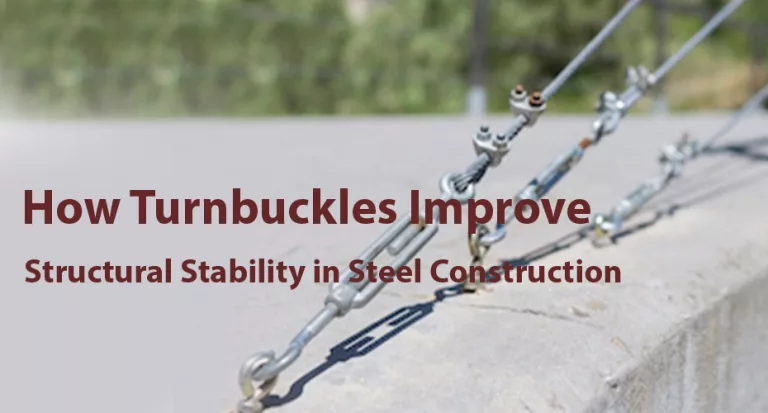
How Turnbuckles Improve Structural Stability in Steel Construction
Modern steel structure buildings rely heavily on stable tensioning systems. From the roofs of sports venues and suspension walkways to the support tension rods of curtain walls and building cable net systems, keeping the steel wire ropes in the proper tension state is crucial for ensuring structural safety. One of the key components for achieving this goal is the turnbuckle.
Although turnbuckles seem to be simple rigging accessories on the surface, they plays a crucial role in load distribution, structural calibration and long-term structural stability in steel structure buildings. With the increasing popularity of large-span steel structures in commercial buildings, airports and public infrastructure projects, the global demand for a reliable turnbuckle is also continuously growing.
According to the industry report of the global structural steel market, turnbuckles have shown a strong growth momentum, especially in transportation hubs, sports venues, and renewable energy projects recently. This trend has greatly promoted the application of heavy-duty turnbuckles in modern construction.
Table of Contents
What Is A Turnbuckle? How does it work in steel structures?
A turnbuckle is a mechanical tensioning device to adjust the length and tension of steel wire ropes, cables, tie rods or chain assemblies. It typically consists of body and end fittings with left-hand and right-hand threads respectively.
By rotating the body, users can adjust the turnbuckle or slack of the connection system without disassembling the entire component. This simple mechanical principle enables precise fine-tuning of wire rope tension during construction, installation, and later maintenance.
In steel structure buildings, common types of turnbuckles include:
* Eye & Eye turnbuckle
* Jaw & Jaw turnbuckle
* Hook & Hook turnbuckle
Among them, the jaw jaw turnbuckle is widely used in the structural cable net support system because it can provide a stable pin connection and help optimize the centering of load transmission.
Turnbuckles are often installed at the following structural locations:
- Steel structure support system
- Roof support cable net
- Building tension structure system
- Suspension hoisting system
- Temporary stability support system during construction
If turnbuckles not properly installed, the steel structure may cause displacement, vibration, and uneven load distribution.
Why Are Turnbuckles crucial to the stability of structures?
The tension of the steel wire rope is directly related to the overall strength and balance state of the steel structure. Cables in an appropriate tension state help achieve uniform load distribution and can minimize the deformation of the structure under external forces such as wind, vibration, and dynamic loads. If the tension of the steel wire rope is too low, it may cause various problems:
- Structural sway
- Cable sagging
- Loose connections
- Fatigue cracking
- Aggravated stress concentration
Even a slight tension imbalance in large-span structures such as airports and sports venues can affect the overall performance of the structure.
For instance, in the cable-supported roof system, turnbuckles are typically used to fine-tune the tension of the cables after installation. Engineers often need to make multiple rounds of adjustments to ensure that all cables maintain consistent load-bearing performance.
Research in structural engineering indicates that cable systems with properly adjusted tension can significantly enhance their ability to resist wind-induced displacement and vibration. This is particularly important for regions frequently hit by hurricanes, subject to heavy snow loads, or located in seismically active zones.
Choosing the appropriate wire rope turnbuckles not only enhances safety but also prolongs the overall service life of the entire steel structure.
Common Applications of Flower Basket Bolts in Steel Structure Construction
Nowadays, flower basket bolts have been widely applied in various steel structure construction projects.
- Architectural Cable-Supported Systems
In modern architectural design, exposed cable systems are often incorporated as part of the aesthetic design. Turnbuckles not only enable precise control of the cable tension but also maintain the simplicity and smoothness of the building’s lines.
- Sports Venues and Exhibition Centers
Large-scale roof systems rely on stable tension structures to support wide spans, while avoiding excessive self-weight due to excessive steel usage. Heavy-duty turnbuckles play a crucial role in such applications, helping to ensure the neat arrangement of cables and the overall balance of the structure.
- Bridge Construction
Suspension pedestrian bridges and various types of suspension structures all rely on precisely adjusted wire rope tensions to ensure the overall stability of the structure and the balance of load distribution.
- Curtain Wall System
In glass curtain wall structures, stainless steel wire rope turnbuckle are often used to support the facade panels, while allowing for slight displacement of the structure within a certain range.
- Temporary construction support
During the hoisting and installation stage of steel structures, turnbuckles are often used in temporary support systems to provide temporary fixation and stability support for columns and frame structures before the final welding or bolt connection procedures are completed.
As architectural design concepts continue to evolve towards lightweight and open structures, the role of turnbuckles in the field of steel structure construction is becoming increasingly important.
Key Factors Affecting the Performance and Safety of Turnbuckles
Not all turnbuckles are suitable for structural engineering applications. The intrinsic quality is directly related to safety and long-term reliability of the structure.
- Material Selection
Most structural turnbuckles are made of the following materials:
- carbon steel
- alloy steel
- stainless steel
Carbon steel turnbuckles are high strength and cost-effectiveness; while stainless steel turnbuckles are excellent corrosion resistance, suitable for outdoor and marine environments.
- Hot-dip galvanized turnbuckles
For outdoor steel structures, hot-dip galvanized turnbuckles are widely used because they can provide long-term anti-corrosion protection.
The thickness of galvanized coating is crucial to the service life of the product, especially in coastal or humid environments.
- Thread Accuracy
Thread quality is one of the most crucial elements in the manufacturing process. Insufficient thread processing accuracy may lead to uneven force distribution, thread slippage, or even premature failure.
Professional manufacturers usually conduct the following tests
- Thread gauge inspection
- Proof load test
- Ultimate tensile strength test (destructive test)
- Compliance Standards
Many construction projects require that the turnbuckles must meet the following standards:
- ASTM F1145
- ASME B30.26
- Federal Specification FF-T-791
These standards help ensure the consistency, mechanical strength and safe working load performance of the products.
Best Practices for the Installation and Maintenance of Turnbuckles
Proper installation is crucial for maximizing the stability of the structure.
During the installation process:
- Avoid applying lateral loads.
- Ensure accurate alignment of components.
- Do not exceed the specified working load limit.
- Use rigging accessories that match the wire rope.
After installation is completed, regular inspections must be carried out to ensure the safe operation of the equipment.
The inspection items should include:
- Thread wear condition
- Corrosion condition
- Whether the body is deformed
- Whether there are cracks
- Whether the pin is damaged
- Whether the connection part is loose
In heavy steel structure construction projects, it is usually necessary to formulate regular inspection plans and implement them as part of the safety management procedures.
Conclusion
Turnbuckles are crucial components for maintaining the tension of steel cables, enhancing structural balance, and ensuring long-term safety.
From architectural cable net systems, sports stadium roofs, to bridge projects and curtain wall structures, choosing the right turnbuckles can help engineers build more robust, safer and more stable steel structures.
As the demand for lightweight design and large-span structures in construction projects continues to grow, the importance of reliable cable bolts systems in the global steel structure construction industry will also continue to increase. If you have any question about turnbuckles, feel free to contact Sail Rigging.