


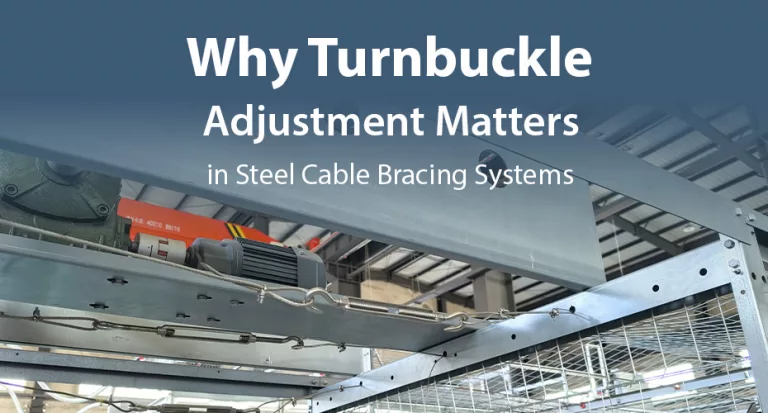
Why Turnbuckles Matter in Steel Cable Bracing Systems?
Steel cable support systems are widely used in modern construction projects, to enhance structural stability and efficiently distribute loads. The key of steel cable bracking systems is the turnbuckle. It is a simple but crucial tension adjustment component. Choosing right turnbuckles will reduce structural displacement, extend the lifetime of cable support system.
As modern architectural design moves towards lighter and larger-span structures, precise tension control has become more crucial than ever. Industry reports indicate that the number of steel structures worldwide that use tension-supported systems is continuously increasing, particularly in transportation infrastructure, commercial buildings, and renewable energy projects. This trend has further boosted the demand for high-strength wire rope turnbuckle systems, which must be capable of maintaining stable tension over long periods of operation.
Table of Contents
Understanding Turnbuckles in Steel Cable Support
The cable support system uses steel wire ropes or cables to stabilize structures and resist external forces such as wind, vibration and dynamic loads. Such systems are commonly found in the following application scenarios:
- Steel structure buildings
- Building curtain walls and facades
- Roof support systems
- Bridge engineering
- Communication towers
The main responsibility of a turnbuckle is to adjust the length of the steel cable and ensure that the steel wire rope remains at an appropriate tension level.
By rotating the main body of turnbuckles, construction workers can adjust the tension or slack of the steel cable system without disassembling any connecting parts. This feature enables precise control of tension during both installation and subsequent maintenance.
In steel structure construction, even a slight tension difference between steel cables can affect the overall balance of the structure. Appropriate adjust turnbuckles helps ensure that the load is evenly distributed throughout the support system.
Jaw and Jaw type turnbuckles is widely used in structural engineering because it can provide a stable pin connection and minimize the risk of accidental disengagement.
If wrong used, the steel cable support system will not reduce its working efficiency, even cause unnecessary displacement or sway of the structure.
How Proper Turnbuckles Adjustment Enhances Structural Performance
Proper usage of turnbuckles can directly enhance the overall performance of the structure through multiple channels.
Maintaining the uniformity of the tension in the steel wire rope
The balanced distribution of tension can ensure that the steel cable support system achieves uniform load sharing. If the tension distribution of the steel cables is uneven, it may lead to stress concentration in certain local areas, and over time, increase the risk of fatigue failure of the structure.
Reduce structural displacement
In high-rise buildings and long-span structures, properly tensioned cables help to reduce:
* Structural sway
* Vibration
* Deflection (deformation)
* Wind-induced displacement
This is particularly important for bridges, stadium roofs and open building structures exposed to strong wind loads.
Engineering research indicates that a well-maintained tensioning system can significantly enhance structural stiffness and reduce dynamic displacement under strong wind conditions.
Improving seismic performance
In areas prone to earthquakes, cable-supported systems help absorb and redistribute forces during ground movements. By properly adjusting the turnbuckles (wire rope tension), it can be ensured that the system responds as designed under the action of earthquakes or sudden impact loads.
Prevent Cable Sagging
Loose cables will reduce the effectiveness of the entire support system. The turnbuckle enables installers to maintain the appropriate tension of the steel wire rope during long-term operation, thus preventing the cables from sagging excessively.
In many large-scale steel structure construction projects, installers usually perform multiple tension adjustments during the construction process to achieve the best structural centering effect.
Common Problems Caused by Wrong turnbuckles
Improper adjustment of turnbuckles may cause serious structural and safety problems.
Problems Caused by Insufficient Tension
If the cable tension is too low, the structure may encounter the following problems:
- Cable sagging
- Excessive displacement
- Reduced support efficiency
- Loose connection parts
- Increased vibration
With the passage of time, repeated displacement movements may cause fatigue damage to the cables and connecting hardware.
Problems Caused by Excessive Tension
Excessive tension is equally dangerous. Overly high tension in the steel wire rope may lead to:
- Cable overload
- Damaged threads of turnbuckles
- Premature wear
- Structural deformation
- Fatigue cracking
In severe cases, excessive tension may even exceed the rated working load limit of turnbuckles assembly.
Lateral force risk
The turnbuckle is mainly designed to withstand axial loads in a straight line. Lateral forces will cause uneven stress on the bolt body and the threaded end, thereby increasing the risk of bolt bending or failure.
This is also one of the most common installation errors found during on-site inspections.
Key Elements for Precise Adjustment of turnbuckles
Several factors can affect the accuracy and safety of the adjustment of the turnbuckle.
Correct Selection of Specifications for turnbuckles
The turnbuckles must match the required load-bearing capacity and the diameter of the steel cable. Turnbuckles that are too small in specification may fail when subjected to heavy loads; while those that are too large may result in a decrease in the accuracy of tension adjustment.
Thread Accuracy
The quality of the thread plays a crucial role in the adjustment performance. High-quality threads can bring the following advantages:
* Smooth adjustment operation
* Better load distribution
* Reduced wear
* Enhanced safety
Professional manufacturers usually make use of thread gauges and proof load testing to ensure the quality of their products.
Materials and Corrosion Resistance
Steel structures used outdoors typically require a durable surface protective layer. Common protective solutions include:
* Hot-dip galvanized turnbuckles
* Stainless steel turnbuckles
Hot-dip galvanizing surface treatment is widely used in bridges and various construction projects because it can provide long-term anti-corrosion protection in outdoor environments.
Tension Measuring Tool
In modern construction projects, the use of tension monitoring devices to ensure the accuracy of steel cable adjustments has become increasingly widespread.
These tools can assist construction parties in maintaining the consistency of wire rope tension in large-scale structural systems.
Best Practices for turnbuckles Inspection and Maintenance
Regular inspections are crucial for maintaining the safety and stability of the steel cable support system.
Key inspection items is as below:
- Thread wear condition
- Signs of corrosion
- Crack situation
- Whether the body is deformed
- The state of the pin
- Alignment of the connection part
In environments with strong corrosiveness, it is also necessary to check whether there is surface damage or zinc layer loss in the galvanized coating.
The maintenance cycle should be adjusted according to the specific environmental conditions and load cycles of use. For structures exposed to marine environments, severe vibrations, or frequent climate changes, more frequent inspections are usually required.
During maintenance, lubricating the threads of the turnbuckles helps reduce wear and improve adjustment efficiency.
Nowadays, many industrial projects have incorporated regular inspection plans into their long-term structural safety management schemes.
Conclusion
Correctly adjusting the turnbuckles is crucial for maintaining the performance and safety of the steel cable support system.
From reducing structural displacement and optimizing load distribution to preventing cable sagging and fatigue damage, precise control of the tension in steel wire ropes plays a crucial role in modern steel structure buildings.
As construction and infrastructure projects continue to move towards large-span and lightweight structural designs, the importance of reliable wire rope turnbuckle systems will become increasingly prominent. For contractors, engineers and rigging professionals, choosing high quality turnbuckles and maintaining proper tension adjustment is one of the most effective ways to enhance long term structural stability and safety. If you have any question about turnbuckles, please feel free to contact Sail Rigging.