
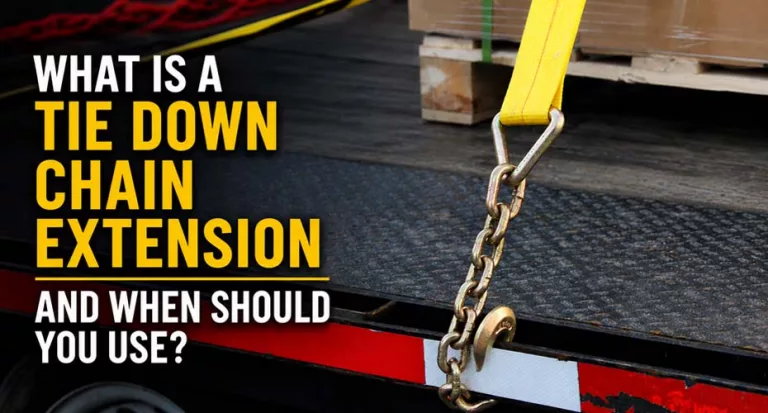
What Is A Tie Down Chain Extension and When Should You Use One?
In transportation, tie down extension is widely used for cargo securing system especially standard tie down is not enought. When transporting passenger vehicles, construction machinery, or agricultural equipment, tie-down chain extenders can help you improve safety, simplify loading, and enhance the flexibility of your transport solution.
Table of Contents
What is a tie-down extension?
A tie-down extension is a shorter transport chain designed to extend the connection distance between the trailer anchor point and the standard tie-down chain. It provides additional flexibility when the existing chain cannot easily reach the desired attachment point, without requiring replacement of the entire chain assembly.
The most common configurations in the North American transportation industry include:
- G43 high test chain or G70 transport chain
- One end connected to delta ring
- The other end connects to a grab hook
This combination will make existing cargo securing system more durable and adjustable.
Unlike complete ratchet tie-down kits, chain extenders are designed to complement your existing equipment, allowing you to secure different types of cargo more easily without having to carry multiple chains.
Why is delta ring important?
The delta ring is a connecting component, could help distribute stress while providing a reliable connection point for the trailer anchoring system.
The delta ring has the following advantages:
- Securely connects to trailer D-rings and anchor points
- Improve load distribution during transportation
- Helps maintain a better bundling angle
- Reduces stress concentration compared to certain direct chain connections
Due to its high strength and wide range of applications, triangular rings are commonly found on flatbed trailers, equipment trailers, roll-on/roll-off trucks, and vehicle transport trailers.
For operators frequently transporting various types of cargo, the triangular ring makes connecting and disconnecting the securing system quicker and more convenient.
Why Use Eye Grab Hook?
At the other end of the extended chain is a eye grab hook, U-shaped hook, widely used hooks in conveyor chain systems.
Unlike slip hooks, grab hooks are specifically designed to hook onto individual chain links, allowing operators to shorten the working length of the chain without cutting or modifying it.
Advantages of using a grappling hook include:
- Quick chain adjustment
- Firmly connected to the transport link
- Perfectly compatible with bundler
- Reliable performance under heavy loads
Since the hook is directly locked onto the link, operators can achieve proper tension while minimizing unnecessary slack.
When should you use a chain extension for bundling?
Bundling chain extensions are very useful when standard chains cannot provide an ideal connection between the trailer and the cargo.
- Vehicle Transportation
Professional vehicle transport companies frequently haul vehicles with varying wheelbases and chassis designs. Chain extenders help bridge the distance between trailer anchor points and vehicle attachment points while maintaining proper chain geometry.
2. Equipment Transportation
Construction machinery, such as skid steer loaders, compact excavators, small tractors, and loaders, typically have connection points located differently than those on passenger vehicles. Chain extenders make connecting at these positions more convenient without compromising the securing effect.
3.Flatbed Truck Cargo Securation
Steel products, machinery, industrial equipment, and oversized cargo are transported by flatbed truck. Due to the varying sizes and shapes of the loads, it is sometimes necessary to extend the chain length to achieve an effective bundling angle.
4.Extend the existing bundling system
Many fleet operators do not use multiple full-length chain assemblies, but instead employ chain extenders to increase the flexibility of existing equipment. This approach reduces inventory while allowing a single transport chain to accommodate different cargo configurations.
G43 and G70 chain extension links
Choosing the correct chain grade is same important as selecting the appropriate length.
Grade 43 Chain Extension
G43 chains, also known as high-strength chains, are typically used in medium-duty transportation applications.
Advantages include:
- High strength, suitable for securing general cargo
- Affordable
- Suitable for multi-purpose trailers and light equipment
It is a practical choice for lighter loads that do not require the ultra-high load capacity of transport-grade chains.
Grade 70 Chain Extension
Grade 70 chains are specifically designed for cargo securing and vehicle transportation.
Its advantages include:
- Heat-treated steel construction
- Higher working load limit (WLL)
- Excellent strength-to-weight ratio
- Gold chromate coating for easy identification
- Widely used in commercial transportation applications
Due to its higher strength, Grade 70 chains have become the preferred choice for professional vehicle transport, flatbed trucking, and commercial freight.
Choosing the Right Chain Length
Chain extenders for bundling and securing typically come in three standard lengths:
| Chain Length | Typical Application |
|---|---|
| 16 ft | Compact cars and short-wheelbase vehicles |
| 20 ft | Standard passenger vehicles and general transport |
| 25 ft | SUVs, pickup trucks, and larger equipment |
Among these options, the 20-foot chain assembly is the most widely used, as it meets the length requirements for most vehicle transport while being easy to operate.
Choosing the appropriate length helps maintain chain tension and minimizes unnecessary slack.
How to Choose the Right Chain Extension for Tie-Down Straps
When selecting a chain extender, consider the following factors.
1. Matching Chain Level
For light to medium-duty transport, Grade 43 chains are suitable; for commercial vehicle transport and heavier loads, Grade 70 chains should be selected.
Verify Working Load Limit (WLL)
The working load limit of all components (including chains, triangular rings, and hooks) must meet the requirements of their intended use. Keep in mind that the load capacity of the entire assembly depends on the component with the lowest rated load.
2. Choose the appropriate length
When selecting length, it’s important to ensure sufficient coverage while avoiding excessive slack. A properly sized extension not only enhances safety but also simplifies the installation process.
3. Check Component Compatibility
Be sure delta ring matches the trailer’s attachment point and hooks compatible with the chain size in the cargo securing system.
4. Common Mistakes to Avoid
Even experienced operators sometimes make avoidable mistakes. Some of the most common issues include:
- The selected chain grade (strength) is insufficient for the load
- Ignoring the rated working load (WLL) limits
- Using mismatched hooks
- Connecting to anchor points not rated for the load
- Continuing to use chains that have suffered excessive wear or deformation
Routine inspections before each transport help prevent these issues and extend the equipment’s service life.
Conclusion
Cargo tie down chain extension is a simple and efficient solution that enhances the flexibility of cargo restraint systems. when standard securing chains are too short or when trailer anchor points require a longer connection distance, it enables operators to establish safer and more effective connections. Selecting the right chain grade, length, and rated working load, and by consistently inspecting the equipment before each transport, you can build a cargo securing system that enhances safety, protects valuable goods, and ensures reliable transportation in demanding operating environments. If you have any question about tie down chain extension, feel free to contact Sail Rigging.