


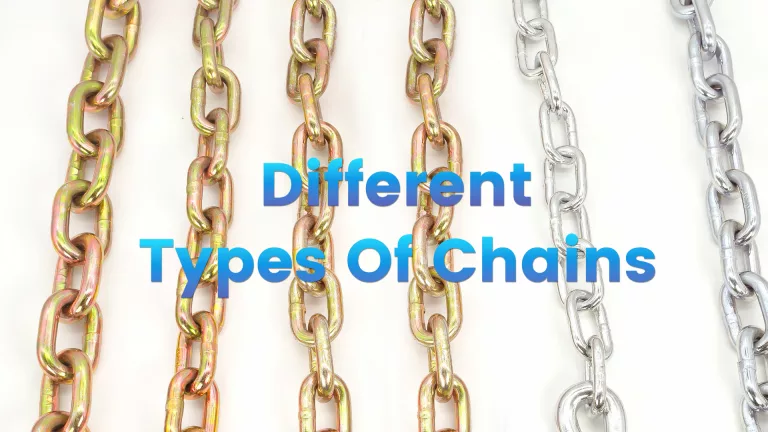
What is chain grade?
Grade is a standard way to express the tensile strength or breaking strength of a chain. The higher the grade, the stronger the chain.
The calculation formula is as follows:
Chain grade = maximum tensile force (Newton) / two cross-sectional areas of a single link
Or
Chain grade = Newton / square millimeter
The grade of a chain is not equal to its working load limit. The working load limit is determined by both the grade and the link width. This is why the same grade of chain can differ by thousands of pounds in working load limit, and why lower grade chains have a stronger load-bearing capacity than thinner, higher grade chains.
Currently, the commonly used grades for transport rigging are G30, G43, and G70. Now let’s discuss the common G43 grade chain.
Grade 43 chain
Grade 43 chain is the second strongest chain and has a wider range of applications than grade 30 chain. However, grade 43 chain is not suitable for overhead lifting applications. In the American chain standard ASTM80/NACM90/NACM96, the working tension of G43 grade chain is 2,600-9200 lbs, and the minimum breaking tension is 7750lbs-27600lbs.
Grade 43 chain is also commonly known as high-strength chain or G-4 chain. It is made of carbon steel and is known for its high tensile strength and wear resistance. Common applications of grade 43 chain:
- Traction
- Heavy truck transportation
- Agriculture
- Construction
- Protective chain
- Container fixing
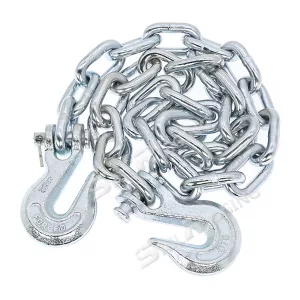
Sail Rigging provides grade 43 industrial chains in various sizes, surface treatments and designs. If you want to know more useful information, please consult Sail Rigging.
Breaking Force/Breaking Strength/Breaking Loads Minimum Of Chains
The breaking load refers to the expected minimum load applied to the chain to make it actually break, which is higher than the proof load.
Breaking strength is important to consider when using safety chains because:
First, if the trailer becomes uncoupled, the safety chains will not be able to support the full weight of the trailer, since most of the weight is supported by the road.
Second, the chains will only engage for a moment and will not actually be responsible for pulling the trailer for a long period of time.
For example, the requirement specifies that the breaking strength of each chain (not the working load limit (WLL)) should be equal to or greater than the gross weight of the trailer. A 5,500 lbs trailer would require each safety chain to have a breaking strength of at least 5,500 pounds.
Working Load Limit Of Chains
The working load limit (WLL) is the maximum tension that can be applied to a new, undamaged chain. It is a rated load capacity, usually measured in pounds.
The working load limit is calculated by dividing the minimum breaking strength of the chain by a specified safety factor. The grade and diameter of the chain are also used to determine the working load limit.
The working load limit (WLL) of a chain is approximately one-fourth of its breaking strength (the force the chain can withstand before breaking).
The following are the working tensions of common chain sizes for reference. If you want to know more, you can consult Sail Rigging.
| Chain Size Inches |
Grade 30
lbs |
Grade 43
lbs |
Grade 70
lbs |
| 1/4 | 1300 | 2600 | 3150 |
| 5/16 | 1900 | 3900 | 4700 |
| 3/8 | 2650 | 5400 | 6600 |
| 7/16 | 3700 | 7200 | 8750 |
| 1/2 | 4500 | 9200 | 11300 |
| 5/8 | 6900 | 13000 | 15800 |
More Articles You May Like
Types And Application Of Rigging Hooks
How To Properly Use Safety Chains?
Questions
For any question on Chains or our Chain Hook Assemblies, contact one of our product experts today!