


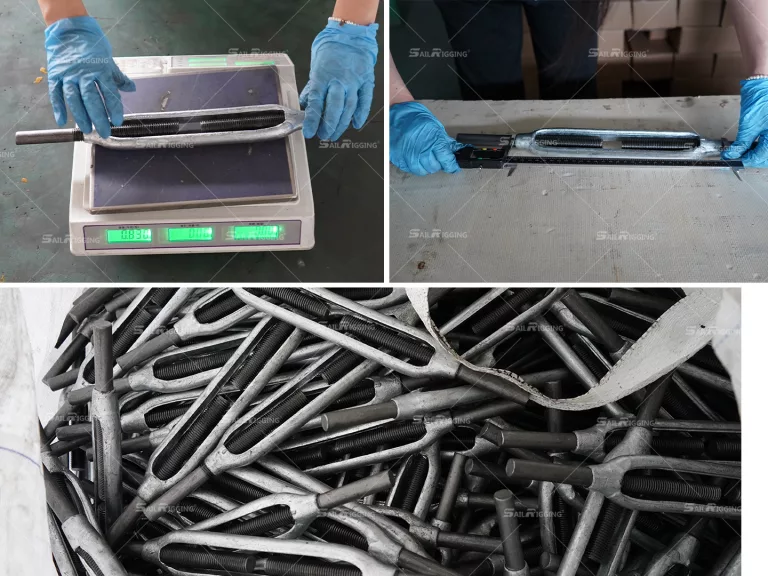
Turnbuckles are essential components in various industries, providing adjustable tension in structures and systems. Proper testing is crucial to ensure their reliability and safety. This article presents a comprehensive guide to testing turnbuckles, covering visual inspection, dimension measurement, tensile testing, and zinc layer thickness assessment.
Visual inspection
This is the initial step in assessing turnbuckle quality. Key aspects to consider include:
Thread Clarity: Ensure threads are clear and free from any burrs or irregularities that could affect functionality.
Zinc Layer Uniformity: Check for a uniform and smooth zinc layer, as an uneven coating may compromise corrosion resistance.
Surface Condition: Inspect for scratches, dents, or other physical defects that may impact performance.
Dimension Measurement
Accurate measurement of turnbuckle dimensions is essential for ensuring compliance with industry standards such as DIN1480, JIS Type, or US Drop Forged Type. Measurements should include:
Length: Verify that the turnbuckle meets specified length requirements, ensuring compatibility within systems.
Body Size: Measure the diameter and length of the turnbuckle body to confirm proper fit and functionality.
End Fitting Size: Assess the dimensions of end fittings to ensure compatibility and proper attachment.
Tensile Test
Sometime we will also do tensile test of turnbuckles. Conducting a tensile test provides valuable insights into the mechanical strength and load-bearing capacity of turnbuckles. This involves:
Ultimate Load Test: Apply gradually increasing tension until failure occurs, determining the maximum load the turnbuckle can withstand without breaking.
Deformation Load Test: Assess the turnbuckle’s ability to maintain structural integrity under sustained loads, measuring any elongation or deformation.
Zinc Layer Thickness Test
The zinc coating on turnbuckles is crucial for corrosion resistance. Different testing procedures apply to various types of galvanization:
Electro Galvanized: Measure the zinc layer thickness, typically ranging from 5 to 20μm, suitable for moderate corrosion environments.
Hot Dip Galvanized: Verify a zinc layer thickness exceeding 30μm, providing excellent corrosion resistance ideal for harsh conditions.
In a conclusion, thorough testing of turnbuckles is essential to ensure their reliability and performance in diverse applications. By following visual inspection protocols, precise dimension measurement techniques, rigorous tensile testing procedures, and zinc layer thickness assessment, manufacturers and users can uphold quality standards and minimize the risks associated with substandard products. Prioritizing quality assurance in turnbuckle testing ultimately enhances safety, durability, and operational efficiency across various industries. If you want to know more about turnbuckle test, please get in touch with Sail Rigging.