


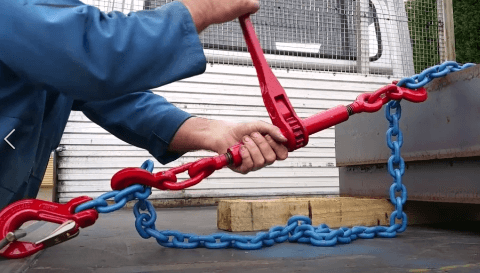
There are mainly two types of load binders: ratchet type binders and lever type binders.
There are fewer hazards associated with using ratchet-type binders when compared to lever-type binders.
Recommended Preventive Action
• All employees who use load binders should be given written procedures along with training on their proper use.
• Routinely check load binders for wear, bending, and cracks. Do not use the load binder if bending or cracks
are present.
• Look up and inspect the load before removing straps and ask for help if any pieces are in danger of falling.
• Do not operate a load binder while you or someone else is standing on the load.
• Position the load binder so it can be operated from the ground, and ensure your footing is secure.
• Move the handle with caution using an open hand, as the handle may whip. Keep your body clear.
• Never use a cheater pipe or handle extender to tighten or release a load.
• Do not attempt to close or open the binder with more than one person.
• When applying a lever type load binder, always position the load binder so the handle is tightened in a
downward manner.
• Protect the edges of the load binder from direct contact with sharp edges or abrasive surfaces.
• While under tension, a load binder must not bear against an object as it will cause side load.
• During and after tightening, check the load binder handle position. Be sure it is in the locked position. For lever
type load binders, the bottom side should touch the tie-downs.