


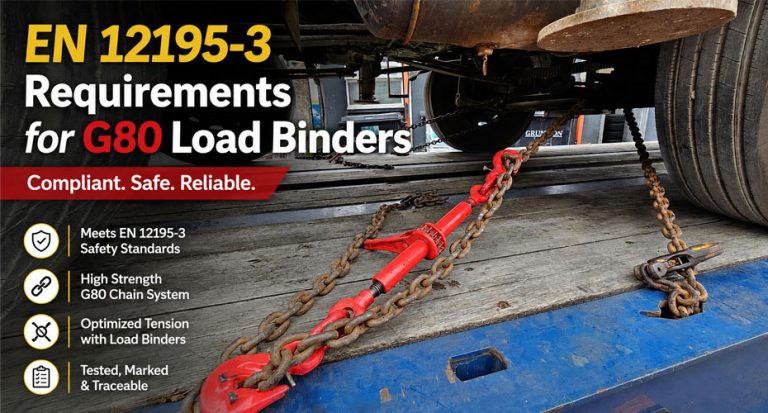
EN 12195-3 Requirements for G80 Load Binders
For European road transportation, EN 12195-3 is an important standard for tie down chain and binder. It also addresses manually operated tensioning devices used with these systems. The standard applies to cargo transported on load carriers such as trucks and trailers, including certain combined road, rail, and vessel transport applications.
We not only need to understand EN12195-1 standard, but also should need to know how to choose right complete cargo securing system, chain size, lashing capacity, tensioning performance, connecting components, markings, and intended application all need to be considered together.
Table of Contents
What Is EN 12195-3?
EN 12195-3 is the European standard for lashing chains used to secure cargo during transportation. It specifies safety requirements for lashing chains and lashing combinations with chain. The standard also includes requirements for manually operated tensioning devices, with a maximum hand force of 500 N.
This distinction is important because a load binder should not be considered an isolated product. In European cargo securement, the binder works as the **tensioning device** within a larger lashing assembly.
A typical system may include:
G80 lashing chain → hook/connecting component → load binder → lashing point → cargo
Each component contributes to the performance of the complete system.
EN 12195 Series at a Glance
The EN 12195 series covers different types of cargo securing equipment:
- EN 12195-1: Calculation of securing forces
- EN 12195-2:Web lashings
- EN 12195-3: Lashing chains
- EN 12195-4:Steel wire rope lashings
Therefore, EN 12195-3 should not be confused with the calculation requirements in EN 12195-1.
What Does G80 Mean?
G80/Grade 80 means the strength grade of the chain, which usually used in many heavy-duty lashing applications. G80 lashing chains are commonly equiped with European chain binder for securing heavy cargo.
But G80 is note equal to Lashing Capacity (LC).The chain grade identifies the material/strength classification, while LC is the rated lashing capacity of the complete lashing chain assembly.
For example, commercial G80 lashing assemblies are available in different chain diameters and LC ratings. One manufacturer lists 8 mm, 10 mm, and 13 mm G80 assemblies with LC values of 4,000 daN, 6,300 daN, and 10,000 daN respectively. Actual ratings depend on the specific design and certified assembly.
This is why European buyers should look beyond “G80” when evaluating a load binder or lashing chain.
Key EN 12195-3 Requirements for G80 Load Binders
1. Mechanical Strength
The lashing system must be capable of resisting the forces generated during transportation.
EN 12195-3 includes requirements for the mechanical properties of complete lashing chains and their load-bearing components. For example, the standard specifies a proof force of 1.25 × LC for the complete lashing chain, with no unacceptable deformation or defect after the load is released. It also specifies minimum breaking-force requirements.
This is why the performance of the binder, chain, hooks, and connecting components cannot be evaluated separately when assessing the complete lashing assembly.
2. Tensioning Device Safety
A European load binder is used to generate tension in the lashing chain.
EN 12195-3 includes several requirements for manually operated tensioning devices. These include:
- No sharp edges that could injure the operator
- Controlled recoil
- Protection against unintentional release
- Protection against crushing and shearing points
- Protection against unintended loosening
- A maximum manual operating force of 500 N
The standard also specifies residual tension requirements after applying the standard manual force. For chain diameters of 6–10 mm, the residual tension must be at least 0.25 LC; for 13–16 mm chain, it must be at least **0.15 LC, subject to the standard’s conditions.
In practical terms, the binder should provide effective tension without requiring an excessive amount of manual force.
3. Lashing Capacity (LC)
LC is one of the most important numbers when selecting a lashing chain.
It should be considered when calculating whether the securing arrangement provides enough restraint for a particular load.
4.Standard Tension Force (STF)
STF describes the tension remaining in the lashing system after the specified manual force is applied to the tensioning device. This is particularly relevant when using **top-over lashing**, where pretension contributes to the friction between cargo and the vehicle bed.
5. Minimum Breaking Load
Breaking force is not the same as the allowable lashing capacity.
A component reaching its breaking load is a failure condition, not a normal operating condition. Cargo securing calculations should therefore be based on the appropriate rated values, not simply on the ultimate breaking strength.
How to Match a G80 Load Binder with Lashing Chain
Choosing a European load binder should start with the complete lashing system, rather than the binder alone.
Step 1: Check the Chain Grade
Confirm that the chain is the required G80 lashing chain.
Step 2: Check Chain Diameter
Common European sizes include:
- 6 mm
- 8 mm
- 10 mm
- 13 mm
- 16 mm
Step 3: Check LC
Make sure the LC is appropriate for the intended cargo securing application.
Step 4: Check Connecting Components
Hooks, shortening devices, links, and other components should be compatible with the chain and tensioner. EN 12195-3 also includes requirements for connecting and shortening components, including provisions against working loose.
Step 5: Check Product Marking and Documentation
A professional European lashing product should have clear identification and relevant technical documentation. Information associated with EN 12195-3 markings includes items such as LC, STF, manufacturer identification, traceability information, and the applicable standard.
Inspection: What Should You Check Before Using a G80 Load Binder?
A load binder may look strong but still be unsafe if it has been damaged during previous use.
Before use, check for:
- Cracks
- Permanent deformation
- Excessive corrosion
- Damaged threads
- Bent hooks
- Excessive wear
- Damaged locking mechanisms
- Missing or unreadable markings
European cargo-securing guidance also recommends removing lashing equipment from service when serious deformation, cracking, corrosion, excessive wear, or hook damage is found.
A simple visual inspection before each use can identify problems before the equipment is placed under load.
G80 Load Binders Are for Cargo Securement—Not Lifting
One of the most important points for users is that **lashing equipment is not lifting equipment.
A G80 lashing chain and its tensioning device are designed for cargo restraint. They should not automatically be treated as equivalent to an overhead lifting chain simply because both products may use Grade 80 steel.
European guidance specifically identifies lashing chains for securing heavy or sharp-edged cargo and warns against using them for lifting loads.
This distinction should also be reflected clearly in product labels, manuals, and marketing materials.
Conclusion
For European cargo securement, choosing a G80 load binder is about more than selecting a strong-looking product. G80 load binder is only one part of complete G80 lashing system. If you have any question about G80 load binder, please feel free to contact Sail Rigging.