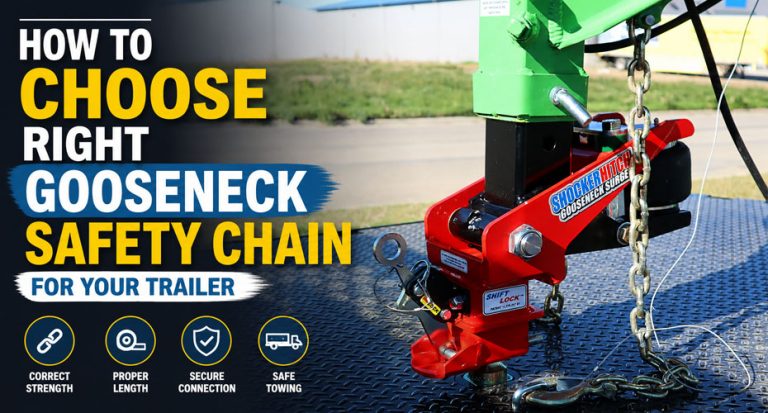
How To Choose Right Gooseneck Safety Chain for Your Trailer?
Gooseneck safety chains provide a secondary connection between the trailer and tow vehicle if the primary coupling becomes disconnected.Choosing right goosenneck safety chain is very important for trailer safety.
Today, i will share some information about how to choose right gooseneck safety chain.You need to consider **chain grade, diameter, length, working load limit, hook design, attachment points, and the requirements of the specific trailer.There are several factors to conside when choosing gooseneck safety chain.
Table of Contents
Start With Your Gooseneck Trailer’s Weight
Determine the trailer’s GVWR and understand the weight the safety-chain system is expected to accommodate.
People often choosing a chain based only on its physical size. A 3/8-inch chain, for example, does not automatically have one universal capacity. Chain grade makes a major difference.
FMCSA’s published chain WLL table illustrates this clearly. Grade 43 5/16 inch chain is list at 3,900 lb WLL, 5/16-inch Grade 70 chain is listed at 4,700 lb. For 3/8-inch chain, the listed values are 5,400 lb for Grade 43 and 6,600 lb for Grade 70.
This is why the selection process should begin with the required capacity rather than simply asking, “What diameter chain should I buy?”
For commercial towing applications covered by FMCSA rules, the agency states that when two safety chains are used in the situation addressed by §393.70(d), their combined ultimate breaking strength** can satisfy the federal requirement when it equals the gross weight of the vehicle being towed. Individual state requirements may be more stringent. ([FMCSA][2])
Always check the requirements applicable to your trailer and location.
Choose the Appropriate Chain Grade
For gooseneck trailers, Grade 43 and Grade 70 are two grades buyers may encounter, but they are not interchangeable from a capacity standpoint.
- Grade 43
Grade 43 chain, called high test chain, is used in various general transport applications. It can be appropriate where its rated capacity meets the requirements of the trailer and application.
- Grade 70
Grade 70 chaink, called transport chain, provides a higher WLL than Grade 43 of the same nominal diameter in the FMCSA chain table. For example, 3/8-inch Grade 70 is listed at 6,600 lb WLL compared with 5,400 lb for 3/8-inch Grade 43.
Grade 70 chain is widely offered for gooseneck safety-chain applications. Current products on the market include 3/8-inch Grade 70 gooseneck safety chains designed specifically for certain gooseneck pin-box configurations.
However, higher grade does not mean you can ignore the rest of the assembly. The hook, attachment point, and installation method still need to be suitable.
Don’t Choose Chain Diameter Alone
Chain diameter is important, but it is not the only factor you conside.
For example:
- 5/16″ chain
- 3/8″ chain
- 1/2″ chain
may all be available in different grades and configurations.
A smaller chain with a higher grade can have a greater rated capacity than a larger chain made to a lower grade. One market example shows a 5/16-inch Grade 70 safety chain rated higher than a 3/8-inch Grade 43 chain, demonstrating why diameter alone can be misleading.
When comparing products, check at least:
Diameter + Grade + WLL/Breaking Strength + Hook + Application
rather than looking at diameter by itself.
Select the Right Gooseneck Safety Chain Length
Once strength has been established, determine the required length.
The correct length depends largely on the physical design of the trailer and truck.
Consider:
- Location of the gooseneck attachment points
- Distance between trailer and truck-bed anchors
- Coupler or pin-box design
- Turning clearance
- Ground clearance
- Required amount of slack
A chain that is too short can restrict normal movement or make connection difficult.
If too excessively long, it will create unnecessary slack and may hang too low.
There is no universal length for gooseneck trailer.
For example, commercially available gooseneck safety chains can be found in configurations such as 84 inches, while other applications use shorter assemblies. The correct choice depends on the specific trailer and attachment configuration.
The goal is simple:
Use enough chain for secure connection and normal turning, without creating excessive slack.
Pay Attention to the Hook Design
The chain itself is only one part of the safety-chain assembly.
The hook determines how the chain connects to the truck or trailer.
Common considerations include:
- Clevis hook
- Grab-style hook
- Other manufacturer-specified connection designs
A properly sized hook should work with the designated attachment point and provide an appropriate connection.
Some gooseneck safety chains are specifically designed with clevis hooks for connection to truck-bed safety-chain anchors. For example, one gooseneck application uses a Grade 70 chain with clevis hooks that attach to the hitch’s safety-chain points.
Don’t choose a hook simply because it can physically be placed over an anchor.
Check whether the hook and attachment system are designed to work together.
Check the Truck-Bed Safety-Chain Anchor Points
Gooseneck trailers are different from conventional bumper-pull trailers because the safety chains typically connect around the gooseneck hitch area in the truck bed.
The connection point needs to be strong, properly installed, and compatible with the chain hook.
Some gooseneck hitch systems use dedicated holes or U-bolt-style anchors for safety-chain attachment.
Before selecting a chain, inspect the anchor points and determine:
- Anchor location
- Anchor size
- Connection method
- Hook clearance
- Required chain length
This is especially important when replacing an existing safety-chain assembly.
Consider the Complete Safety-Chain Assembly
One of the most important rules when buying a gooseneck safety chain is:
Don’t evaluate the chain in isolation.
The complete load path may look like:
Trailer Attachment → Chain → Hook → Truck Anchor
If the chain has a high rated capacity but the hook or attachment point is unsuitable, the complete system cannot simply be treated as having the chain’s full capacity.
This principle also applies when purchasing replacement chains. FMCSA’s cargo-securement rules emphasize that devices and systems used for securement must be capable of meeting applicable performance criteria, and damaged or weakened components should not be used when they could adversely affect performance. ([FMCSA][6])
Check the Chain’s WLL and Breaking Strength
WLL and breaking strength are not the same thing.
Working Load Limit is the rated working capacity used for an application. Breaking strength refers to the force at which the chain may ultimately fail during testing.
For example, FMCSA’s published chain table lists a 3/8-inch Grade 70 chain at 6,600 lb WLL, while its listed ultimate breaking strength is not simply the same number.
When comparing safety chains, make sure you understand which rating a supplier is providing.
Don’t compare: Product A: 6,600 lb WLL with Product B: 28,000 lb breaking strength, as though those numbers describe the same property.
Common Mistakes When Choosing a Gooseneck Safety Chain
Mistake 1: Choosing the Chain Only by Diameter
A larger diameter does not automatically mean a higher rated capacity.
Mistake 2: Ignoring Chain Grade
Grade can significantly affect WLL. ([FMCSA][1])
Mistake 3: Too Short Chain
The chain may not provide enough reach for the truck-bed anchor points or normal turning movement.
Mistake 4: Excessively Long Chain
Too much slack can create unnecessary movement and ground-clearance problems.
Mistake 5: Ignoring the Hook
The hook must be compatible with the chain and the designated anchor point.
Mistake 6: Using a Damaged Chain
Bent links, cracks, severe corrosion, or damaged hooks are reasons to remove a chain from service rather than simply adding another component.
Mistake 7: Assuming Every Gooseneck Chain Fits Every Hitch
Some safety chains are designed for specific pin boxes or hitch systems. One current example explicitly states that its 84-inch chain is designed for a particular gooseneck pin-box configuration.
Gooseneck Safety Chain Selection Checklist
Before ordering a replacement or new chain, check these items:
- Trailer GVWR:*What is the trailer’s rated weight?
- Chain grade: Grade 43, Grade 70, or another specified grade?
- Chain diameter:Does it provide the required capacity?
- WLL:*Is the rated capacity appropriate?
- Length: Does it provide enough reach?
- Hook: Does it fit the truck-bed anchor?
- Attachment point: Is the trailer connection suitable?
- Application: Is the chain specifically intended for the towing setup?
- Regulations: Are there federal, state, or local requirements that apply?
If you’re purchasing chains for multiple trailer models, it is also worth keeping a specification sheet showing the chain diameter, grade, length, hook type, WLL, and attachment configuration for each model.
FAQ
1.What size chain is best for a gooseneck trailer?
There is no single size that fits every gooseneck trailer. The correct chain should be selected according to the trailer’s requirements, chain grade, rated capacity, hook configuration, and applicable regulations.
2.Is Grade 70 better than Grade 43 for a gooseneck trailer?
Grade 70 generally provides a higher WLL than Grade 43 of the same nominal diameter, but the appropriate grade depends on the specific application and requirements. ([FMCSA][1])
3.How long should a gooseneck safety chain be?
The chain should be long enough to connect securely and allow the required movement and turning clearance without excessive slack. Trailer and hitch geometry determine the actual length.
4.Do both gooseneck safety chains need to have the same capacity?
The answer depends on the applicable regulation and towing configuration. Under the FMCSA guidance for the situation covered by §393.70(d), two chains can satisfy the federal strength requirement when their combined ultimate breaking strength equals the gross weight of the towed vehicle; some states may require more. ([FMCSA][7])
5.Can I use any safety chain on a gooseneck hitch?
Not necessarily. The chain, hook, length, and attachment method must be compatible with the specific hitch and trailer configuration.
Conclusion
Right gooseneck safety chain is the one that provides sufficient strength, the correct length, and a compatible connection for your specific trailer—not simply the largest chain you can buy. If you confuse with gooseneck safety chain, please feel free to contact Sail Rigging.