


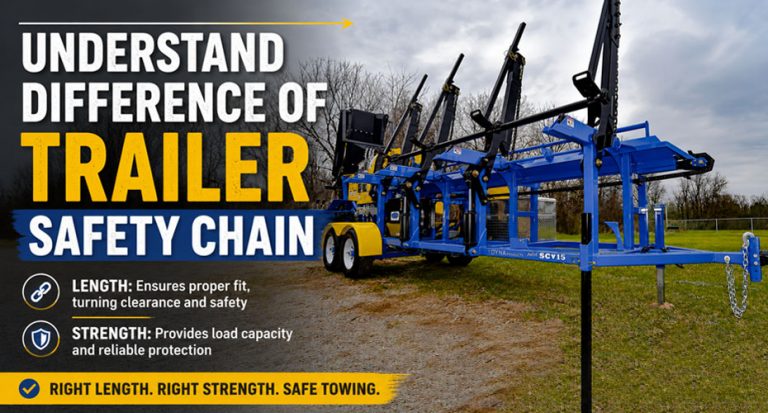
Understand Difference Of Trailer Safety Chain Length and Chain Strength
When choosing a trailer safety chain, people often focus on chain size, 5/16-inch or 3/8-inch but rarely concern on chain strength.
For trailer safety chains, length and strength are two different specifications. Length determines whether the chain fits the towing setup and allows normal movement. Strength determines whether chain assemblies meet load capacity requirements.
Understanding the difference can help trailer owners avoid a common mistake: choosing a chain simply because it is longer, thicker, or heavier.
Table of Contents
What Does Trailer Safety Chain Length Mean?
Trailer safety chain length refers to the physical chain assembly length, used between the trailer and tow vehicle.
Unlike chain strength, length is primarily determined by the geometry of the towing setup.
Important factors include:
- Distance between the trailer and tow vehicle attachment points
- Trailer tongue design
- Hitch height
- Safety-chain mounting location
- Turning clearance
The chain needs enough slack to allow the vehicle and trailer to turn properly. But excessive slack should be avoided.
U.S. federal regulations for towing specifically state that safety trailer chain should have no more slack than necessary to permit proper turning.
In practical terms, the goal is simple:
The chain should be long enough to move, but not so long that it drags or hangs excessively low.
What Does Trailer Safety Chain Strength Mean?
Chain strength is a completely different specification.
Strength determines whether a chain is suitable for the weight and application of the trailer.
It is affected by factors such as:
- Chain diameter
- Chain grade
- Material
- Heat treatment
- Manufacturing process
- Working Load Limit (WLL)
- Hook and attachment capacity
This is why two chains with the same diameter should not automatically be considered equal.
For example, 5/16-inch Grade 43 chain and 5/16-inch Grade 70 chain are different, because their rated capacities can be different.
Federal cargo-securement tables also show that WLL varies by both chain size and grade. For example, a 5/16-inch Grade 43 chain and a 5/16-inch Grade 70 chain have different listed WLL values.
Trailer Safety Chain Length vs. Strength: What’s the Difference?
The easiest way to understand the difference is to look at what each specification controls.
| Factor | Chain Length | Chain Strength |
|---|---|---|
| Main purpose | Proper fit and movement | Load capacity |
| Mainly affected by | Hitch and trailer geometry | Grade, diameter and construction |
| Related to | Turning clearance | WLL / breaking strength |
| Too little | May restrict turning | May fail under load |
| Too much | May drag or create excessive slack | Usually does not increase capacity |
| Selection basis | Towing setup | Trailer weight and application |
In other words:
Length answers “Will this chain fit and move correctly?”
Strength answers “Is this chain strong enough for the application?”
Both questions need to be answered before selecting a trailer safety chain.
Does a Stronger Chain Need to Be Longer?
No,a stronger chain does not automatically need to be longer.
Imagine two trailers with similar hitch configurations. One weighs 5,000 pounds and another weighs 10,000 pounds.
They could potentially require similar physical chain lengths if the distance between their attachment points and their turning requirements are similar.
The heavier trailer, however, may require a higher-capacity safety chain assembly.
That could mean:
- Higher chain grade
- Larger diameter
- Higher WLL
- Stronger hooks
- Stronger attachment points
So the selection process should separate these two questions:
Trailer geometry → determines length.
Trailer weight and application → determine required strength.
Does a Longer Trailer Safety Chain Have More Load Capacity?
Not necessarily.
Adding chain length does not automatically increase its WLL.
For example, a 4-foot chain and a 3-foot chain made from the same chain specification are same working load limit, because the chain size, grade, construction, rated specifications are same.
There is another important point: the chain is only one part of the complete safety-chain assembly.
The load path may include:
Chain → Hook → Attachment Point → Trailer Frame
If one component has a lower capacity than the others, it can become the limiting point of the assembly.
This is why selecting a chain based only on its diameter can be misleading.
How Chain Diameter and Grade Affect Strength
-
Chain Diameter
Common trailer safety chain sizes include:
- 1/4 inch
- 5/16 inch
- 3/8 inch
- 1/2 inch
In general, increasing diameter can increase chain capacity, but diameter alone does not tell you the complete strength rating.
The chain grade also matters.
2. Chain Grade
Grade 43 and Grade 70 are two grades commonly encountered in transport and towing applications, although the appropriate specification depends on the application and applicable requirements.
Grade 43 is often used for general transport and towing applications.
Grade 70 is widely used for higher strength cargo securement and heavy-duty transport applications.
FMCSA’s cargo-securement tables list different WLL values for Grade 43 and Grade 70 chains of the same nominal diameter. Don’t assume chain strength from diameter alone. Check the grade and rated capacity.
How to Choose the Correct Trailer Safety Chain Length
Once you have determined the required strength, you can select the appropriate physical length.
Step 1: Check the Attachment Points
Measure the practical distance between the trailer’s safety-chain attachment points and the tow vehicle’s connection points.
Step 2: Consider Turning Clearance
The chain needs enough slack for normal left and right turns.
A chain that is perfect when the vehicle and trailer are straight may become too tight during a sharp turn.
Step 3: Check Ground Clearance
The chain should not continuously contact the pavement.
Dragging can accelerate wear and damage the chain or hook.
Step 4: Check the Emergency Position
The safety-chain arrangement should be capable of supporting the trailer appropriately if the primary coupling connection becomes disconnected.
For certain commercial towing applications, federal requirements address both safety-device strength and the amount of slack permitted. ([GovInfo][1])
How to Choose the Correct Chain Strength
Strength selection should start with the trailer and load rather than the chain itself.
1. Determine the Trailer Weight
Consider the loaded trailer rather than looking only at the empty trailer weight.
2. Check the Required Strength
For applicable U.S. commercial towing requirements, FMCSA guidance states that when two safety chains are used, their **combined ultimate breaking strength** can satisfy the federal requirement when it equals the gross weight of the vehicle being towed. State requirements may be more stringent. ([FMCSA][3])
For consumer trailers, requirements can also vary by state and trailer classification, so the trailer manufacturer’s specifications and applicable local requirements should be checked.
3. Select the Chain Grade and Size
Choose a chain with an appropriate rated capacity for the application.
4. Check the Hooks and Attachments
Do not stop at the chain.
The hook, attachment hardware, and trailer mounting point also need to be suitable for the application.
A Simple Example: Choosing Length and Strength Separately
Consider an 8,000-pound loaded equipment trailer.
A common mistake would be to start with:
“I need a longer chain because the trailer is heavy.”
That is not necessarily correct.
Instead, divide the selection into two stages.
1.Determine Strength
The 8,000-pound trailer requires a safety-chain assembly with appropriate strength and capacity for the application and applicable requirements.
2. Determine Length
Measure the towing setup and check turning clearance.
The required length may be similar to another trailer with a different weight if the two trailers have similar hitch geometry.
This example demonstrates the key principle:
Trailer weight helps determine how strong the chain needs to be. Trailer geometry helps determine how long it needs to be.
Common Trailer Safety Chain Selection Mistakes
Mistake 1: Choosing Only by Length
36-inch chain is not automatically suitable because you need to check grade, diameter, WLL, hook capacity.
You still need to check:
Mistake 2: Choosing Only by Diameter
A larger chain is not necessarily the right chain if its grade or application is unsuitable.
Mistake 3: Assuming Longer Means Safer
Excessive slack can create dragging, wear, and poor positioning.
Mistake 4: Assuming Stronger Always Means Better
Overspecifying a chain can add unnecessary weight and cost. The objective is not to buy the biggest chain available, but to select a chain assembly appropriate for the actual application.
FAQ: Trailer Safety Chain Length vs Strength
1.Does a heavier trailer need a longer safety chain?
Not necessarily. Trailer weight primarily affects required strength. Chain length depends more on trailer and hitch geometry.
2. Does chain diameter affect safety chain length?
No. Diameter affects strength and capacity, while length is determined by the towing configuration.
3. Is a longer trailer safety chain safer?
Not automatically.The chain should provide enough slack for proper turning without excessive slack or road contact.
4. Is Grade 70 always better than Grade 43?
Not necessarily. The appropriate grade depends on the application, required capacity, manufacturer’s specifications, and applicable regulations.
5. Which is more important: chain length or strength?
Both matter, but they address different requirements. Length affects fit and movement; strength affects load capacity.
Conclusion
Trailer safety chain is an assembly of chain and chain hook, when choosing trailer safety chain, we need to conside chain length, strength, grade, WLL, hook, attachment method. If you have any question about trailer safety chain, you could contact us.