


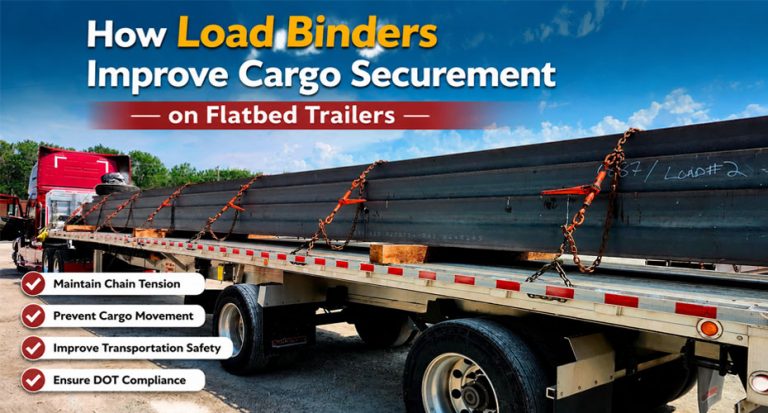
How Load Binders Improve Cargo Securement on Flatbed Trailers
Flatbed trailers are widely used for transporting heavy equipment, construction machinery, industrial materials, and oversized cargo. Correct cargo control will keep driver and road safe. Today, i will discuss how load binders improve cargo securement, hope this will make you clear.
Table of Contents
What Is a Load Binder?
Load Binder, also known as Chain Binder, is a mechanical device designed to tighten and secure chains around cargo during transportation.
It works by connecting both ends of transport chain and applying tension to remove slack from the chain. Once properly tightened, the binder keeps the chain under tension and helps prevent cargo movement.
A complete cargo securement system usually includes:
- Transport chain
- Load binder
- Hooks or connecting hardware
- Trailer anchor points
- Proper tie-down arrangement
The load binder is equiped with transport chain to provide reliable restraint.
Why Are Load Binders Important for Flatbed Trailer Cargo Securement?
1. Prevent Cargo Movement During Transportation
One of the biggest challenges in flatbed transportation is controlling cargo movement.
A truck traveling on the highway experiences different forces, including:
- Forward force during sudden braking
- Backward force during acceleration
- Side force during turning
- Vibration from road conditions
If not correct tie down equipment, heavy cargo can shift, causing safety risks for the driver and other vehicles.
Chain and binders Lwill help keep cargo in its original position throughout the journey.
For example, when transporting an excavator or bulldozer on a flatbed trailer, properly tensioned chains connected with load binders help prevent the equipment from moving during sudden stops or sharp turns.
2. Maintain Proper Chain Tension
The effectiveness of a chain securement system depends heavily on maintaining the correct amount of tension.
A loose chain may:
- Allow cargo movement
- Reduce securement effectiveness
- Create additional impact forces
A load binder allows operators to tighten the chain and maintain consistent tension.
However, more tension does not always mean better performance. Over-tightening can damage:
- Chain links
- Hooks
- Binder components
- Trailer attachment points
The load capacity should match with the working load limit of cargo.
3. Improve Safety and Transportation Reliability
For commercial trucking companies, cargo securement is directly connected to operational safety.
Using the correct load binder helps:
- Reduce cargo shifting risks
- Protect expensive equipment
- Minimize transportation delays
- Improve compliance with cargo securement requirements
It provides confidence during long-distance hauling and heavy-duty transportation.
Load Binder and Chain: Safety Cargo Control Solution
A load binder is only as effective as the chain and components used with it.
Grade 70 Transport Chain
Grade 70 chain is most popular choices for cargo securement in North America.
It is widely used for:
- Flatbed trailers
- Heavy equipment transport
- Construction machinery hauling
- Agricultural equipment transportation
Advantages include:
- High strength-to-weight ratio
- Heat-treated alloy steel construction
- Designed for transportation applications
Common sizes include:
- 5/16 inch Grade 70 chain
- 3/8 inch Grade 70 chain
- 1/2 inch Grade 70 chain
The load binder should always match the chain size and Working Load Limit.
Choosing the Right Load Binder for Flatbed Trailers
Selecting the correct load binder depends on several factors:
- Chain size
- Chain grade
- Cargo weight
- Application requirements
- Required Working Load Limit
Ratchet Load Binder
Ratchet load binders use a threaded ratchet mechanism to gradually tighten the chain.
Benefits:
- Easier tension adjustment
- Better control during tightening
- Reduced physical effort
- Lower risk of sudden release
They are commonly used for:
- Long-distance transportation
- Heavy equipment hauling
- Professional fleet operations
Lever Load Binder
Lever load binders use a handle mechanism to tighten the chain quickly.
Benefits:
- Simple design
- Fast operation
- Suitable for heavy-duty applications
They are often used for:
- General cargo transportation
- Short-distance hauling
- Construction equipment transport
Operators should always follow safe handling procedures because lever binders store tension during operation.
Common Flatbed Applications for Load Binders
Load binders are widely used across multiple industries.
Heavy Equipment Transportation
Examples:
- Excavators
- Bulldozers
- Wheel loaders
- Skid steers
These machines are heavy and require strong chain securement systems to prevent movement.
Construction Material Transportation
Common cargo includes:
- Steel beams
- Pipes
- Machinery components
- Building materials
Load binders help keep irregular and heavy materials stable during transportation.
Agricultural Equipment Hauling
Farm equipment such as:
- Tractors
- Harvesters
- Implements
often requires chain and binder systems because of their size and weight.
Industrial Cargo Transportation
Industrial products such as:
- Cable reels
- Manufacturing equipment
- Heavy components
are commonly transported on flatbed trailers using chain securement systems.
Common Mistakes When Using Load Binders
Even high-quality load binders may fail if they are used incorrectly.
Using the Wrong Chain Grade
Different chain grades have different strength levels.
Using a low-strength chain for heavy equipment transportation can reduce overall system safety.
Choosing an Incorrect Binder Size
A binder must match the chain size and capacity.
A properly sized binder ensures the securement system performs as designed.
Ignoring Equipment Inspection
Before every use, check:
- Cracks or deformation
- Damaged hooks
- Worn threads
- Bent handles
- Missing components
Damaged equipment should be removed from service immediately.
How to Maintain Load Binders?
Proper maintenance could extend lifetime and improves safety.
We could do these ordinally
- Clean dirt and debris after use
- Lubricate moving parts regularly
- Protect threads from corrosion
- Store in a dry environment
- Inspect before each application
For truckers, regular inspection process can reduce unexpected failures and equipment replacement costs.
Conclusion
Load binders are an essential part of flatbed trailer cargo securement systems. Correct chain and binders will provide a safer and more reliable cargo securement solution. If you have any question, don’t hesitate to contact US.