
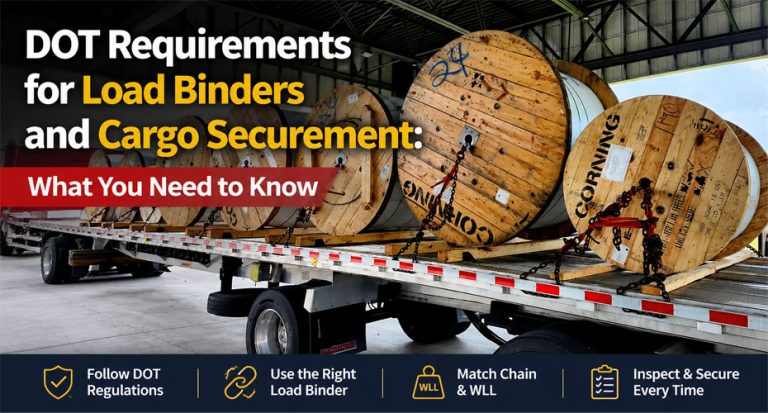
DOT Requirements for Load Binders and Cargo Securement: What You Need to Know
DOT is important requirement for load binders. When transporting heavy equipment, machinery, or industrial materials, securing load properly is important safety requirements. A properly selected Load Binder works together with transport chains to keep cargo stable during transportation and prevent dangerous load shifting.
In USA, load binders are commonly used for flatbed trailers, heavy equipment hauling, and commercial transportation. However, many users misunderstand DOT requirements and assume choosing a strong binder alone is enough. DOT cargo securement focuses on the entire tie-down system, the chain, binder, hooks, anchor points, and working load limit (WLL).
This guide explains key DOT requirements for load binders and how to select right chain binder for cargo securement.
Table of Contents
What Are DOT Cargo Securement Requirements?
The Federal Motor Carrier Safety Administration (FMCSA) regulates cargo securement requirements under **49 CFR Part 393 Subpart I – Protection Against Shifting and Falling Cargo**.
The purpose of these regulations is to ensure that cargo remains secure during transportation and does not:
- Move forward during sudden braking
- Shift backward during acceleration
- Slide sideways during turning
- Fall from the vehicle during operation
A compliant cargo securement system is not based on a single component. It includes:
- Transport chain
- Load binder
- Hooks and connecting hardware
- Tie-down points
- Cargo attachment method
For example, a high-strength chain cannot provide safe securement if it is paired with an undersized or damaged load binder.
Is a Load Binder DOT Approved?
We are often asked if your load binder DOT approved?
The answer is slightly different from what many people expect.
DOT does not typically approve individual products such as a specific load binder model. Instead, DOT regulations require that the complete cargo securement system meets safety requirements.
A properly used load binder should:
- Have a clearly marked Working Load Limit (WLL)
- Match the chain size and grade
- Be suitable for the cargo application
- Be installed and operated correctly
Therefore, instead of looking for a product labeled “DOT approved load binder,” users should focus on whether the complete chain and binder system complies with cargo securement requirements.
Understanding Working Load Limit (WLL) for Load Binders
Working load limit is The most important factor for choosing load binder.
WLL refers to the maximum load that a component can safely handle under normal working conditions.
The securement capacity of a system depends on the weakest component.
For example:
- Chain WLL
- Binder WLL
- Hook WLL
- Anchor point strength
All components should be properly matched.
Example: Grade 70 Transport Chain
| Chain Size | Common Application | Matching Binder |
|---|---|---|
| 5/16″ Grade 70 Chain | Medium equipment transport | 5/16″ Load Binder |
| 3/8″ Grade 70 Chain | Heavy equipment hauling | 3/8″ Load Binder |
| 1/2″ Grade 70 Chain | Large machinery transport | 1/2″ Load Binder |
G70 transport chain is widely used chains for cargo securement in North America.
Typical applications include:
- Excavator transportation
- Bulldozer hauling
- Skid steer transport
- Agricultural equipment hauling
Choosing a binder that does not match the chain size can reduce the safety performance of the entire system.
How to Choose the Right Load Binder for DOT-Compliant Transport
There are two major types of load binders commonly used in transportation:
1. Ratchet Load Binder
A ratchet load binder uses a threaded mechanism to gradually tighten the chain.
Advantages:
- Easier tension control
- Less physical effort
- Lower risk of sudden release
- Suitable for long-distance transportation
Common applications:
- Flatbed trailers
- Heavy equipment transport
- Commercial trucking
Ratchet binders are controlled tension adjustment, now becoming popular among professional drivers and fleet operators.
2. Lever Load Binder
A lever load binder uses a handle mechanism to tighten and secure the chain.
Advantages:
- Fast operation
- Simple design
- Easy installation
Common applications:
- Short-distance hauling
- Heavy-duty transportation
- General cargo securement
However, operators should be careful during installation because improper handling can create safety risks from stored tension.
How Many Load Binders Are Required?
The number of load binders needed depends on several factors, including:
- Cargo weight
- Cargo length
- Cargo type
- Transportation method
- Tie-down arrangement
For heavy equipment such as excavators or loaders, multiple tie-down points are normally required to prevent movement in all directions.
The goal is not simply to add more binders but to create a secure system that controls:
- Forward movement
- Rearward movement
- Side movement
- Vertical movement
Proper placement is just as important as the number of binders used.
Common Mistakes When Using Load Binders
Even high-quality load binders may fail if they are used incorrectly. The following mistakes are common in cargo transportation.
1. Using the Wrong Chain Grade
Different chain grades have different strength levels.
For example:
- Grade 30 chain is not designed for heavy equipment securement.
- Grade 70 transport chain is widely used for highway cargo applications.
Always match the binder with the correct chain grade.
2. Ignoring Working Load Limit Markings
Every chain and binder should have clear identification markings.
Operators should check:
- Chain size
- Grade
- WLL
- Manufacturer information
Using equipment without visible ratings can create safety risks.
3. Over-Tensioning the Chain
More tension does not always mean better securement.
Excessive tightening can:
- Damage chain links
- Deform hooks
- Reduce equipment service life
The goal is secure restraint, not maximum force.
4. Using Damaged Load Binders
Before every use, inspect the binder for:
- Cracked body
- Bent handle
- Damaged threads
- Worn hooks
- Missing components
A damaged binder should be removed from service immediately.
Load Binder Inspection Checklist
Before securing cargo, operators should check:
| Inspection Item | What to Check |
|---|---|
| Body | No cracks or deformation |
| Threads | Smooth operation |
| Hooks | No bending or damage |
| Chain | No excessive wear |
| Markings | WLL information visible |
| Locking system | Works properly |
Regular inspection helps prevent unexpected failures during transportation.
Maintenance Tips for Longer Load Binder Service Life
Proper maintenance improves safety and extends product life.
Recommended practices include:
- Clean dirt and debris after use
- Lubricate moving parts regularly
- Store in a dry environment
- Protect threads from corrosion
- Replace damaged components immediately
For transportation companies operating multiple trailers, maintaining a regular inspection program can reduce equipment replacement costs and improve safety.
Conclusion
Meeting DOT cargo securement requirements will helps protect cargo, equipment, drivers, and everyone sharing the road. Hope you will understand more about DOT requirement of load binder. If you have any question about load binder, feel free to contact Sail Rigging.