


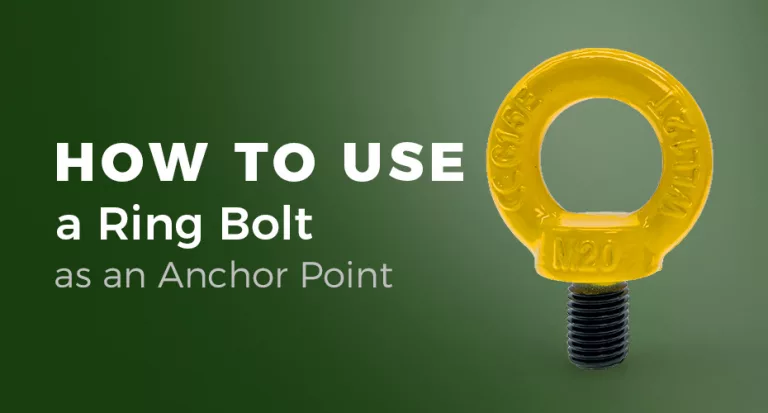
How to Use a Ring Eye Bolt as an Anchor Point
Eye bolts are widely used as anchor points in applications such as lifting, rigging assembly, and cargo securing. They are simple in structure, reliable in performance, and easy to install – but only if used properly. Misuse is a common cause of failure, especially when subjected to oblique loads or in poor installation conditions.
This guide will cover the basic knowledge when using ring eye bolts as anchor points, aiming to ensure the process is both safe and practical.
Table of Contents
What is a ring bolt anchor point?
A ring bolt anchor point refers to a fixed connection point that connects the load to this point through accessories such as hooks, shackles or wire ropes. It is responsible for transmitting the received force into the base material (such as steel or concrete).
In most cases, the eye bolt itself is not the weak link – the real weak link often lies in its installation method and the direction of the force it bears.
Select the Appropriate Type of Eye Bolt
Not all eye bolts are suitable for the same load conditions.
Shoulder Eye Bolts
* There is a shoulder (supporting surface) under the ring.
* It can withstand limited oblique loads.
* It is often used in lifting operations.
Shoulderless Eye Bolts
* Lack of shoulder support structure
* Only suitable for vertical load conditions
* Strictly prohibited for lateral tensile (side pull) conditions
For most rigging assembly operations, forged eye bolts with shoulders are a safer choice.
Key Points for Installation
- Ensure that the threads are fully engaged.
The ring bolts must be fully screwed in. The shoulder (support surface) of the bolts should be in tight contact with the installation surface without any gap.
Incomplete meshing of the threads will lead to a significant reduction in strength.
- Adjust the direction to align with the load
The opening direction of the ring should be directly towards the force direction of the load.
The following situations should be avoided:
- Lateral bending force
- Produces torsional stress
Misalignment of the force direction with the eyelet can easily lead to rapid failure of the bolt.
- Check the Condition of Basic Materials
The overall strength of an anchor point depends on the strength of the base material to which it is fixed.
Suitable base materials include:
- Structural steel
- Solid metal components
- Reinforced concrete with embedded parts
It should be avoided to be installed on thin plates or materials with relatively weak strength.
- Ensure the installation surface is tightly adhered to.
The contact surface between the ring bolt and the installation surface should be flat and clean. If necessary, washers can be used to assist in ensuring a complete and tight fit.
Load and Safety Precautions
Working Load Limit (WLL)
Each eye bolt is marked with its rated working load limit (WLL) . Overloading is strictly prohibited. If the load condition is uncertain, do not make assumptions – instead, choose a product with a higher specification and greater load-bearing capacity.
Angular Load
The load angle is of vital importance.
- Vertical load = Full load capacity
- Angular load = Reduced load capacity
As the angle increases, its strength will rapidly decrease. Even for eye bolts with shoulders, the range of angles for their use should be limited.
Dynamic Load
Factors such as movement, vibration or shock can all lead to an increase in stress.
For dynamic load conditions:
A higher safety factor should be adopted.
If rotation operation is involved, common (shoulderless) eyebolt should be avoided.
Common Mistakes
The following problems are frequently encountered in actual application sites:
- Use plain (shoulderless) eye bolts for lateral load conditions.
- The bolts were not fully tightened.
- The directionality of the load was ignored.
- Overloading was applied.
- The bolts were installed on a substrate with insufficient material strength.
The vast majority of failure incidents are attributed to one of the aforementioned errors.
Select the appropriate eye bolt
When choosing ring bolt anchor points, the following key elements should be given priority:
- Load-bearing capacity (with safety margin reserved).
- Correct thread type (metric or UNC imperial thread).
- Material (carbon steel, stainless steel or alloy steel).
- Surface treatment (galvanization is recommended for outdoor use).
To ensure the consistent quality of the products, please be sure to choose a reliable lifting ring bolt supplier and ask them to provide relevant test data and detailed technical specifications.
Typical Application Scenarios
Lifting ring bolts are commonly used in the following fields:
- Lifting and hoisting equipment.
- Cargo securing and lashing.
- Structural anchoring and connection.
- Offshore engineering and rigging assembly.
- Mechanical equipment installation.
Whether used as a temporary anchor or a fixed anchor, the eye bolt can perform well.
Conclusion
As long as it is used within the specified load-bearing range, the eye bolt can serve as an efficient and reliable anchor connection component. The key points for its use are straightforward:
- Select the correct type of bolt.
- Ensure that the installation operation is carried out in accordance with the correct specifications.
- Keep the load direction aligned with the bolt’s axis.
If any corner is cut or any step is neglected in the above-mentioned processes, it is very likely to cause safety hazards and malfunctions.
For critical application scenarios, it is essential to choose high-quality products from reliable eye bolt manufacturers and carefully verify their rated load parameters before putting them into use.
FAQ
1. What are the differences between eye bolts with shoulders and those without shoulders?
The main differences lie in its structure and application aspects:
The eye bolts with shoulders have an integrated shoulder structure that can support limited angular loads. The eye bolts without shoulders lack this support structure and are only suitable for withstanding straight vertical loads.
In lifting and rigging applications, shoulder bolts with rings are usually a safer choice.
2. How can I determine the appropriate size of the eye bolt?
You could choose eye bolts by working load limit, application type and load direction.
It is essential to select lifting ring bolts with a working load limit higher than the actual load and reserve a certain safety margin.
3. Are galvanized eye bolts suitable for outdoor use?
Yes, galvanized eye bolts are suitable for use in outdoor environments.
Hot-dip galvanized eye bolts have superior corrosion resistance.
They are ideal for construction, marine operations and long-term outdoor applications.
For environments with extremely strong corrosiveness, stainless steel material lifting ring bolts can also be considered.