


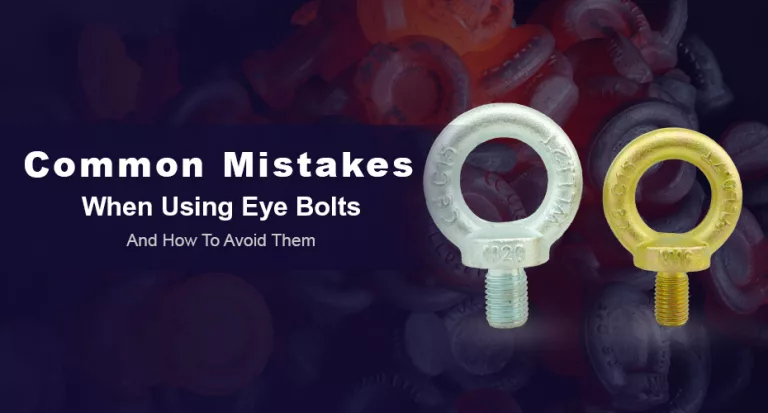
Common Mistakes When Using Eye Bolts And How To Avoid Them
Lifting ring bolts are widely used in lifting, rigging assembly and anchoring operations. They may seem simple, but in practical applications, many malfunctions often result from improper use rather than quality issues of the products themselves. For contractors, distributors and end users, understanding these common mistakes can help prevent costly equipment damage and safety hazards.
Table of Contents
Common Mistakes When Using Eye Bolts
The following lists the most common problems that occur on-site during operations – as well as the corresponding avoidance methods.
- Use of Shoulderless Hoop Bolts for Inclined Loads
This is one of the most common mistakes. The shoulderless ring bolts are specifically designed for pure vertical loads. When the force angle tilts, the load will generate bending stress on the bolt shank.
Possible Consequences:
- The bolt has undergone bending deformation.
- The thread is damaged.
- It experiences sudden fracture under load.
How to Avoid:
- In all cases involving lateral forces, shoulder lifting ring eye bolts must be used.
- Try to minimize the tilt angle of the load.
- Do not assume that ordinary lifting ring bolts can withstand tensile forces in the inclined direction.
The ring eye bolts were not fully tightened in place.
Improper installation is another common problem. In many cases, the eye bolts are not fully tightened to the bottom, leaving a gap between their shoulders and the installation surface.
Why This Matters:
- The load cannot be evenly distributed.
- The stress on the threads exceeds the design limit.
- The bolts may loosen during use.
Best Practices:
- Ensure that the threads are fully engaged.
- The bolt shoulder must be in tight contact with the installation surface without any gap.
- The contact area must be kept clean and flat.
2. Ignoring the direction of the load force
The lifting ring bolt achieves its best load-bearing capacity when the load is applied along the axis of the bolt. If the load is applied from the side or at an angle without corresponding alignment adjustments, problems will arise.
Common Consequences:
- The load-bearing capacity decreases.
- The phenomenon of stress concentration intensifies.
- The risk of deformation increases.
Solution:
Adjust the direction of the lifting ring to be consistent with the force direction of the load. Avoid generating torsional force or lateral pulling. If necessary, reposition the anchor point.
Operating beyond the rated load capacity for overloading work
Each eyebolt is marked with a clear Working Load Limit (WLL). Exceeding this limit will directly result in the failure or breakage of the bolt. In practical applications, overloading usually occurs in the following situations:
- The actual load was underestimated.
- Dynamic loads were ignored.
- Safety factors were not taken into account.
How to Prevent:
- Before use, be sure to check the **Working Load Limit (WLL)**
- Leave a safety margin, especially when performing lifting operations
- If in doubt, choose a larger specification product
3. Installation on substrates that are insufficiently strong or unsuitable
The strength of the anchor point of a ring bolt is not only determined by the bolt itself but also by the substrate to which it is installed.
Common Mistakes:
- Installed on thin steel plates
- Using base materials that are too soft or have cracks
- Ignoring the uplift strength of the base material
Possible Consequences:
- The base material fails before the bolt does.
- The anchor point pulls out when loaded.
Suggested Approach:
- Select base materials with structural-level strength.
- If necessary, reinforce the installation points.
- If installed on concrete, suitable embedded parts or special anchor bolts should be used.
4. Using inferior or unverified products
Not all eye bolts on the market meet the same quality standards. Some low-cost products may have the following problems:
- The quality of the materials varies greatly.
- The thread processing technology is rough.
- It has not undergone load testing.
Potential Risks:
- Performance is unpredictable.
- The actual strength is lower than the rated strength.
- The failure rate in actual use is relatively high.
How to Reduce Risks:
- Choose a reliable **eye bolt supplier**
- Request relevant test reports or material certificates
- Prefer products manufactured by experienced manufacturers
5. Neglecting corrosion and environmental factors
Lifting ring bolts used in outdoor or harsh environments are often exposed to moisture, chemical erosion and temperature changes for long periods of time.
If the material is not properly selected, the corrosive effect will gradually weaken the strength of the bolt over time.
Typical Issues:
- Rust accumulation on the surface
- Reduction in the cross-sectional strength of the bolt
- Seizing (jamming) of the threads
Better Choice:
When used outdoors, hot-dip galvanized eyebolt screws should be selected. In marine environments or areas with high salt fog, stainless steel materials should be considered. Regular inspection and maintenance should be carried out in corrosive environments.
6. Lack of inspection and maintenance
Ring bolts are often forgotten about after installation. Over time, their wear or damage is often overlooked.
Key inspection points:
- Is the screw bent?
- Is the thread worn?
- Are there any cracks or surface defects?
Good Operating Practices:
Regular inspections should be carried out, especially in heavy-load or high-intensity usage environments. Replace any damaged lifting ring bolts immediately. Do not reuse any damaged parts.
Quick Check List – Prevention is Better Than Cure
Before using the eye bolt as an anchor point, please check the following items:
- Whether the type is correct (shouldered type vs. non-shouldered type)
- Whether the installation is standard and fully in place
- Whether the load direction is aligned with the body of the lifting ring
- Whether the load is within the working load limit (WLL) range
- Whether the base material is solid and suitable
- Whether the material and surface treatment process are appropriate
Conclusion
Most failure accidents of eye bolts can be prevented. The key is not complicated – select the correct type, install it in accordance with the specifications, and ensure that the usage load does not exceed its limit range.
For critical application scenarios, the quality of the product itself is equally crucial. Choosing to collaborate with a reliable lifting ring eye bolt manufacturer helps ensure the consistency of product performance and the reliability of load ratings.
In rigging lifting operations, even the slightest oversight can often lead to serious consequences. Paying attention to and implementing the above details will be the key to ensuring the safety of the operation. There are substantial differences in terms of safety and long-term use. If you have any question, don’t hesitate to contact Sail Rigging.
FAQ
1. Will the lifting ring eye bolts fail when subjected to lateral loads?
Yes, ring eye bolts can indeed fail when subjected to lateral loads, especially those without shoulders (non-shoulder type). This type of bolt is only designed to bear vertical loads. When used at a certain Angle (i.e., in a non-vertical direction), the stress generated may cause the bolt to bend or suddenly break and fail.
2. What are the most common mistakes regarding lifting ring bolts? The most common mistake is choosing the wrong type eye bolts. Many users mistake apply lateral loads to shoulder-less lifting ring bolts, which significantly reduces the load-bearing strength of the bolts and greatly increases the risk of failure.
3. How often should lifting ring bolts be inspected?
The lifting ring eye bolts should be inspected regularly, especially in heavy-load or critical application scenarios. The inspection items include: whether there is deformation, whether the thread is worn, whether there are cracks or corrosion. Once any damage is found, the lifting ring bolt should be replaced immediately.