


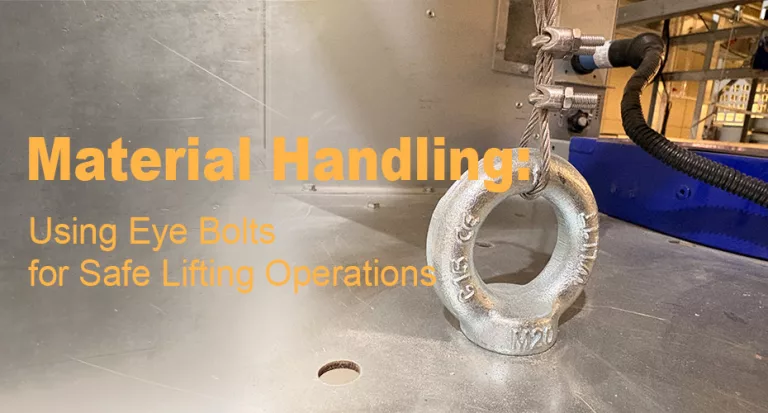
Material Handling: Using Eye Bolts for Safe Lifting Operations
Material handling is a crucial link in construction, manufacturing, logistics, and marine. Heavy equipment, steel structures, molds, and machinery often need to be safely lifted, moved, or fixed. To ensure the efficient operation of lifting tasks, reliable lifting eye bolts are of vital importance.
Among the most commonly used lifting components, eye bolts play a significant role; they provide stable connection points for slings, hooks and shackles,etc. As long as they are properly selected and installed, lifting eye bolts can enhance safety, improve efficiency and reduce risks in lifting operations.
This article will elaborate on what is a eye bolt, the ways it is applied in material handling, its advantages, relevant safety standards, and how to choose a right supplier.
Table of Contents
Why Eye Bolts Are Crucial in Material Handling
In modern industrial settings, material handling and lifting operations are carried out almost every day. Whether it is mechanical hoisting within factories or the transportation of structural components on construction sites, safety and reliability are always the top priorities.
Lifting ring bolts are widely used as permanent or temporary lifting points, capable of securely connecting loads to cranes, winches or rigging assemblies.
By using lifting eye bolts with the appropriate rated load grade, eye bolts manufacturer can ensure the safety of load handling, reduce downtime, and effectively protect the safety of workers during lifting operations.
What Is A lifting Eye Bolt?
A ring bolt is a fastener with a threaded end and a circular loop at the other end (referred to as the “ring eye”). It is designed to be screwed into machinery, equipment, or structural components to create a secure anchor point.
Lifting ring bolts are widely used in fields such as lifting, rigging assembly, anchoring, and material handling.
Common Types Of Eye Bolts Used In Lifting Operations
1. Shoulder eye bolts
The characteristic of the shoulder eye bolt is a “shoulder” (i.e. a protrusion) . There is a shoulder between the ring eye and the threaded rod. This shoulder structure enables the bolt to withstand loads at an angle, making it suitable for more complex lifting conditions.
2. Conventional (shoulderless) eye bolts
Conventional eye bolts without shoulders are only designed for vertical lifting. They must not be used in situations where lateral forces (lateral lifting) are applied.
3. Standard lifting Eye bolts
Some of the eye bolts are manufactured in accordance with international standards, such as the DIN 580 eye bolt standard; this standard clearly stipulates the dimensions, materials and rated load parameters of metric lifting eye bolts.
Material And Surface Treatment
Lifting ring bolts are usually made of the following materials:
- High-strength carbon steel
- Low-strength carbon steel
- Alloy steel
- Stainless Steel
Common surface treatment processes include
- Hot-dip galvanizing treatment
- Electro-galvanizing treatment
- Black oxided treatment
- Self color with oil
These surface coatings can significantly enhance the corrosion resistance of products, and are particularly suitable for marine lifting operation environments or outdoor construction sites.
The Application Of Eye Bolts In Material Handling
Ring bolts play a crucial role in numerous industrial lifting systems. They offer a convenient lifting connection point that can be directly linked to various rigging accessories such as shackles, hooks, and slings.
Typical material handling application scenarios include:
Lifting of mechanical equipment
Heavy machinery and equipment usually have threaded holes specially designed for installing lifting ring bolts. By installing such bolts, cranes or winches can safely lift the equipment during installation or maintenance.
Steel structure handling
In construction projects, lifting ring bolts are often used to hoist steel beams, steel frame structures and various prefabricated components.
Warehousing and logistics operations
In warehouse environments, eye bolts are widely used for lifting large containers, industrial parts and various heavy components.
Marine engineering and shipyard applications
In the shipbuilding and marine engineering industries, lifting eye bolts with excellent corrosion resistance are often selected for hoisting engines, marine equipment and ship components.
In the above-mentioned application scenarios, eye bolts are usually used in conjunction with rigging accessories such as shackles, hooks and lifting slings.
Why Choosing Lifting Eye Bolts In Lifting Operations?
1. Easy to install
The eye bolts can be easily screwed into the threaded holes reserved on the equipment or structure. This feature enables operators to quickly and conveniently set up temporary lifting points.
2. Strong load-bearing capacity
High-strength lifting ring bolts are meticulously designed to safely bear heavy loads, making them an ideal choice for various high-intensity material handling tasks. Common SEO search terms include:
- Heavy-duty lifting ring bolts
- High-strength lifting ring bolts
- Industrial lifting equipment
- Lifting ring bolts
3. Reusable and cost-effective
Unlike some lifting accessories that require welding or permanent installation, eye bolts can be disassembled and reused, making them an economical and efficient lifting solution.
4. Enhance lifting safety.
As long as they are properly installed and used within the rated working load limit (WLL), eye bolts can provide reliable and predictable lifting performance.
Compliance Standards
Due to the significant safety risks involved in lifting operations, lifting eye bolts must comply with strict industry standards.
A widely recognized international standard is the DIN 580 eye bolt standard, which stipulates the mechanical performance requirements for metric eye bolts used in mechanical and equipment lifting operations.
Key safety requirements
- Working load limit (WLL)
Each lifting ring bolt has a rated working load limit, which specifies the maximum load that the bolt can safely support.
- Correct installation
The threaded part must be fully screwed into the mating hole to ensure uniform load distribution.
- The correct direction of force application
Ordinary eye bolts are only suitable for vertical linear lifting; while eye bolts with shoulders (with flanges) can withstand inclined loads at limited angles.
- Check before use
The operator should check the following items:
Is the thread damaged?
Is the lifting ring deformed?
Is there any corrosion or wear?
- Routine inspections help prevent accidents during lifting operations.
How to Choose The Right Eye Bolt Supplier
1. Choosing a reliable lifting ring bolt supplier is crucial for ensuring product quality and safety.
Certified materials and manufacturing processes
Professional manufacturers should use high-quality steel and adopt controlled forging or machining processes for production.
2. Load testing and quality control
Reliable suppliers usually conduct the following tests:
Proof Load Testing
Tensile Strength Testing
Dimensional Inspection
These tests are designed to ensure that the lifting ring bolts meet the specified load grade requirements.
3. In line with international standards
Suppliers should be selected whose products meet recognized standards, such as:
DIN 580 eye bolts standard
ISO requirements for lifting hardware
4. Customization capability
Many industrial projects require customized lifting hardware, such as:
Customized thread size
Special surface coating
Heavy-duty lifting ring bolts
Suppliers with strong OEM (Original Equipment Manufacturer) capabilities can meet these customized demands. Internal link suggestions
View our full range of eye bolts products
Conclusion
Lifting eye bolts are indispensable tools in the field of material handling, such as mechanical installation and construction. By providing a stable lifting point, they make it possible to safely and efficiently lift heavy objects using cranes, winches and slings. Choose the correct type, rated load and installation method of lifting ring bolts. Strictly follow recognized standards such as the DIN 580 lifting ring bolt standard, and conduct regular inspections. These are key measures to ensure the safety of lifting operations. If you have any questions about lifting ring bolts, please feel free to contact us at any time. Our team will be dedicated to serving you and assist you in selecting the appropriate lifting ring bolts.