


What Are The Differences Between D Shackles And Bow Shackles?
A shackle is a U-shaped metal component, typically made of carbon steel or alloy steel, secured to an opening with a U-shaped pin or bolt. Shackles are essential components across a wide range of industries, from maritime, construction, and demolition to manufacturing, serving as connecting links in lifting, rigging, securing loads, and towing.
In my years in the industry, I’ve witnessed numerous instances where using the wrong shackle can lead to risk of failure. Choosing the right shackle can prevent serious safety incidents. Two common types of shackles available on the market are bow shackles and D-shaped shackles. While they may appear similar at first glance, each type serves a specific purpose, and understanding their differences is crucial for selecting the right shackle for a specific application. Today, we’ll compare bow shackles and dee shackles.
The Difference Between D Shackle And Bow Shackle
- Shape: Bow shackles, called Omega shackles too, offer greater side-to-side movement, making them suitable for applications involving multi-directional loads. Dee shackles, also called Chain shackles, have a more streamlined “D” shape. They are typically narrower than bow shackles, which limits lateral movement.
- Application: Bow shackles excel in applications involving distributed loads, reducing stress concentrations. Their rounded structure allows for angular adjustment without significantly reducing strength, making them ideal for handling forces from multiple directions. But dee shackles are generally stronger in applications involving single-direction, linear forces. Their smooth geometry makes them ideal for applications where slippage is unacceptable and space is limited
- Price: Bow shackles are typically slightly higher than D shackles. D shackles are generally less expensive, making them a more cost-effective option for larger applications.
- Angular Loads: Bow shackles are particularly well-suited for applications involving angular lifting, where the load may be pulled from different directions. But dee shackles are less versatile when handling forces from multiple directions. Misdirected forces can weaken the structure, leading to faster wear and, in extreme cases, even failure.
- Space Constraints: Bow shackles’s bulky design can be inconvenient for use in confined spaces. The smoother shape of the D-shaped shackle may be advantageous in applications with limited room for maneuver.
- Load Direction: Bow shackles are particularly well-suited for applications involving angular lifting, where the load may be pulled from different directions. Dee Shackles are typically more robust in applications involving unidirectional, linear forces.
- Working Load: Bow shackles have a higher working load limit. Dee shackles have a lower working load limit.
Three Common Applications for Bow Shackles
-
Bow Shackles in Marine
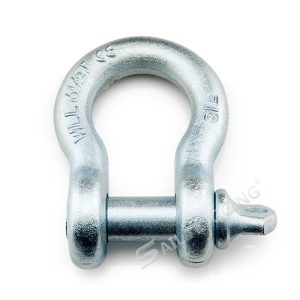
You may often hear the term “anchor shackle,” especially in the marine industry. An anchor shackle is actually a bow shackle, referring to its classic use: connecting a chain to an anchor. As a vessel moves with tides and currents, shackles are often subjected to loads from various angles. Bow shackles are well-suited to handling these dynamic, multi-directional loads.
-
Bow Shackles in Vehicle Recovery
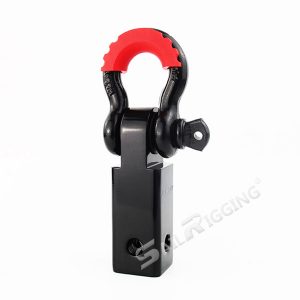
Bow shackles are also used when a vehicle is stuck and needs to be recovered. Vehicle recovery isn’t simply a lifting operation; it involves dynamic design. Vehicles can be stuck in mud, sand, or snow, creating significant additional resistance and potentially even increasing forces. In this case, you need a shackle with a working load limit (WLL) significantly greater than the vehicle’s static weight. For vehicle recovery, a bow shackle with a working load limit (WLL) of at least 3-4 times the vehicle’s gross vehicle weight is generally used. The right size ensures safe towing without damaging the equipment. Choosing the wrong shackle size can be dangerous and may lead to malfunction.
-
Bow Shackles in Material Handling
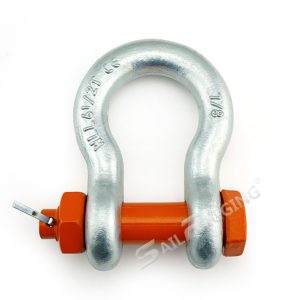
In material handling applications, shackles are essential components that connect various lifting equipment together. No building is complete without these efficient material handling tools. Shackles are made of forged and hardened alloy or carbon steel and are used to lift large amounts of building materials. They are commonly found in material handling operations on construction sites, on ships, and in the manufacturing industry.
Conclusion
The choice between a bow shackle and a D-type shackle depends not only on appearance but also on your operational needs. Understanding the inherent characteristics, advantages, and disadvantages of bow and straight shackles can improve the efficiency and safety of rigging and lifting operations. Choose carefully; the details of these seemingly simple devices can determine the success of the entire operation. If you want to know more useful information about bow shackles, you can also consult Sail Rigging