


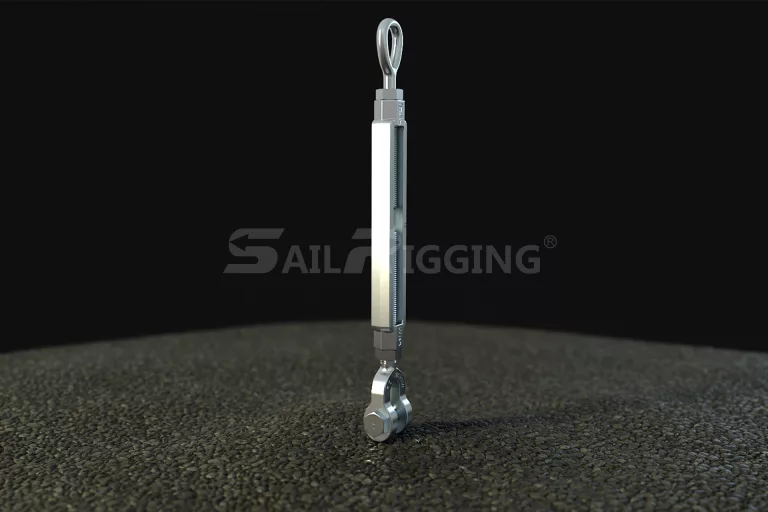
Turnbuckles, also known as rigging screws or bottle screws, are crucial tools used to adjust the tension and length of ropes, cables, and other tensioning systems in various industries. They are widely utilized in construction, marine applications, and theater rigging due to their simplicity and effectiveness. There’re three main parts of a turnbuckle, the central body, the left-hand threaded end fitting, and the right-hand threaded end fitting. This article will delve into each component’s role and significance.
1. The Central Body
The central body of a turnbuckle, also known as the turnbuckle frame, is typically an elongated, open or closed cylinder with internal threading at both ends. This central body can be made from various materials, including steel, stainless steel, or galvanized steel, depending on the application requirements.\
Material and Durability: For outdoor or marine applications, a galvanized turnbuckle is preferred due to its corrosion-resistant properties.
Design Variations: The body can come in different shapes and sizes, such as a rectangular or tubular frame, to accommodate different loads and applications.
Function: The central body’s primary function is to house the internal threads that interact with the end fittings. By rotating the central body, the user can simultaneously adjust both end fittings, thus increasing or decreasing the tension on the connected cables or rods.
2. The Left-Hand Threaded End Fitting
One end of the turnbuckle features a left-hand threaded end fitting. This component can vary in its specific design, including eye, hook, or jaw configurations, each serving different purposes.
Eye End Fitting: This type has a loop at the end, providing a secure attachment point that prevents disconnection.
Hook End Fitting: The hook design allows for quick and easy connection and disconnection, ideal for temporary setups.
Jaw End Fitting: Featuring a clevis pin and jaw, this fitting is used when a more robust and permanent attachment is necessary.
Function: The left-hand threaded end fitting moves inward or outward when the central body is rotated. The left-hand thread tightens when turned counterclockwise, making it essential for the turnbuckle’s tensioning mechanism.
3. The Right-Hand Threaded End Fitting
Opposite the left-hand threaded end fitting is the right-hand threaded end fitting. Like its counterpart, this fitting can also come in various designs such as eye, hook, or jaw.
Eye End Fitting: Offers a strong and permanent connection.
Hook End Fitting: Useful for applications where the connection needs to be frequently adjusted or removed.
Jaw End Fitting: Provides a secure connection with a clevis pin, ensuring stability and ease of installation.
Function: The right-hand threaded end fitting moves in the opposite direction of the left-hand fitting when the central body is rotated. The right-hand thread tightens when turned clockwise, working in tandem with the left-hand thread to adjust tension.
How They Work Together
The interplay between the left-hand and right-hand threaded end fittings is what makes the turnbuckle an efficient tensioning device. By rotating the central body:
Clockwise Rotation: Both end fittings move towards the center, increasing tension on the attached cables or rods.
Counterclockwise Rotation: Both end fittings move away from the center, reducing tension.
This mechanism allows for precise control over the tension in various applications, making turnbuckles invaluable in construction, marine rigging, and more.
The 3 component plays a critical role in the turnbuckle’s ability to adjust tension. Whether you’re using a galvanized turnbuckle for outdoor applications, a rigging screw for marine purposes, or a jaw turnbuckle for heavy-duty construction, understanding these parts will help you utilize this tool effectively. The combination of left and right-hand threads ensures a smooth and efficient tensioning process, making turnbuckles indispensable across various industries. If you want to know more about turnbuckles, don’t hesitate to contact Sail Rigging(Excellent Turnbuckle Supplier and Manufacturer for 15Years).