


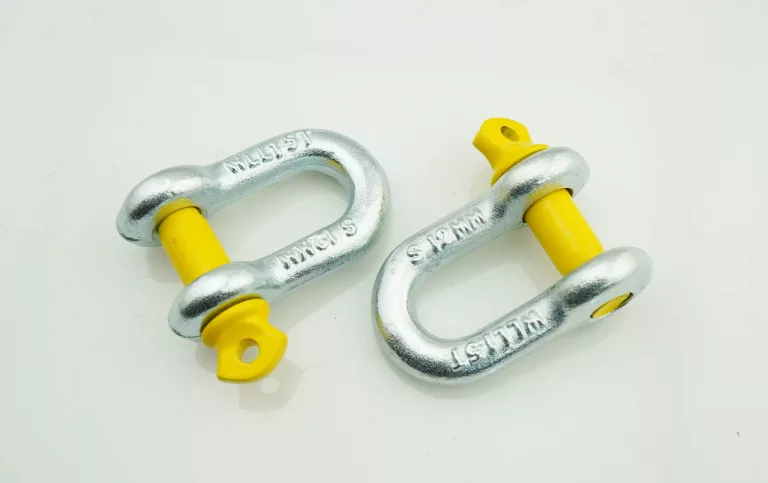
In Australian market, Australian standard shackles are common. There’re 3 types of grades, grade S, Grade M, and Commercial Grade. Each grade means different specific purposes and load capacities.
S Grade Shackles: A Foundation of Strength and Versatility
S Grade shackles stand out as the most prevalent grade owing to their exceptional strength and compatibility with similarly robust straps, chains, and wire ropes. The diameter of the pin is noticeably larger than that of the body, contributing to its robustness. An interesting characteristic of S Grade shackles is the occasional difference in color between the pin and the body. Contrary to popular belief, this color difference is not a standardized identifier but rather a means for suppliers to distinguish their products in the market.
The inherent strength of S Grade shackles makes them a preferred choice in a myriad of applications where a reliable and robust connection is paramount. The larger pin diameter further enhances their load-bearing capabilities, making them suitable for tasks ranging from towing to anchoring.
M Grade Shackles: Superior Ductility for Specialized Applications
M Grade shackles, while surpassing mild steel in strength, don’t quite match the sheer robustness of their S Grade counterparts. However, they carve a niche for themselves with a unique advantage—superior ductility. Ductility, the ability to change form under pressure without breaking, makes M Grade shackles invaluable in specific industries, such as fishing.
In the demanding conditions of the fishing industry, where forces fluctuate and the need for adaptability is crucial, M Grade shackles prove their worth. The larger pin diameter, akin to S Grade shackles, ensures a sturdy connection, while the enhanced ductility allows these shackles to endure and adapt to the dynamic pressures experienced during fishing operations.
Commercial Grade Shackles: Caution in Non-Rated Territory
Commercial Grade shackles, in contrast to the well-defined S and M Grades, often present a challenge due to their non-rated or non-marked nature. Identifying their grade or Working Load Limit (WLL) becomes a tricky task, and as a result, they are not recommended for critical applications. One distinctive feature of commercial grade shackles is the equal sizing of the body diameter and pin diameter.
These shackles lack the clear standards and markings found in S and M Grade counterparts, making them unsuitable for scenarios where precise load-bearing capacities are essential. While they may find use in non-critical, light-duty tasks, caution should be exercised when opting for commercial grade shackles, as their grade or WLL cannot be reliably ascertained.
Conclusion
In conclusion, understanding the nuances of S Grade, M Grade, and Commercial Grade shackles is crucial for making informed decisions in various applications. Each grade has its unique characteristics, strengths, and ideal use cases, and choosing the right shackle ensures both safety and efficiency in diverse industrial settings. If you want to know more about Australian Standard Shackles, Please contact Sail Rigging Now.