


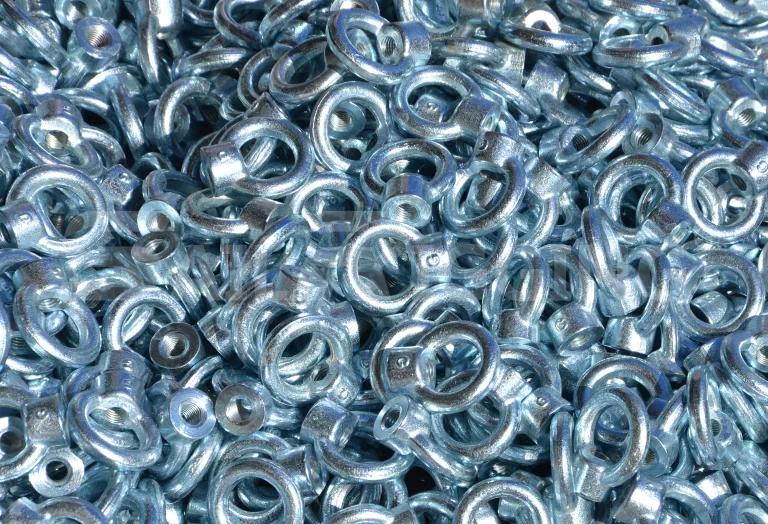
The quality of the lifting ring is crucial to ensure the safety of lifting and hoisting and provide work efficiency. No matter DIN eye bolt, JIS eye bolt or US eye bolts, must undergo a series of rigorous tests.
- Appearance inspection.
By visually inspecting the appearance of the lifting eye bolt, observe whether the surface galvanizing is rusted, leaking galvanizing, scratched, whether there is material shortage, whether there are burrs, etc. This step is a preliminary inspection, which can quickly find some obvious defects.
- Tensile test
Using the static tensile test method, the lifting ring is connected to the tensile testing machine through the tooling, and the tension is gradually increased until the lifting eye bolt breaks or deforms significantly.
- Hardness test
Check whether the hardness of the lifting eye bolt meets the standard requirements. Too hard or too soft lifting eye bolt may cause safety hazards in use. We mainly test the hardness of the lifting eye bolt by Rockwell hardness tester. Rockwell hardness tester determines the hardness of the lifting eye bolt material by applying a certain load on the surface of the lifting ring and then measuring the depth of the surface depression or the size of the indentation on the surface of the lifting eye bolt to determine whether the material of this lifting eye bolt can resist penetration or indentation.
- Size detection
Use a vernier caliper to measure the size, whether the thread is consistent with the typing, and whether the screw, thread, inner length, and material diameter are within the standard range.
- Go and no-go gauge detection
For thread measurement, we usually use go and no-go gauges for detection. First, the thread plug gauge is used to check whether the size of the internal thread meets the requirements. When using it, first try to screw it in with the go gauge. If it cannot be screwed in, it means it is unqualified; if it can be screwed in, then use the no-go gauge for testing. If the no-go gauge cannot be screwed in or can only be screwed in one or two teeth, it is qualified. Secondly, the thread ring gauge is used to measure the external thread. During operation, if the go gauge can be completely screwed into the external thread, and the no-go gauge can only be screwed in partially and not more than two pitches, then it can be judged that the external thread is qualified, otherwise it is unqualified.
- Salt spray test
We have our own salt spray tester, and the salt spray on the surface of eye bolt can be produced and tested according to international standards or customer requirements.If you have same inspection requirement of eye bolts, don’t hesitate to consult Sail Rigging.