
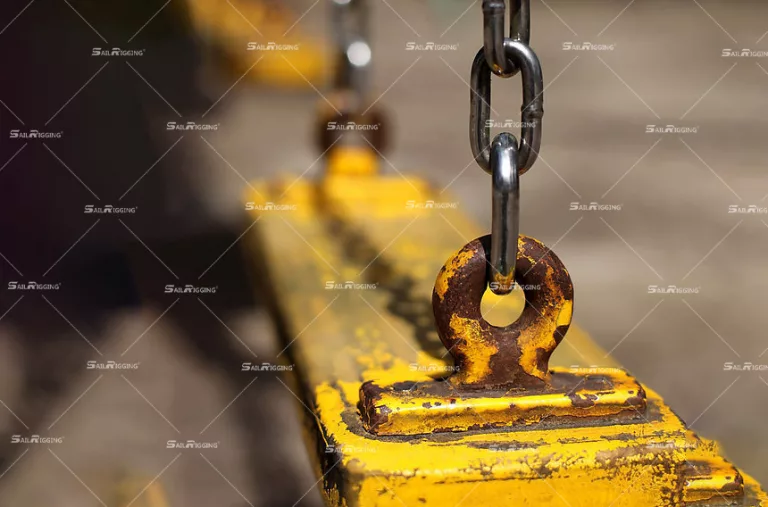
Producing galvanized welding chain involves a series of meticulous steps to ensure the chain’s strength, durability, and resistance to corrosion. There’re various standards of the quality and specifications, including ASTM (American Society for Testing and Materials) and DIN (Deutsches Institut für Normung).It is widely used in transport, lifting and hauling, lashing application. In this article, we will take you to see the production of galvanized chain, from raw material to quality control and package.
1. Material Selection
Raw Material High-quality steel wire or rod is chosen based on its suitability for welding and meeting required strength specifications.
2. Wire Forming
- Wire Drawing: Steel is drawn through dies to reduce its diameter, enhancing tensile strength and elongation properties.
- Link Production: The drawn wire is cut into precise lengths for link formation, often using automated machinery for accuracy.
3. Chain Assembly
- Link Formation: Links are shaped using bending machines or jigs.
- Welding: The links are welded together using electric arc or resistance welding techniques to create a robust chain structure.
4. Galvanization Process
- Cleaning: The assembled chain is thoroughly cleaned to remove contaminants such as grease and oxidation, using methods like sandblasting or chemical cleaning.
- Zinc Coating: The chain undergoes galvanization through:
- Hot-Dip Galvanization: Immersion in molten zinc creates a thick, durable coating.
- Electro-Galvanization: A thinner zinc layer is applied using an electroplating process, suitable for lighter applications.
5. Cooling and Inspection
- Cooling: The galvanized chain is cooled, allowing the zinc to adhere effectively.
- Inspection: Batches are inspected for coating quality, link integrity, and overall appearance, checking for thickness and strength.
6. Quality Control and Standards
- Testing: Chains are tested for compliance with industry standards, ensuring they meet performance criteria for tensile strength and corrosion resistance.
- Standards: Different standards apply to galvanized chains, including:
- ASTM Standards: In the U.S., ASTM A391 (for welded steel chain) and ASTM A153 (for zinc coating) are commonly referenced for performance and coating specifications.
- DIN Standards: In Europe, DIN 766 (for short link chain) and DIN 5685 (for round link chains) provide guidelines on dimensions, load capacities, and testing methods.
- Certification: Chains may receive certification based on these standards, ensuring they meet safety and performance criteria.
7. Packaging and Distribution
- Packaging: Finished chains are packaged securely, often coiled or placed in containers to prevent tangling and damage during shipping.
- Shipping: Packaged chains are distributed to retailers or customers, ready for various applications in industries like construction, agriculture, and marine.
Producing galvanized chain requires careful attention to material selection, manufacturing techniques, and compliance with established standards like ASTM and DIN. By following these steps, Qingdao Sail Rigging Co.,Ltd could produce reliable, corrosion-resistant chains suitable for demanding applications where strength and durability are paramount. If you have any need of galvanized chain, please feel free to contact Sail Rigging.