


Do Not Over-torque Wire Rope Clips!
This means avoid torque wire rope clips over their recommended torque value , which will prevent damage from thread stripping, bolt breakage, material deformation, and ultimate failure. When we install wire rope clips, some people may not understand the torque specifications of the clips, or they simply follow methods passed down from previous generations. However, over torque wire rope clips will lead to property damage, even cause injury to oneself or others. Therefore, understanding the torque values of wire rope clips and torque them correctly is crucial.
What is Torque Value?
Torque is the rotational force used to rotate a nut, bolt, or screw. Torque is calculated by multiplying the applied force by the distance from the pivot point to the point of rotation. It represents the tightness of the clip bolt rotation to achieve the specific tension required for product integrity. Torque value could be measured in foot-pounds (ft-lbs) or Newton-meters (Nm). The correct torque value prevents over-torque or undertightening. The specific value depends on bolt size, material, lubrication, and surface treatment.
Torque Values for Wire Rope Clips
The torque value of wire rope clips varies with the rope diameter. Different standards of wire rope clips have different torque values. For US drop forged wire rope clips G450, 4.5 ft-lbs for 1/8 inch wire rope clips, 15 ft-lbs for 1/4 inch cable, and 30 ft-lbs for 3/8 inch cable. The larger size is, the greater torque value will be. For DIN74 wire rope clips, 36 N·m for M10 wire rope clips, 67 N·m for M14 wire rope clips, and 85 N·m for M16 wire rope clips. For DIN1142 wire rope grips, 9 N·m for M10 wire rope clamp, 33 N·m for M13 wire rope clamp, and 49 N·m for M16 wire rope grip.
Different Torque Value for Different Standard Wire Rope Clips
Different standards wire rope clips have different torque value. US drop forged wire rope clip’s torque values from 4.5-1200 N·m, DIN741 wire rope clip’s torque values from 7-270 N·m, and DIN1142 wire rope clip’s torque values from 2-363 N·m. US malleable iron wire rope clip’s torque values ranging from 2-363 N·m. You could refer to below chart for specific torque values for different standard wire rope clips.
| US Drop Forged Wire Rope Clip G450 |
DIN741 Wire Rope Clip |
DIN1142 Wire Rope Clip |
|||
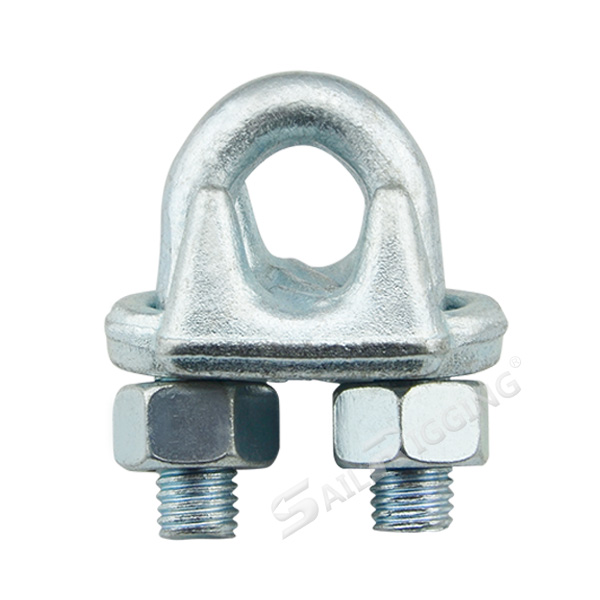 |
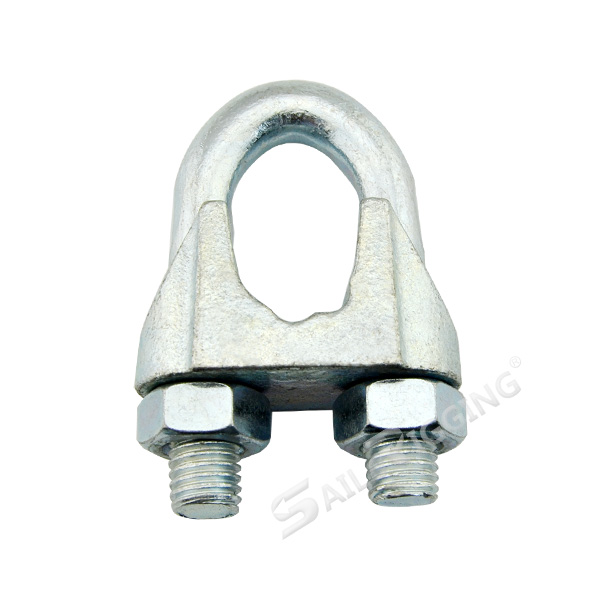 |
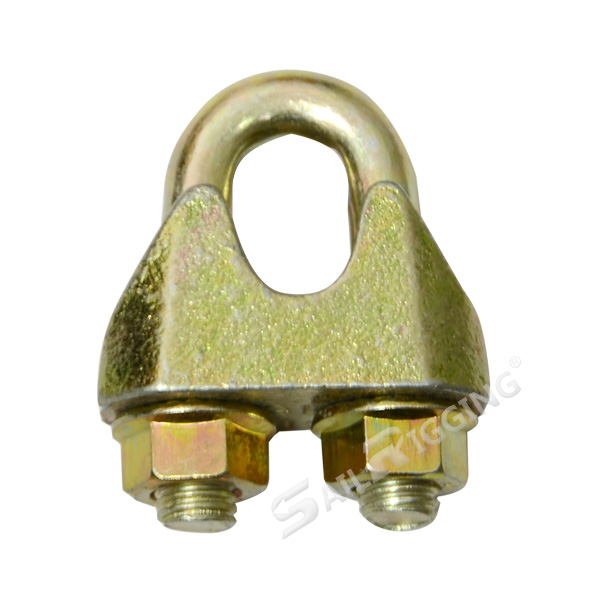 |
|||
| Size (Inch) | Torque(lbf*ft) | Size (mm) |
Torque(N·m) | Size (mm) |
Torque(N·m) |
| 1/8′ | 4.5 | M3 | ….. | M5 | 2 |
| 3/16′ | 7.5 | M5 | 7 | M6.5 | 3.5 |
| 1/4′ | 15 | M6 | 7 | M8 | 6 |
| 5/16′ | 30 | M8 | 11 | M10 | 9 |
| 3/8′ | 45 | M10 | 36 | M13 | 33 |
| 7/16′ | 65 | M11 | 36 | M16 | 49 |
| 1/2′ | 65 | M12 | ….. | M19 | 67.7 |
| 9/16′ | 95 | M13 | 67 | M22 | 107 |
| 5/8′ | 95 | M14 | 67 | M26 | 147 |
| 3/4′ | 130 | M16 | 85 | M30 | 212 |
| 7/8′ | 225 | M16 | 115 | M34 | 296 |
| 1′ | 225 | M22 | 228 | M40 | 363 |
| 1-1/8′ | 225 | M26 | 228 | ||
| 1-1/4′ | 360 | M30 | 270 | ||
| 1-3/8′ | 360 | M32 | ….. | ||
| 1-1/2′ | 360 | M34 | 270 | ||
| 1-5/8′ | 430 | M40 | 270 | ||
| 1-3/4′ | 590 | M45 | ….. | ||
| 2′ | 750 | M50 | ….. | ||
| 2-1/4′ | 750 | ||||
| 2-1/2′ | 750 | ||||
| 2-3/4′ | 750 | ||||
| 3′ | 1200 | ||||
How to Install Correctly
1. Use a torque wrench
apply the correct force by a calibrated torque not wrench or impact wrench.
2. Follow wire rope clip specifications
Contact Sail Rigging to determine the correct number of clips, spacing, and specific torque settings (usually in N·m) suitable for your wire rope size.
3. Correct direction
Place the saddle (U-shaped part) on the live end (load-bearing part), and the U-bolt on the dead end. Remember not put the saddle on the dead horse.”
4. Tighten alternately
Rigging experts recommend tightening the nuts alternately to ensure even pressure.
5. Retighten nuts after initial loading
After the rope is initially loaded, the nuts should be rechecked and retightened.
Conclusion
Understanding the torque values of wire rope clamps and proper installing are crucial for rigging operations.If you want to learn more about wire rope clamps, you can consult Sail Rigging. Sail Rigging offers a wide variety of wire rope clips in various specifications and is equipped with tensile testing machines, salt spray testing machines, and zinc coating testers, allowing them to provide complete test reports.
FAQ
1. Why don’t over torque wire rope clips?
Over torque is very harmful: First, it will cause wire rope clip’s bolts to stretch or weaken. Once the bolts are stretched and weakened, they cannot withstand the required load, which may cause them to break under pressure. Second, it will cause thread stripping and damage, rendering the bolt unusable. Third, it may deform, crack, or crush the clamped U-bolt component. Fourth, it will lead to twist or damage to the rope, preventing it from bearing the expected load and resulting in an unsafe connection.
2. The torque for a 9/16 American forged wire rope clip is 95 ft-lbs. How to install it correctly to achieve the specified torque value?
Using a calibrated torque wrench, alternately tighten the two nuts on the wire rope clip. First, tighten nut one by one, and then evenly tighten both nuts, locking the torque to 95 foot-pounds. The torque wrench will stop turning once this torque value is reached. It’s difficult to know if the specified torque value has been reached using only a regular socket wrench or power drill. Finally, the clamp bolts must be subjected to a load and tested before being tightened again.