


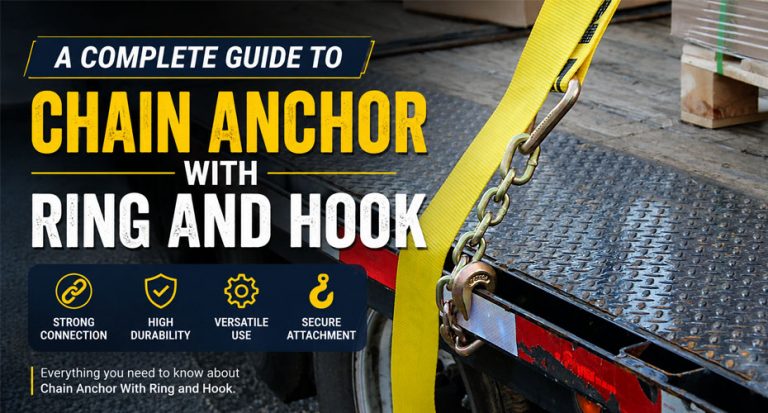
A Complete Guide To Chain Anchor With Ring and Hook
When a trailer, truck, or cargo securement system needs a little extra reach, a Chain Anchor With Ring and Hook can be a practical solution. This type of hardware combines a chain anchor, connecting ring, and hook into one compact assembly, making it easier to connect chains to trailer anchor points or extend an existing chain system.
Chain extensions are commonly used when the original chain is too short to reach the required connection point. In trailer applications, for example, longer safety chains may be needed when the tow vehicle has a different hitch configuration. Commercial trailer products also use chain-extension assemblies to connect tie-down chains or webbing to stake pockets and rub rails.
But what exactly is a Chain Anchor With Ring and Hook, and how should it be selected? This guide explains its structure, applications, WLL, and key purchasing considerations.
Table of Contents
What Is Chain Anchor With Ring and Hook?
Chain Anchor With Ring and Hook is a connecting component designed to provide a secure transition between an anchor point and a chain. Depending on the design, the assembly typically consists of three main parts:
- Chain Anchor: Provides the attachment point for the assembly.
- Ring: Creates a connection interface between the anchor and chain or other hardware.
- Hook: Allows the chain to be attached or detached quickly.
The exact configuration can vary according to the application. Some assemblies are designed specifically for trailer tie-down systems, while others are used as chain extensions or connection accessories.
The main advantage is simple: one assembly can provide both connection and additional reach without requiring a completely new chain system.
How Does a Chain Anchor With Ring and Hook Work?
The basic load path can be understood as:
Trailer or Anchor Point → Ring → Hook → Chain → Secured Load
When used as a chain extension, the assembly is connected between the existing chain and the trailer’s designated anchor point. This allows the operator to compensate for a chain that does not have enough usable length.
For example, a lifted truck may position the hitch farther from the trailer than a standard truck. In such cases, an extension can provide the additional reach needed for the safety-chain connection. Real-world trailer applications use additional chain sections or extension hardware for precisely this type of problem.
The extension should not, however, be viewed as a way to increase the capacity of the original system. Its job is to improve reach and connection compatibility while maintaining an appropriate load rating.
Using Chain Anchor With Ring and Hook as a Chain Extension
One of the most useful applications is extending an existing chain.
A chain extension can be helpful when:
- The original trailer safety chain is too short.
- A different hitch configuration requires additional reach.
- A tie-down chain needs to reach a trailer stake pocket.
- The connection point is difficult to access with the original chain.
- A damaged extension section needs to be replaced without replacing the entire system.
Commercial tie-down assemblies commonly combine transport chain with a D-ring and grab hook so the chain can connect conveniently to trailer stake pockets or rub rails. (US Cargo Control)
For trailer safety chains, extension solutions are also available for different chain sizes and ratings. The important point is to match the extension hardware with the original chain and the trailer’s rated attachment points.
Key Components and Their Functions
1. Chain Anchor
The chain anchor provides the structural connection to the trailer, truck, or other fixed point. It must be strong enough for the intended application and properly attached to the supporting structure.
2. Ring
The ring provides an intermediate connection point. Its shape and inside diameter determine what hooks, links, or other hardware can be connected.
A properly sized ring should allow the connecting hardware to move naturally without creating excessive side loading.
3. Hook
The hook provides the quick connection to the chain. Depending on the application, manufacturers may use different hook designs, including grab hooks, slip hooks, clevis hooks, or other specialized configurations.
The hook should always be compatible with the chain size and intended load rating.
Where Is a Chain Anchor With Ring and Hook Used?
This type of assembly can be useful across several industries.
Trailer Load Securement
Trailer operators can use chain extension assemblies to connect tie-down systems to available anchor points.
Heavy Equipment Transport
Construction equipment, agricultural machinery, and other heavy loads may require flexible connection points because anchor locations differ from one trailer to another.
Vehicle Towing
Towing and trailer applications sometimes require additional chain reach because of differences in hitch height, vehicle configuration, or attachment geometry.
Cargo Tie-Down Systems
Chain-and-hook assemblies can also work alongside webbing and winch straps. Chain extensions are particularly useful around stake pockets and rub rails because the chain section can provide a durable connection while the webbing handles the main tie-down function.
How to Choose the Right Chain Anchor With Ring and Hook
Choosing the correct assembly involves more than selecting a chain diameter. Consider at least five factors.
1. Chain Size
Common transport-chain sizes include 1/4″, 5/16″, and 3/8″. The chain, hook, connecting ring, and anchor should be physically compatible.
2. Chain Grade
Grade 43 and Grade 70 chains are commonly found in trailer and cargo securement applications. Do not assume that a larger-diameter chain automatically provides a suitable rating. Chain grade and the complete assembly rating must also be considered.
3. Working Load Limit
WLL is one of the most important specifications.
The WLL of the complete connection should not be determined by looking at the chain alone. The hook, ring, connecting hardware, anchor point, and chain all contribute to the performance of the system.
For example, some commercially available 5/16″ Grade 70 trailer safety-chain assemblies specify a WLL of 4,700 lb per chain, illustrating why chain diameter and WLL should not be treated as interchangeable specifications.
4. Hook Type
Select the hook according to the connection point and chain configuration.
A grab hook is useful when the hook needs to engage a specific chain link. A clevis hook can be useful for trailer safety-chain attachment points. Other hook styles may be more appropriate for specialized towing or securement applications.
5. Length
Measure the actual distance between the connection points before ordering an extension.
Too short, and the extension will not solve the connection problem. Too long, and excessive slack may create another safety or handling issue.
Why the Weakest Component Matters
A common mistake is to calculate the capacity of a Chain Anchor With Ring and Hook based only on the chain.
The actual connection is a system.
Chain WLL ≠ Hook WLL ≠ Ring WLL ≠ Anchor Point Capacity
If one component has a lower rated capacity than the others, that component can become the limiting factor. Therefore, the complete assembly should be selected according to the manufacturer’s rated capacity and the requirements of the application.
This is particularly important when modifying an existing trailer safety-chain system. A stronger chain does not automatically make the entire assembly stronger if the connecting link or anchor point has a lower capacity. Extension components should be selected so that they are compatible with the existing system.
Common Mistakes to Avoid
Several problems can be avoided with a few simple checks:
- Do not select an extension based only on chain diameter.
- Do not mix chain grades and hardware without checking compatibility.
- Do not use a hook with an inadequate WLL.
- Do not bend or modify hooks to make them fit an anchor point.
- Do not exceed the rated capacity of the complete system.
- Do not ignore the capacity of the trailer’s original anchor point.
- Inspect chains, hooks, rings, and connecting hardware before use.
In particular, modifying a hook to make it fit a connection point is not a good solution. Properly sized replacement or extension hardware is the safer approach.
Chain Anchor With Ring and Hook vs. Standard Chain Extension
A standard chain extension may simply consist of a length of chain with a hook or connecting link at one end. A Chain Anchor With Ring and Hook provides a more structured connection arrangement, particularly when a defined anchor point is required.
| Feature | Chain Anchor With Ring and Hook | Standard Chain Extension |
|---|---|---|
| Connection flexibility | High | Medium |
| Quick connection | Yes | Depends on design |
| Suitable for trailer anchor points | Yes | Yes |
| Available configurations | Multiple | Multiple |
| Customization | Chain, ring, hook, length | Mainly chain and connector |
For B2B buyers, the best configuration depends on the trailer design, chain grade, required length, and target WLL.
What Should Buyers Look for From a Supplier?
For commercial purchasing, product quality should go beyond appearance.
Ask the supplier about:
- Chain grade and material
- Hook material and manufacturing process
- Ring dimensions
- Working Load Limit
- Proof or tensile testing
- Surface treatment
- Dimensional inspection
- Batch traceability
- Custom chain length
- Custom hook and ring combinations
- OEM packaging and labeling
For products used in towing and cargo securement, clear WLL marking and consistent quality are especially important.
Frequently Asked Questions
1.Can a Chain Anchor With Ring and Hook be used as a chain extension?
Yes. When the assembly is designed and rated for the application, it can provide additional reach between an existing chain and an anchor point.
2.Does a chain extension increase the WLL of the original chain?
No. An extension primarily increases usable length or improves connection compatibility. The complete system remains limited by its applicable rated components and anchor point.
3.What chain size should I use?
The chain size should be selected according to the load, required WLL, application, and existing trailer or tie-down system. The hook and ring must also be compatible with the selected chain.
4.Is Grade 70 always better than Grade 43?
Not necessarily. Grade 70 provides a higher strength-to-size ratio in applications designed for transport securement, but the correct chain grade depends on the intended use and applicable requirements.
Conclusion
Chain Anchor With Ring and Hook provides a convenient connection between an anchor point and chain and can be particularly useful when additional reach is needed for trailer, towing, and cargo securement applications. If you have any question about chain anchor with ring and hook, don’t hesitate to contact Sail Rigging.