


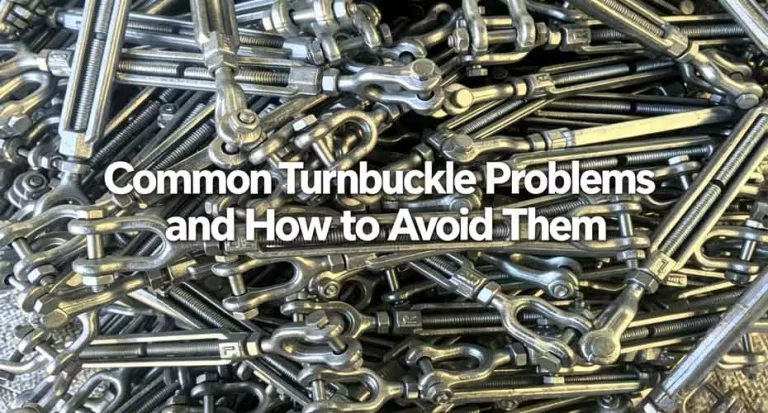
Common Turnbuckle Problems and How to Avoid Them
A Turnbuckle is one of the commonly used components in rigging and tensioning systems. It is used to adjust and maintain the tension of steel wires, cables, rods and chains. From construction sites and ship equipment to fence systems and industrial structures, tensioning screws are widely used to keep the system correctly aligned and firmly connected.
Although the design of turnbuckles are relatively simple, problems may still take place during installation or long-term use. Many buyers, distributors and contractors encounter similar issues when using tension screws, especially if quality or installation method is not ideal.
Understanding these common problems and knowing how to prevent them can help improve safety, extend product life and reduce maintenance costs.
Table of Contents
Damaged threads or stripped threads
One common problems with heavy-duty turnbuckles is thread damage. Since the turnbuckle works by adjusting tension through the threaded rod, the thread is a key component of its mechanism.
Reasons
- Poor thread processing
- The quality of the materials is poor.
- Over-tightening during installation
- The lead screw is misaligned.
- Once the thread is damaged, the tensioner cannot maintain the appropriate tension, and in some cases, the entire component must be replaced.
How to avoid this problem
To prevent damage to the threads:
- Choose a tensioner with high precision in thread processing.
- Avoid applying excessive force when making adjustments.
- Make sure the two threaded ends are correctly aligned before tightening.
- Work with reputable tensioner manufacturers to ensure they strictly adhere to processing tolerances.
- High-quality manufacturing processes can significantly reduce the risk of thread failure.
Corrosion and Rusting
Another common problem is corrosion. Many galvanized tensioners are used in outdoor or damp environments, such as ship equipment, building structures or agricultural fencing systems.
Without proper protection, steel components will rust over time. Corrosion weakens the metal surface, reduces the load-bearing capacity, and makes adjustments difficult.
How to avoid this problem
Choosing the appropriate surface treatment is of vital importance.
Common protective coatings include:
- Hot-dip galvanized basket screws for outdoor applications
- Galvanized flower basket screws for indoor applications
- Stainless steel flower basket screws for marine or corrosive environments
Among these options, hot-dip galvanizing is widely used in the rigging hardware industry because it can form a thick zinc protective layer, thereby enhancing corrosion resistance.
Incorrect selection of the size of turnbuckles
Using wrong size of turnbuckle screws is another common problem. Some users choose a smaller size to cut costs, but this may cause serious safety hazards.
If working load limit of the hexagon socket head cap screw is lower than the actual applied tensile force, the following situations may occur:
- Bending under force
- Long-term deformation
- Unexpected failure under extreme conditions
How to avoid this problem
When choosing hexagon socket set screws, buyers should consider:
- The required working load
- Connection type (ring, hook or claw)
- The required adjustment length
- The usage environment of the product
A reputable supplier of hexagon socket set screws should be able to provide technical specifications and rated loads to assist customers in choosing the appropriate size.
Deformation under Overload
In some cases, heavy-duty turnbuckles may bend or deform after being under stress for a long time. This usually occurs when the product is made of low-grade materials or when the forging process is poor.
High-quality turnbuckle screws are usually produced by die forging, which can enhance the strength and internal structure of the metal.
If the manufacturing process is not well controlled, the tension screw body may have internal defects, thereby reducing its load-bearing capacity.
How to avoid this problem
To reduce the risk of deformation:
- Choose forged rather than cast tension screws.
- Confirm that the manufacturer has conducted overload verification tests.
- Verify the material grade and mechanical properties.
Reliable rigging hardware manufacturers usually conduct strict strength tests on their products before they leave the factory.
Loose connection during operation
The design purpose of turnbuckles are to maintain tension, but if it is not fixed correctly, it may gradually loosen due to vibration or movement.
This situation is particularly common in the following applications:
- Transport equipment
- Structural support system
- Marine Applications
When the tensioning screw becomes loose, the entire tensioning system may become unstable.
How to avoid this problem
After adjustment, there are several ways to secure the tensioning screw:
Use lock nuts
Install a safety wire on the screw body.
Use tension locks or clips
These methods help prevent unnecessary rotation and keep the tension stable over the long term.
Choose reliable turnbuckles supplier to ensure long-term performance
Choosing products from a tensioner manufacturer with rich experience and a sound quality control system can prevent many tensioner problems.
A reliable supplier
High-quality pliers products pay close attention to material selection, precise processing, appropriate forging techniques, and rigorous testing procedures.
For distributors and contractors, collaborating with turnbuckle supplier not only enhances product reliability but also helps to reduce maintenance costs and minimize customer complaints.
Conclusion
Although turnbuckles are small components, it plays a crucial role in many tensioning and rigging systems. Have you meet damaged threads, corrosion, size mismatch, deformation, and loose connections? If you have same problems with turnbuckles, don’t hesitate to let us know.