A Guildline To Tension Lever With Chain And Hook
In cargo transportation, we often use lashing equipment to secure and tie-down goods. In maritime logistics, we also meet a specialized type of load binder —tension lever with chain & hook. Today we’ll introduce this unique lashing device, including its components, dimensions, and application scenarios.
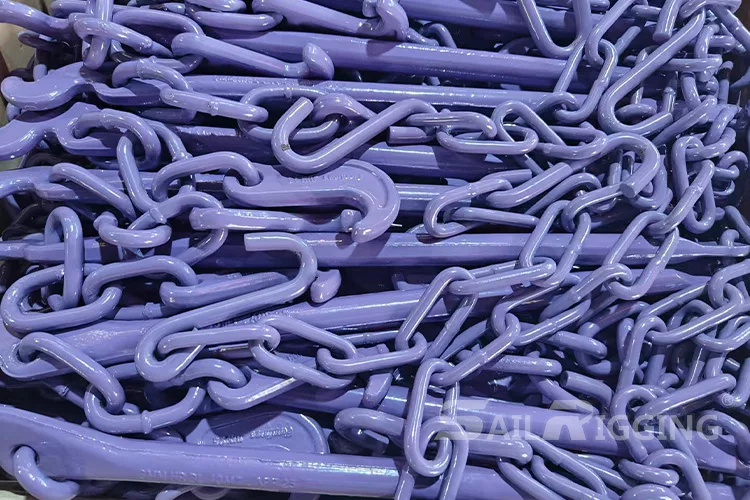
Tension lever with chain and hook, also known as Lashing Chain Tension Lever or Ro-Ro Lashing Chain Tensioner, is a common ship securing device, particularly on roll-on/roll-off vessels. It serves as a tool and apparatus for securing cargo on ships, preventing displacement during rough seas. These tensioners apply and maintain tension on lashing chains, ensuring vehicles, machinery, or containers remain stationary during maritime transport—especially in rough seas.
Table of Contents
What is a tension lever with chain & hook?
It consists of an extension lever, two chains (long chain, short chain), and hooks at both ends of the chains (typically flat hooks/climbing hooks and S-hooks) to generate tension for securing cargo. Loading/unloading personnel apply greater force to the tensioning rod during lashing, thereby enhancing the overall efficiency of the chain system. Its components are typically crafted from high-strength forged steel, ensuring robustness, durability, and reliable performance. Like other load binder, tension lever with chain and hook is always used in conjunction with cargo lashing chains. The extension lever is manufactured from exceptionally sturdy materials, guaranteeing durability and dependable functionality. Its surface is coated with paint (red, blue, yellow, etc.) to protect against harsh weather conditions and extend service life.
Common Sizes
Tension lever with climbing hooks are used to tighten chains of varying lengths for cargo securing. climb hooks are available in different strength specifications, including 9mm, 11mm, and 13mm. The 13mm lashing chain tension rod has a Working Load Limit (W.L.L.) of 10 tons and a Breaking Load of 20 tons. The 11mm lashing chain tensioner has a Working Load Limit (W.L.L.) of 7.5 tons and a Breaking Load of 15 tons. The 9mm lashing chain tensioner has a Working Load Limit (W.L.L.) of 5 tons and a Breaking Load of 10 tons.
| Size
mm |
Breaking Load | L
mm |
L1
mm |
D
mm |
Weight
KGS |
| 9 | 10 | 575 | 275 | 11 | 3.4KGS |
| 11 | 15 | 595 | 335 | 12 | 4.5KGS |
| 13 | 20 | 570 | 370 | 14 | 5.6KGS |
Where To Use Tension Lever?
1. Suitable for securing heavy cargo during maritime transport
With a maximum breaking strength of 200 kN (20 tons), the crossbar hook’s high tensile capacity makes lashing chains ideal for securing heavy cargo during transit. Adjustable chain lengths combined with tension levers enable rapid tightening, allowing heavy loads to be securely fastened to vessels and other transport vehicles.
2. Suitable for Roll-on/Roll-off (RoRo) Transport
Due to their rapid installation capability, lashing chains are also ideal for Roll-on/Roll-off (RoRo) transport, where cargo is loaded onto or unloaded from vessels via vehicles. For instance, trucks, agricultural machinery, and earthmoving equipment can be securely fastened.
How to Use Spreader Hooks More Effectively?
Safety standards for ship cargo securing equipment are critical to ensuring safe cargo transport and crew safety. Therefore, proper use and maintenance of spreader hooks are paramount.
1. Regular Inspection: Spreader hooks should be inspected periodically for signs of wear, rust, or any damage that could compromise their strength or integrity.
2. Proper Usage: Ensure the lashing equipment used is appropriate for the type and size of the cargo being secured to prevent overloading or inadequate securing.
3. Secure Tensioning: Lashing lines should be properly tensioned to prevent cargo shifting during rough seas or sudden maneuvers.
4. Load Distribution: Distribute cargo weight evenly and appropriately across the ship’s deck to prevent overloading and maintain stability.
5. Weather Considerations: Account for weather conditions when securing cargo, particularly in rough seas or adverse weather, to prevent accidents or cargo damage.
Conclusion
Understanding, selecting, and correctly using tension lever with chain and hook is crucial for ensuring safe and stable maritime cargo transport. If you have further questions about spreader hooks, feel free to consult Sail Rigging. We will arrange for an experienced product manager to assist you.