
Eye Nut Guide: Understanding Their Parameters, Materials, Types, Applications, and Installation
Are you troubled by not finding safe lifting or anchoring points when handling materials? Are you worried about lifting heavy machinery or securely securing goods? Choosing the wrong hardware can be dangerous, even leading to accidents. That’s when you need a reliable lifting solution. Eye nuts provide a secure threaded connection for these demanding industrial applications.
What are Eye Nuts?
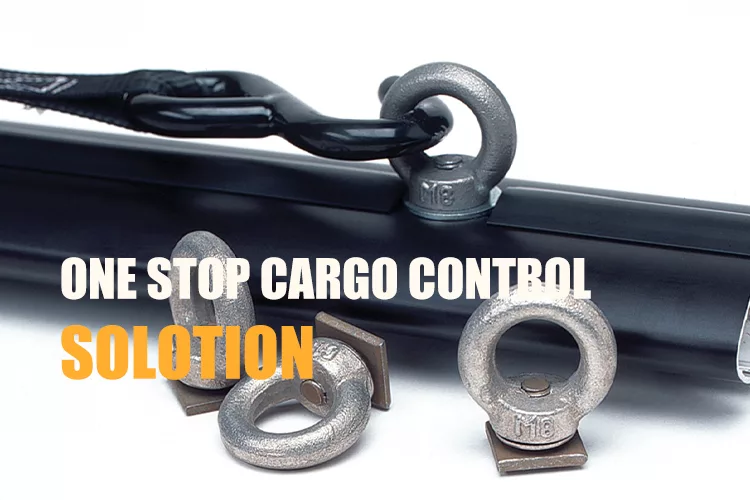
Eye nuts (also called eye bolts) are fasteners with a ring-shaped head. They are designed to connect hooks or ropes, serving as detachable lifting points or ends for chain and wire rope assemblies, primarily used for lifting at heights, securing, and pulling. Eye nuts are rated according to different application types and come in oval and round shapes. Rated load eye nuts are designed for vertical lifting but are not recommended for angled lifting. Unrated load eye nuts are designed for binding straps and guide lines. They are not suitable for lifting applications.
Eye Nut Materials
Eye nuts come in various materials and finishes. Common materials for eye bolt nuts include carbon steel, alloy steel, stainless steel, and brass. Many different grades of carbon steel and alloy steel are used as fastener materials. Stainless steel does not require an anti-corrosion coating, but its hardening is not as good as carbon steel. Carbon steel eye bolt nuts require galvanizing treatment, such as electro-galvanizing or hot-dip galvanizing. Alloy steel eye bolt nuts require powder coating treatment, resulting in a more corrosion-resistant, stronger adhesion, and more environmentally friendly surface.
| Surface Treatment | Description | Corrosion Resistance |
| Electro-galvanizing | Zinc plating thickness is at least 5–20 micrometers. | Good |
| Hot-dip galvanizing | Thicker zinc coating, minimum thickness >30 μm. | Very good |
| Stainless Steel | Strong corrosion resistance | Strong |
Eye Bolt Specifications
Important specifications for eye bolt nuts include: thread size and type, maximum load capacity, internal dimensions and overall dimensions, and weight. Maximum load capacity is the maximum load the eye bolt nut can withstand. Internal dimensions, such as bore diameter/width, determine the size of objects that can pass through. The overall dimensions include the bell diameter and height. The bell diameter refers to the portion of the eye nut that includes the threaded hole.
Eye Nut Dimensions
Eye nut thread sizes are measured in two units: imperial (e.g., inches (in)) and metric (e.g., millimeters (mm)). Imperial eye nut sizes include: 1/4, 5/16, 3/8, 7/17, 1/2, 5/8, 3/4, 7/8, 1, 1 1/8, 1 1/4, 1 3/8, 1 1/2, 1 3/4, 2, 2 1/4, 2 1/2, and 2 3/4 inches. Eye nuts with designations #16, #18, #20, and #24 are also common. Metric eye nut grades include: M6, M8, M10, M12, M14, M16, M18, M20, M22, M24, M25, M26, M27, M28, M30, M32, M33, M35, M36, M38, M40, M42, M48, M56, and M54. Generally, the number after the letter “M” indicates the diameter (in millimeters). For example, an M6 eye nut has a diameter of 6 millimeters.
Types of Eye Nuts
DIN 582 Eye Nut
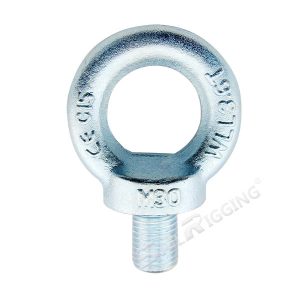
Conforms to DIN 582 2.9 standard, with the same performance and angle reduction as DIN 580 eye bolts. Material identification symbol: C15 or C15E.
• Material: Carbon steel, C15
• Process: Die forging
• Standard: Usually conforms to DIN 582
• Surface treatment: Natural or electro-galvanized
Die nuts conforming to DIN 582 are available in various sizes.
BS3974 Bow Nut
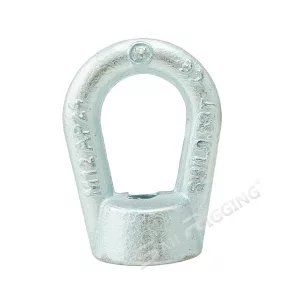
Made of high-strength steel, normalized, suitable only for axial loads (not for tilting or lifting). Available in metric and imperial threads.
• Material: High-strength steel
• Process: Die forging
• Standard: Usually conforms to BS 3974 – Part 1 – 1974
• Surface treatment: Natural, electro-galvanized upon request
JIS 1169B Eye Nut
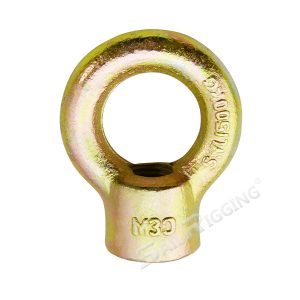
Conforms to JIS1169B standard, with the same performance and angle reduction as JIS1168 eye bolts. British Standard Thread
• Material: Q235 steel
• Process: Die forging
• Surface Treatment: Electro-galvanized, other treatments available upon request.
G400 Eye Nut
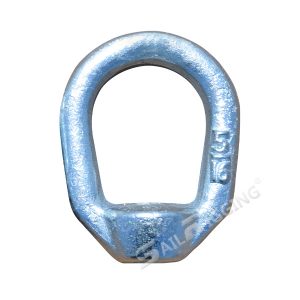
Crosby-G400, conforming to or exceeding ASME B30.26 requirements.
• Material: 45# carbon steel
• Process: Die forging
• Surface Treatment: Electro-galvanized, hot-dip galvanized, other treatments available upon request.
Applications of Eye Nuts
1. Connecting Loads
Eye bolts are key components connecting loads and lifting equipment. Their robust design ensures a secure connection, enabling safe and efficient lifting. Eye bolts are typically connected via shackles, but in some cases, they can be directly connected to the crane hook.
2. Material Handling
Eye bolts are widely used in material handling to securely connect slings, cables, or hooks to loads.
3. Construction and Rigging
In construction and rigging operations, eye bolts play a crucial role in lifting heavy objects, providing reliable connection points for rigging equipment.
5. Baling Straps
Provide anchor points for securing goods to trucks or trailers with ropes or cables; also used for applications such as securing tents or canopies.
| Application | Description | Type |
| High-altitude crane | Attached to machinery or objects for lifting by cranes or lifts | DIN 582 |
| Tie Down | Secures goods or equipment to prevent movement during transport, keep cargo securement. | DIN 582 |
| Towing | Provide connection points for trailer applications. | DIN 582 |
| Anchor Point | Used as a fixing point to connect to other rigging equipment. | DIN 582/JIS B1169 |
| Termination | Used at the end of chains or wire ropes to form a connecting loop. | DIN 582 |
Conclusion
Eye nuts and eye bolts are important fasteners in the lifting and rigging field, precisely and securely connecting loads to lifting equipment. Whether it’s DIN580, JIS1169, BOW NUT, or G400 eye nuts, each plays a unique role in industrial applications.
Sail Rigging offers a complete range of eye nuts designed to meet your diverse lifting application needs. Browse our eye nut products now to improve your lifting operation efficiency.