


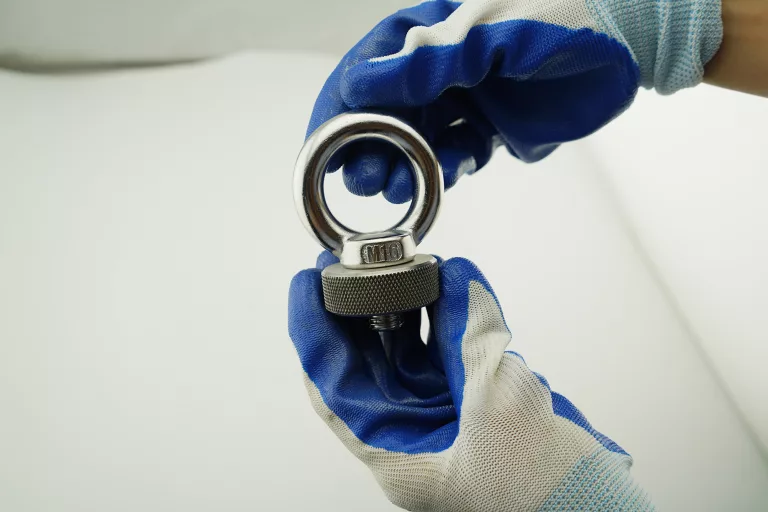
Using GO-NO GO fixed gauges to test eye bolts involves a straightforward process to ensure the eye bolt’s threads meet specified tolerances. These gauges are precision tools designed to quickly assess whether the threaded portion of the eye bolt falls within acceptable limits. Here’s a step-by-step guide on how to use GO-NO GO fixed gauges for testing eye bolts:
Requirements
GO-NO GO Fixed Gauges: These gauges consist of two ends – the “GO” end, which represents the minimum acceptable thread size, and the “NO GO” end, representing the maximum acceptable thread size.
Eye Bolt to be Tested: Ensure the eye bolt is clean and free of any debris that might affect the gauge measurements.
Procedure:
1.Inspect the Eye Bolt
Before using the gauges, visually inspect the eye bolt for any visible defects, damage, or irregularities. If there are any concerns, address them before proceeding with the testing.
2.Identify the Correct Gauges
Confirm that you have the appropriate GO-NO GO fixed gauges for the specific thread size and pitch of the eye bolt you are testing. Using the wrong gauges may lead to inaccurate results.
3.Prepare the Eye Bolt
Ensure the eye bolt is securely held or mounted in a stable position for testing. This prevents any movement that could affect the gauge readings.
4.Insert the GO Gauge
Begin the testing process by inserting the “GO” end of the gauge onto the threaded portion of the eye bolt. The “GO” end should easily and smoothly thread onto the eye bolt. If it fits without resistance, the threaded portion meets the minimum acceptable size.
5.Check the NO GO Gauge
After testing with the “GO” gauge, switch to the “NO GO” end. Attempt to thread the “NO GO” end onto the eye bolt. If the “NO GO” end does not thread smoothly and stops at a certain point, it indicates that the threaded portion exceeds the maximum acceptable size.
6. Interpret the Results
The results can be interpreted as follows:
If the eye bolt threads successfully with the “GO” gauge and fails to thread with the “NO GO” gauge, the eye bolt is within acceptable tolerances.
If the eye bolt fails to thread with the “GO” gauge, it is undersized.
If the eye bolt threads with the “NO GO” gauge, it is oversized.
7.Record and Document
Record the results of the test, including whether the eye bolt passed or failed. Maintain documentation for quality control records.
8.Take Necessary Action
Depending on the results, take appropriate action. If the eye bolt fails the test, it may need to be replaced or undergo further inspection and correction.
Conclusion
Using GO-NO GO fixed gauges helps maintain the quality and reliability of eye bolts, ensuring they meet the specified thread tolerances for their intended applications. If you want to know more about how to test eye bolt by GO-NO GO Fixed Gauges, please feel free to contact Sail Rigging.