


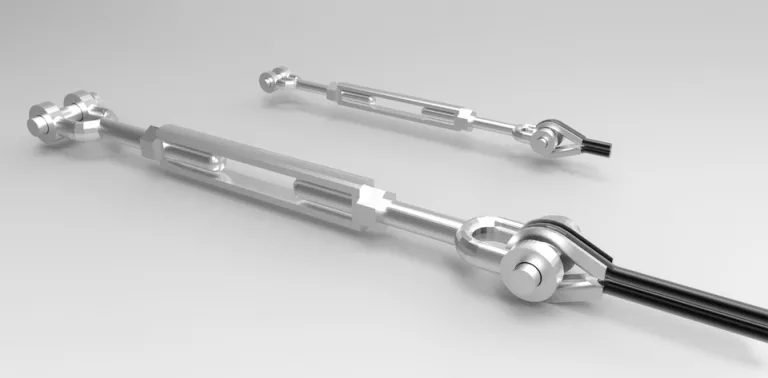
Turnbuckles are essential devices used in various industries for adjusting the tension or length of ropes, cables, and rods. Among the different types of turnbuckles, the closed-body turnbuckle stands out for its unique design and applications. Australian standard turnbuckles and DIN1478 turnbuckles have closed body. In this article, we will explore what a closed-body turnbuckle is, its construction, applications, and the advantages it offers.
What is a Closed-Body Turnbuckle?
A closed-body turnbuckle, also known as a tubular or pipe turnbuckle, is a type of mechanical linkage device used to adjust the tension or length of ropes and cables. What sets it apart from traditional turnbuckles is its enclosed casing, providing protection to the internal threads and mechanisms. This design enhances the turnbuckle’s durability and resistance to environmental elements.
Construction and Design
Closed-body turnbuckles consist of a threaded rod or bar with end fittings and a tubular or cylindrical body that encases the central mechanism. The end fittings are typically eye bolts or hooks, allowing for easy attachment to other components in a structure.
The threaded rod passes through the tubular body, and both ends are equipped with right-hand and left-hand threads. This design enables the extension or retraction of the turnbuckle by rotating the body, effectively adjusting the tension in the connected elements.
The tubular body, often made of materials like steel or stainless steel, serves as a protective housing for the internal threads, preventing dirt, debris, and corrosive elements from affecting the turnbuckle’s performance.
Applications of Closed-Body Turnbuckles
Closed-body turnbuckles find application in various industries and scenarios, thanks to their protective design and versatility. Some common applications include:
- Architectural and Structural Rigging:
Closed-body turnbuckles are used in architectural and structural applications for adjusting tension in cables and rods, providing stability and support in structures like bridges and buildings.
- Marine and Nautical Use:
In marine environments, closed-body turnbuckles are employed for rigging and securing sails. The closed design protects the turnbuckle from saltwater corrosion, making it suitable for maritime applications.
- Agricultural and Fencing:
Farmers and fence installers use closed-body turnbuckles to tension wires in agricultural fences, providing support and stability to enclosures.
- Tent and Canopy Installation:
Closed-body turnbuckles play a role in tensioning and securing ropes in tent and canopy installations, ensuring structural integrity and stability.
Advantages of Closed-Body Turnbuckles
- Protection from Elements
The enclosed design of the turnbuckle provides protection against environmental factors, reducing the risk of corrosion and wear.
- Enhanced Durability
The protective casing contributes to the overall durability of the turnbuckle, extending its lifespan in various applications.
- Versatility
Closed-body turnbuckles are versatile and can be used in a wide range of industries and applications due to their protective design.
- Easy Installation
The threaded rod and end fittings make closed-body turnbuckles easy to install, allowing for quick adjustments in tension.
Conclusion
Closed-body turnbuckles offer a robust and protective solution for adjusting tension in cables, ropes, and rods across diverse industries. Their unique design, with an enclosed body, enhances durability, protects internal threads, and makes them well-suited for applications where environmental factors and longevity are critical considerations. From structural rigging to maritime use, closed-body turnbuckles play a vital role in ensuring the stability and reliability of various systems and structures. If you want to know more about closed body turnbuckles, please feel free to contact Sail Rigging now.