


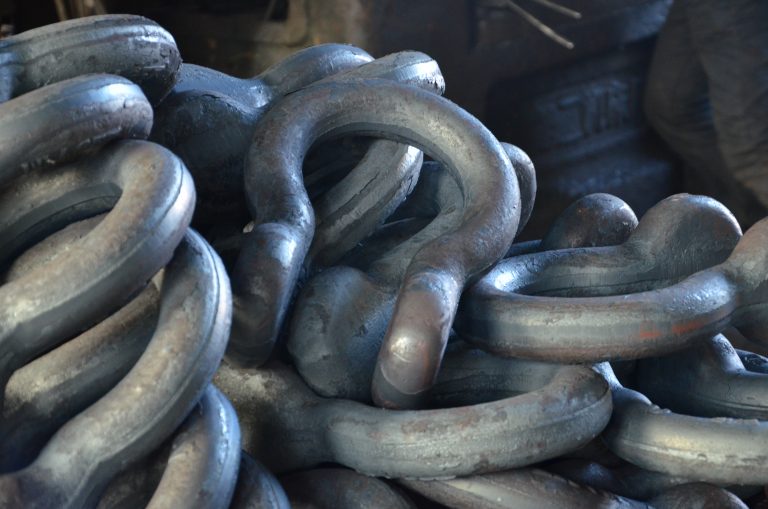
Shackle is one type of rigging hardware, which is widely used in metal, petroleum, machinery, railway, chemical, port, automotive, lifting, marine and other industries. Shackles have relatively high requirements for hardness, plasticity and impact resistance when used. Most of the production process adopts the steps of heating, forging, bending, mold forming, trimming, drilling, tapping, high temperature quenching and low temperature tempering to produce shackles.
The comprehensive performance of the produced shackles can meet the requirements of low load The hardness and plasticity requirements of the environment. Die forging is a common process in the production of shackles. It is a method of processing metal mechanical parts or parts blanks under impact or pressure with the help of tools or molds. Excellent comprehensive mechanical properties. The mold section production process of the shackle, in short, is to use the mold to forge the shackle, and bend the heated material into the shape of the shackle mold. After kneading, the prototype of a shackle comes out. After other treatments, a complete shackle is formed.
The followings are the flows of Sail Rigging ‘s shackles.
①Blanking and cutting: Use a band sawing machine 5000kn to cut the bar material such as 40cr according to the size of the shackle.
②Heating: Transport the blanked bar to the forging furnace for heating, and heat the workpiece to 800-850°C.
③Forging: The heated bar is taken out from the forging furnace, and then the bar is forged with an air hammer. During the forging process, the bar is evenly forged so that the length of the bar becomes smaller. Long enough to meet the subsequent forming needs, and through uniform forging, the internal structure of the bar is evenly arranged, and the tensile strength of the bar is improved.
④Bending: use a bending machine to bend the forged bar, and bend the bending angle of the bar to be close to the bending angle of the finished shackle.
⑤ Forming: Put the bent bar into the shackle mold, and then use the press to drive the upper and lower molds of the mold to squeeze each other, and extrude the bar into the shape of the shackle through the mold.
⑥ Edge trimming: After the molding is completed, there are redundant thin edges around the shackle, and the thin edges around the shackle are cut off by cutting molds.
⑦ Drilling: Drill holes at both ends of the shackle, and the size of the hole drilled at one end is larger than the size of the hole drilled at the other end.
⑧Tapping: use a tapping machine to tap in smaller holes.
⑨Quenching: Heat the shackle to 850-860°C by means of electric heating, heat preservation treatment for 50-90 minutes, then oil-cool the shackle for 20 minutes, and cool the shackle oil to 50-60 ℃.
⑩Tempering treatment: Heat the quenched shackle to 450-550°C by electric heating, then keep it warm for 1.5-2 hours, and then cool the shackle to room temperature in the air.