


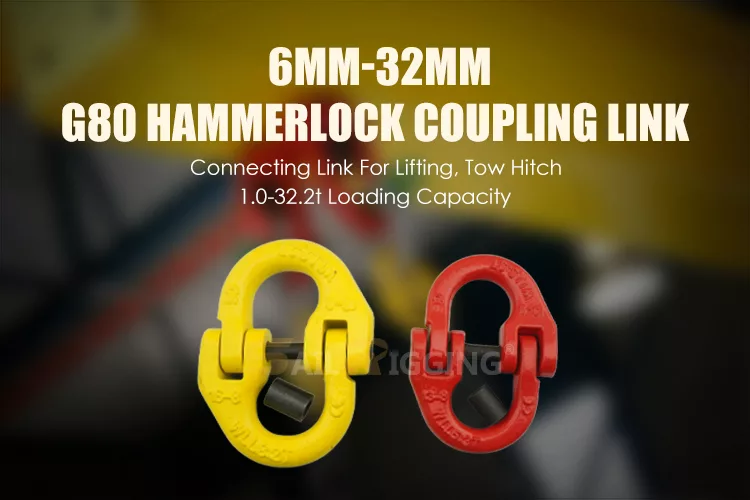
Understand G80 Chain Connector or Hammerlock
Today we’ll discuss the hammerlock connector, also known as a link, hammer lock, connecting chain, or chain connector, used to connect hooks, chains, and other accessories to the legs of chain slings, or to the main ring of a sling. It has always been a favorite among rigging workers because it can be easily assembled and disassembled on-site with just a hammer and punch.
What Is A Hammerlock?
A link, also called a connecting chain or connector, is a connecting element primarily used in lifting and rigging operations. It serves as the connection point between various components in a lifting or rigging assembly, such as chains, wire ropes, slings, or hooks. Links are designed to provide a safe and reliable connection while ensuring the safe handling of heavy objects.
Key Components of a Hammerlock
The center bushing is one of the most important components of a hammerlock connector. With the bushing, the load-bearing pin can hold the hammerlock connector together—it can actually move freely within the body. The ends of the load-bearing pin are tapered, allowing the bushing to be positioned and securely holding the components together. The bushing contains a spring-like system that allows the load-bearing pin to pass through when struck with a hammer, but once in place, it returns to an immovable state—unless struck again!
Where To Use Hammerlock?
Rigging and Lifting Applications
Assembling Chain Slings: Connecting main chain links, hooks, and other components to create lifting slings of custom lengths. Slings are assembled by connecting the individual chain links of the sling to the main chain link or hook. Unlike other quick-connect slings, hammerlock slings are suitable for high-altitude lifting operations and are primarily used for sling fabrication, connecting the two legs of the sling to the main chain link or hook attachment.

Industrial Applications
Used to connect various components in rigging assemblies, such as connecting chains to hooks or installing new chain links on old slings. Securely attaching attachments such as hooks or shackles to the end of the chain to extend chain length or provide a more convenient connection point for other accessories such as shackles, extending general-purpose chains suitable for heavy lifting and material handling in industries such as construction, manufacturing, and metallurgy.
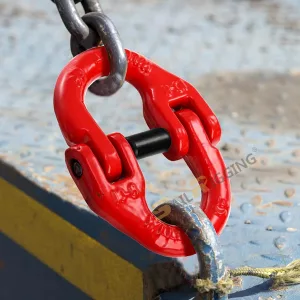
Vehicle Towing Applications
Provide a secure and easy-to-use connection point for trailer safety chains, typically used to extend chains or replace traditional hooks for better clearance or fit, making trailer safety chains more secure and easier to attach to vehicle hooks. Especially suitable for trucks with limited chassis space, such as some Ford, Chevrolet, and GMC models.
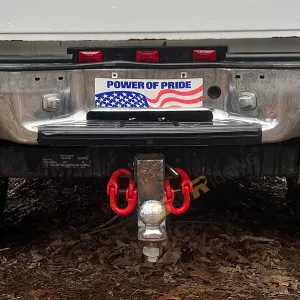
Shackle Alternatives
Can be used in place of D-shaped shackles in certain situations.
How To Assemble & Disassemble Hammerlocks?
Assemble Hammerlocks
1.Close the two halves of the body, aligning the center connector.
2.Place the bushing in the center of the hammerlock, aligning it with the connector.
3.Insert the load pin as deeply as possible into the hammerlock by hand.
4.Tank the load pin fully in with a hammer until both ends are completely flush.
Disassemble Hammerlocks
1.Locate the hammerlock link on the raised flat surface, leaving space for the load pin to protrude from the bottom.
2.Align the punch with the top center of the load pin.
3.Strike the punch to knock the load pin out of the center of the hammer lock chain link.
4.Pull the loose part apart by hand.
Hammer lock links are essential components in lifting and hoisting operations, available in various sizes (10mm, 13mm, and 8mm, 3/8 inch, 1/2 inch) and grade (G80, G100)to select the appropriate model based on different chain diameters and load capacities. For more information about hammer lock links, please contact Sail Rigging.