

Grade 8.8 Eye Bolt & Nut Explained: A Manufacturer’s Guide to Material and Heat Treatment
Eye bolts are special fastener with a threaded rod and a ring-shaped head. They are often wide used for securing, lifting, or suspending objects using ropes, cables, or hooks. Their load-bearing capacity varies greatly depending on the design, material, and size, ranging from light-duty to heavy-duty applications.There are shoulder eye bolts, machine eye bolts, wood screw eye bolts, and nut eye bolts, which are frequently used in construction and mechanical fields to ensure secure connections. We often meet questions like “Do you have 8.8 grade eye bolts?” or “What is the grade of your eye bolts?”. Today, we will share eye bolt grades, what an 8.8 grade eye bolt is,what is requirement of Grade 8.8 eye bolts, hoping to help you choose the right eye bolt.
Table of Contents
1. Eye Bolt Grades
Actually eye bolts don’t have seperate grades.The grade refers to the fastener. Fasteners are classified into different grades, varied on their material composition, mechanical properties, and strength. We will introduce three commonly used fastener grades.
• Grade 2 Fasteners
This is the most economical option, best suited for low-stress or low-load applications. They are readily available, versatile, and suitable for general use. The common material is low-carbon or medium-carbon steel, tensile strength is 74,000 psi. Grade 2 fasteners are used in non-critical applications,no high strength required, such as household hardware, woodworking, and light equipment.
• Grade 5 Fasteners
More wear-resistant than Grade 2, suitable for machinery, automotive, and agricultural equipment that experience moderate stress. It is made from medium-carbon steel, heat-treated by quenching and tempering to increase strength, with a tensile strength of approximately 120,000 psi.
• Grade 8 Fasteners
higher tensile strength than Grade 5, ideal for high-stress, heavy-duty applications. It is made from high-strength carbon steel, heat-treated to improve toughness, tensile strength is up to approximately 150,000 psi. They are used in heavy machinery, automotive applications (such as engines and suspension), and other requiring high tensile strength application.
2. What is an 8.8 Grade Lifting Ring?
Grade 8.8 is a code for the mechanical properties of fasteners. The first “8” means a nominal tensile strength of 800 MPa (megapascals). The second “8” means the yield strength ratio. The eye bolt will begin to undergo permanent plastic deformation when it reaches 80% of its ultimate tensile strength (approximately 640 MPa). Compared to common 4.8 grade hardware, 8.8 grade lifting rings have almost double the load-bearing capacity and are standard equipment in the construction steel structure and heavy lifting industries.
3. Requirements for 8.8 Grade Lifting Rings
The key factors that truly determine a Grade 8.8 lifting ring are the material base , heat treatment capabilities , size and structural design, not just the material alone.
Material Requirements
8.8 grade lifting ring bolts are made of high-strength medium-carbon steel. In our lifting ring production system, we mainly use the following C1045 (medium-carbon steel) material.
C1045 (AISI 1045) — is a medium-carbon steel and a commonly used material for Grade 8.8 lifting rings in the international market. 45# material has a stable strength base. After heat treatment, C1045 can stably achieve: tensile strength ≥ 800 MPa, yield strength ≥ 640 MPa, fully meeting the basic requirements of Grade 8.8. At the same time, its toughness performance is also good. Compared with low-carbon steel, C1045 has significantly better impact toughness. Compared with alloy steel, its low-temperature toughness and impact resistance are slightly weaker. Therefore, it is more suitable for indoor working conditions, conventional mechanical equipment lifting, and low-impact load scenarios. In addition, C1045 lifting rings have good processing and forging properties, stable forging formation, high machining efficiency, and easy control of thread processing quality, allowing for consistency in mass production.
Heat Treatment
What truly determines the performance of a Grade 8.8 lifting ring is the heat treatment capability. Grade 8.8 ≠ material label, but rather the result of heat treatment.
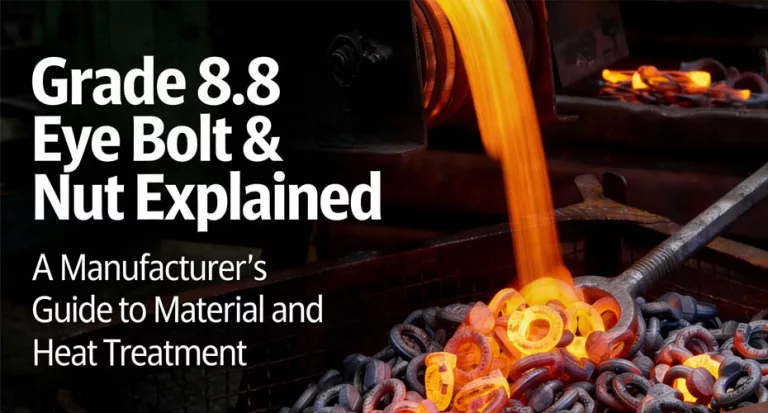
Our standard heat treatment process involves tempering, annealing, and quenching. The lifting eye bolts undergo quenching, where the bolts are heated to a critical temperature (approximately 850°C), transforming their molecular structure into austenite, followed by rapid cooling in oil. This step significantly increases strength, but at this point, the bolts are very brittle. To eliminate brittleness, the bolts are tempered, being reheated to a lower temperature (550°C – 660°C). This step is crucial, finding a balance between hardness and ductility, ensuring that the lifting eye will bend and deform under overload rather than shattering like glass. Strict control of heating temperature and holding time, cooling medium, and tempering temperature curve ensures that the lifting eye has a tensile strength ≥ 800 MPa and a yield strength ≥ 640 MPa, balancing strength and toughness to prevent brittle fracture.
Dimensional Structure
Dimensions and threads are strictly controlled according to DIN580/DIN582 standards. The threads are precisely manufactured, ensuring even load distribution across each thread.
Conclusion
In lifting systems, Grade 8.8 lifting eye bolt is not simply a standard part. Sail Rigging has been deeply involved in rigging hardware manufacturing for sixteen years, and we understand that Grade 8.8 quality comes from every controllable aspect of the manufacturing process. If you would like to know more about lifting eyes, please feel free to contact Sail Rigging.