

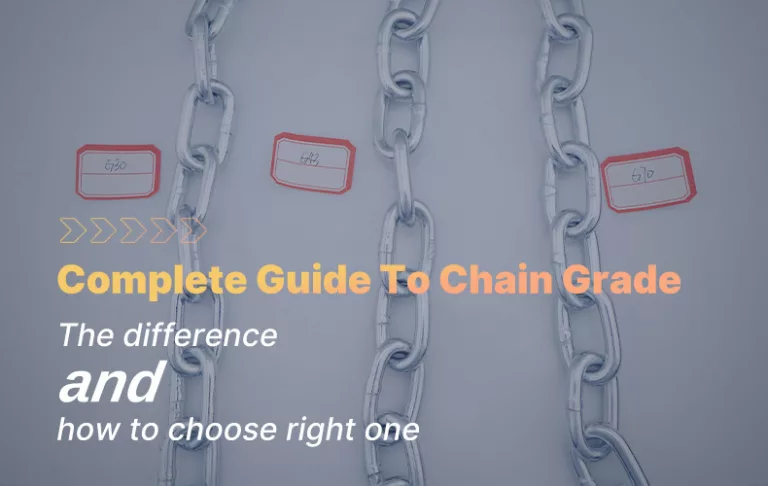
Complete Guide To Chain Grade: The difference and how to choose right one
Welded chain is a widely used industrial chain. It is manufactured by welding, connect the ends, forming a strong and durable chain. It boasts high strength, strong stability, and high fracture resistance. It is widely used in high-altitude lifting, traction, and bundling, especially in harsh environments where high tensile strength and durability are required. During the chain sales process, we are often asked by customers questions like, “What are the differences between 70, 80, 100, and 120 grade chains?”, “What material is 43 carbon steel?”, “What grade of chain should I choose for a 10t load?”, etc. These numbers represent the chain grades, and different grades have different strengths. Today, we will explain the differences between these grades and recommend the appropriate chain grade based on your needs.
What are the different grades of chains?
Chain grade is a standard method of indicating the ultimate breaking strength (tensile strength) of a chain. The grade helps determine the appropriate application for a particular chain. The higher the grade, the stronger the chain and the greater its resistance to bending and breaking. Different grades of chains are suitable for different applications. Each chain grade has unique advantages and is suitable for specific applications. The following are the different chain grades offered by Qingdao Yunfan:
Grade 30

This is the lowest grade of welded chain on the market, commonly known as “Proof Coil Chain”. Grade 30 chain is a general-purpose, economical chain with low tensile strength and is not suitable for heavy loads, as it will easily stretch under heavy loads. It is widely used in various applications such as logging, safety trailer chains, and even playground equipment. Most trailer safety chains are made of G30 grade transport chain, with a length of 36 inches, and a safe working load ranging from 750lbs to 9750lbs, designed to help securely connect the trailer to the vehicle, giving you enough time to safely pull over. For heavy vehicles, it is recommended to choose G43/G70 safety chains.
Grade 43

Grade 43 chain is stronger than Grade 30 chain and has better wear resistance. It is commonly known as “high-strength chain” and is typically used for container securing, logging, agriculture, towing, marine applications, and as a general-purpose chain.
Grade 70

Grade 70 carbon chain is the highest grade of chain in the carbon chain category. Made from high-strength heat-treated carbon steel, this chain is harder, has a higher strength-to-weight ratio, and offers approximately 20% higher load capacity than Grade 43 chains. It is more wear-resistant and durable, with a gold chromate surface treatment and marked chain grade. It is commonly used for securing trucks and other cargo, and for vehicle towing.
Grade 80
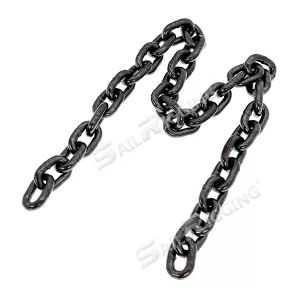
Grade 80 chain is a high-strength, heat-treated alloy chain made from high-quality alloy steel with surface treatments such as blackening and electroplating. It can be used as a component in high-altitude lifting slings and heavy-duty drag chains. Due to its higher strength-to-weight ratio, Grade 80 chain is superior to Grade 100 chain in some cases, making it the most economical choice for high-altitude lifting operations. Sail Rigging can provide Grade 80 alloy steel chains that comply with EN818-2 and AS2321 standards.
Dimensions and Working Load Limits of Different Chain Grades
The working load of a chain is the maximum load the chain can withstand under normal conditions. It is far less than the chain’s breaking load (tensile strength) and is determined by the chain’s grade and diameter. The grade and size are usually stamped on the chain. Below, I will list the dimensions and working load limits of different chain grades. Please be sure to adhere to the chain’s load limits to ensure proper operation.
| Chain Size | Grade 30 | Grade 43 | Grade 70 | Grade 80 | Grade 100 |
| 1/4 inch | 1300 lbs | 2,600 lbs | 3,150 lbs | 3,500 lbs | 4,300 lbs |
| 5/16 inch | 1,900 lbs | 3,900 lbs | 4,700 lbs | 4,500 lbs | 5,700 lbs |
| 3/8 inch | 2,650 lbs | 5,400 lbs | 6,660 lbs | 7,100 lbs | 8,800 lbs |
| 7/16 inch | 3,700 lbs | – | – | – | – |
| 1/2 inch | 4,500 lbs | 9,200 lbs | 11,300 lbs | 12,000 lbs | 15,000 lbs |
| 5/8 inch | 6,900 lbs | 13,000 lbs | 15,800 lbs | 18,100 lbs | 22,600 lbs |
Hope this article will help you understand the meaning of chain grades and the differences between different chain grades. Choosing the right chain grade based on the application and load capacity is crucial. Selecting chain correctly will ensure more safety, efficiency, and durability. If you have any question about chain grade, just feel free to contact Sail Rigging.