
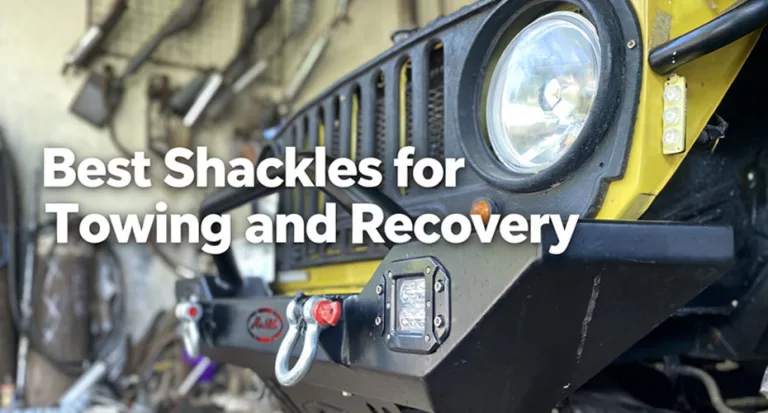
Best Shackles for Towing and Recovery
In any towing or rescue operation, choosing the right shackles is of vital importance. Whether you are towing a trapped vehicle or securing goods, the shackle is a crucial link connecting the towing, winch and rescue anchor points. Once the wrong choice is made, it may lead to equipment failure, damage or even personal injury. This guide will provide you with a detailed introduction to the various key factors that need to be considered when selecting the best towing shackle for practical application scenarios.
Table of Contents
What role does a shackle play in towing operations?
In the rescue system, shackles are mainly used to connect the following components:
- Tow belt or rescue belt
- winch rope (steel cable or synthetic rope)
- Tow Hitch Receiver (Hitch Receiver) or D-ring mounting seat.
It serves as a connection hub for transferring loads among various components. For this reason, its strength and reliability are particularly crucial.
Common types of drag shackles:
- D type shackles (chain shackles)
The D type shackles are specifically designed for linear drag conditions. The narrow shape helps keep the load in a straight-line alignment. When subjected to direct tension, the force transmission efficiency is higher. It is often used in the towing configuration of the foundation. When the load direction remains single and unchanged, the D-type shackle can perform at its best.
- Bow Type Shackles(Anchor Shackles)
The bow-shaped shackle (anchor shackle) has a wider, arc-shaped appearance. It is more suitable for handling multi-directional load conditions. In rescue operations, it can provide greater angular flexibility. It is widely popular in off-road rescue equipment. For rough terrain or scenarios that require oblique towing, bow-shaped shackles are usually a more ideal choice. Soft shackles
- Soft Shackles
The soft shackle is made of high-performance synthetic fiber rope.
- Light in weight and easy to operate
- Free of metal parts, if it breaks, it can significantly reduce the risk of rebound and injury
- In the field of four-wheel drive off-road rescue equipment, its popularity is increasing day by day.
In special scenarios such as off-roading where safety and portability are highly required, soft shackles are particularly practical.
Key factors to consider when purchasing:
The working load limit (WLL)
Be carefully checked for the Working Load Limit (WLL) of the shackle. This value must be higher than the actual load you expect. Never make a judgment based solely on the indicator of “ultimate breaking strength”. In practical applications, the “working load” that can ensure safety is the truly decisive indicator.
Material And Strength
Most steel shackles are typically made of the following materials:
- Die forged carbon steel (Drop-forged carbon steel)
- Alloy steel (used to achieve higher strength grades) compared with shackles made by casting process, shackles made by die forging process usually perform better in terms of durability and material uniformity.
The size
The size of the compatible shackle must match your equipment: Although common sizes like 3/4 inches are widely used, when purchasing, they should be determined based on actual application requirements rather than blindly following popular trends.
Surface Protection
Corrosion resistance is of vital importance for surface protection in outdoor usage environments. For long-term exposure to the environment, it is advisable to choose hot-dip galvanized shackles. For off-road usage environments, powder-coated shackles can be selected. This surface protection helps to extend the product’s service life, especially in harsh conditions such as dampness or mud. Many faults do not occur due to defects in the product itself, but rather because of improper use.
Please be highly vigilant about the following points:
- Overloading beyond the working load limit (WLL)
- Applying lateral loads to D-type shackles
- Failing to tighten the shackle pins properly
- Using low-quality or untested shackles under force, even a minor operational error can lead to serious consequences.
Choosing a Reliable Supplier
For towing and rescue equipment, the stability of product quality is of vital importance when choosing a reliable supplier.
- A reliable supplier should be able to provide:
- Clear and definite load grade identification
- detailed material information
- basic test data
This information helps to reduce usage risks and ensure that the product can perform as expected.
Conclusion
The key to choosing the most suitable shackle for towing and rescue tasks lies in its specific application scenario. The D-type shackle is highly suitable for linear towing. The Bow Shackle, on the other hand, can better cope with towing conditions with more complex angles. In addition, the Soft Shackle can offer higher safety and flexibility in off-road environments. Please be sure to pay attention to the matching degree of the size, the verified load limit, and the correct usage method. In towing operations, seemingly tiny components often bear significant responsibilities – choosing a suitable shackle will have a decisive impact on the success or failure of the entire operation. If you have any question, don’t hesitate to contact Sail Rigging.